
The Whales That Stopped Growing on Purpose
Shorter, Same Ocean
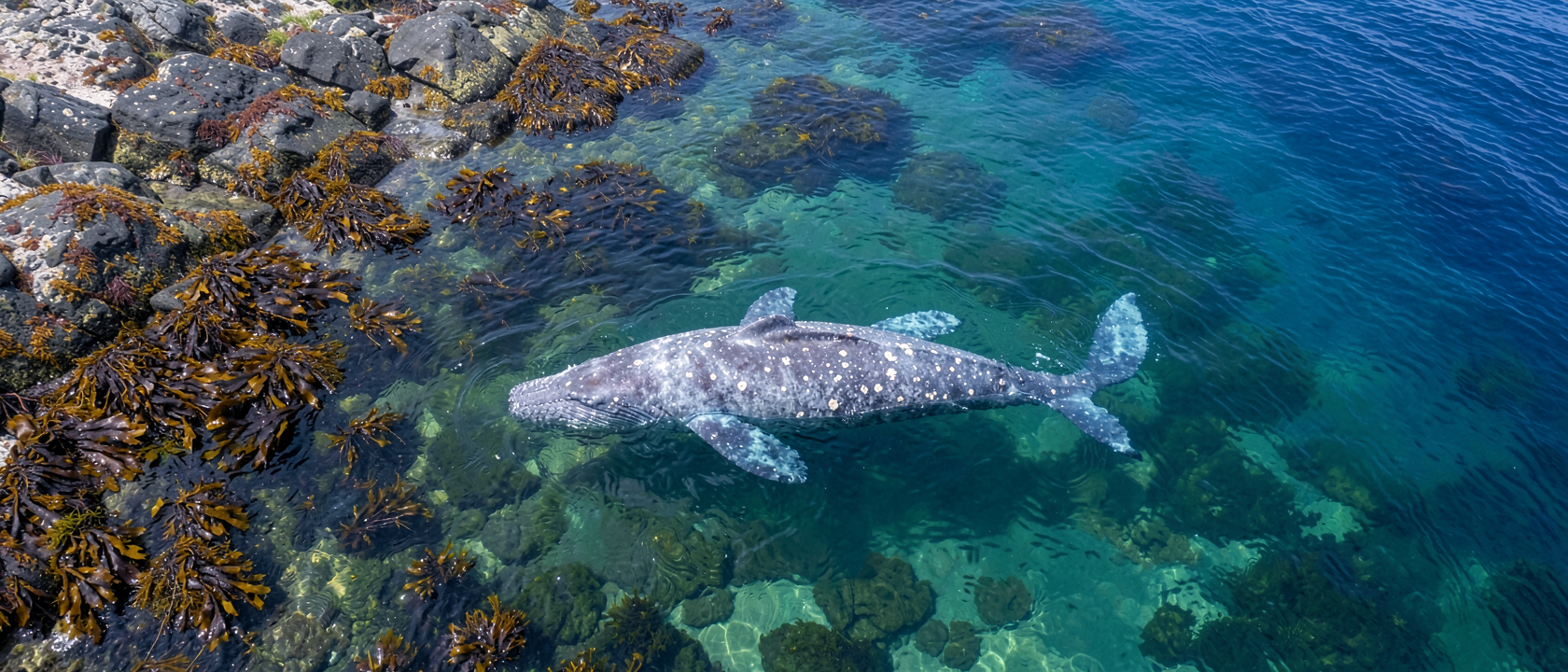
Some gray whales (Eschrichtius robustus) skip the family trip north. Instead of migrating to the Bering and Chukchi seas like the rest of their population, 212 of them spend the warm months close to home, feeding along the coast of Oregon, northern California, Washington, and southern Canada. Researchers call this group the Pacific Coast Feeding Group, or PCFG. As adults, they are measurably smaller than everyone else in the family, and the two sexes shrink by different amounts.
A 2023 study by K.C. Bierlich, Leigh Torres, and colleagues at Oregon State University’s Marine Mammal Institute, published in Biology Letters, put numbers on the gap. PCFG females average about 3 feet (1 meter) shorter than females in the roughly 16,000-strong Eastern North Pacific (ENP) population that migrates north each spring. PCFG males run about 1.5 feet (0.5 meter) shorter than ENP males, a smaller shortfall but still a consistent one. Their skulls and flukes, the paired lobes at the end of a whale’s tail, measure smaller too. This is not two species. It is not even two populations in the genetic sense. It is one stock, one migratory lineage, with 212 animals quietly running a smaller body plan.
They Don’t Grow Slower. They Just Stop Sooner.
To find where the gap comes from, the team rebuilt growth curves using historic whaling records, stranded-animal data, aerial observations, and drone-based photogrammetry, which measures a living whale’s body from overhead images without ever touching it. Through calfhood and adolescence, the two curves sit almost on top of each other: same rate, same shape, same climb. The split only shows up at the finish line. PCFG whales level off at a shorter final length. ENP whales keep adding length until they reach a taller adult size. Growth rate and final size, it turns out, are two separate dials, and on these whales only one of them moved.
Smart Adaptation or Rough Life? Science Shrugs.
Why PCFG whales stop shorter is still unresolved. One reading: a smaller body suits the shallow, rocky kelp-forest habitat these whales work, a different kind of foraging from the deep Arctic waters ENP whales travel for. The other reading: the smaller size reflects a harder life, limited food, chronic stress, or poorer health, a pattern seen in plenty of animals under resource pressure. Bierlich and his coauthors say plainly that neither explanation is confirmed. The 2023 paper does not decide whether the PCFG is thriving on a different plan or getting by on a worse one.
The Population Was Never as Uniform as It Looked
Here is the assumption this study quietly wrecks: that one gene pool means one body plan. You would expect 212 whales sitting inside a population of roughly 16,000, same ancestry, same migratory stock, to land at roughly the same adult size as everybody else. They don’t. The PCFG holds a persistently smaller adult length, a smaller skull, and smaller flukes, all while growing at the exact same rate as its ENP relatives from birth onward. The genetics never split. The size did anyway. That is the part worth repeating at dinner: you can share every gene that matters and still end up built differently, just by where you choose to eat.
212 Small Whales, One Big Management Problem
In the United States, the PCFG is currently managed as part of the larger ENP population rather than as its own unit, even though it now looks morphologically distinct and amounts to a fraction of the numbers. Since 2015, researchers have tracked these whales using photo identification to recognize individuals by their skin markings, fecal sampling to determine sex, and drone imagery to measure their bodies, work driven in part by how much closer this group sits to boat traffic, noise, and pollution than its Arctic-bound relatives. A later, separate follow-up study found that PCFG whales have gotten smaller over recent decades and are in worse body condition than ENP whales, which sharpens the open question rather than closing it. Whether a smaller body changes how well these whales reproduce, or how well they survive a ship strike or an entanglement, nobody has shown yet. Nor has anyone decided whether 212 animals with a body plan of their own should be counted, and protected, on their own terms.