
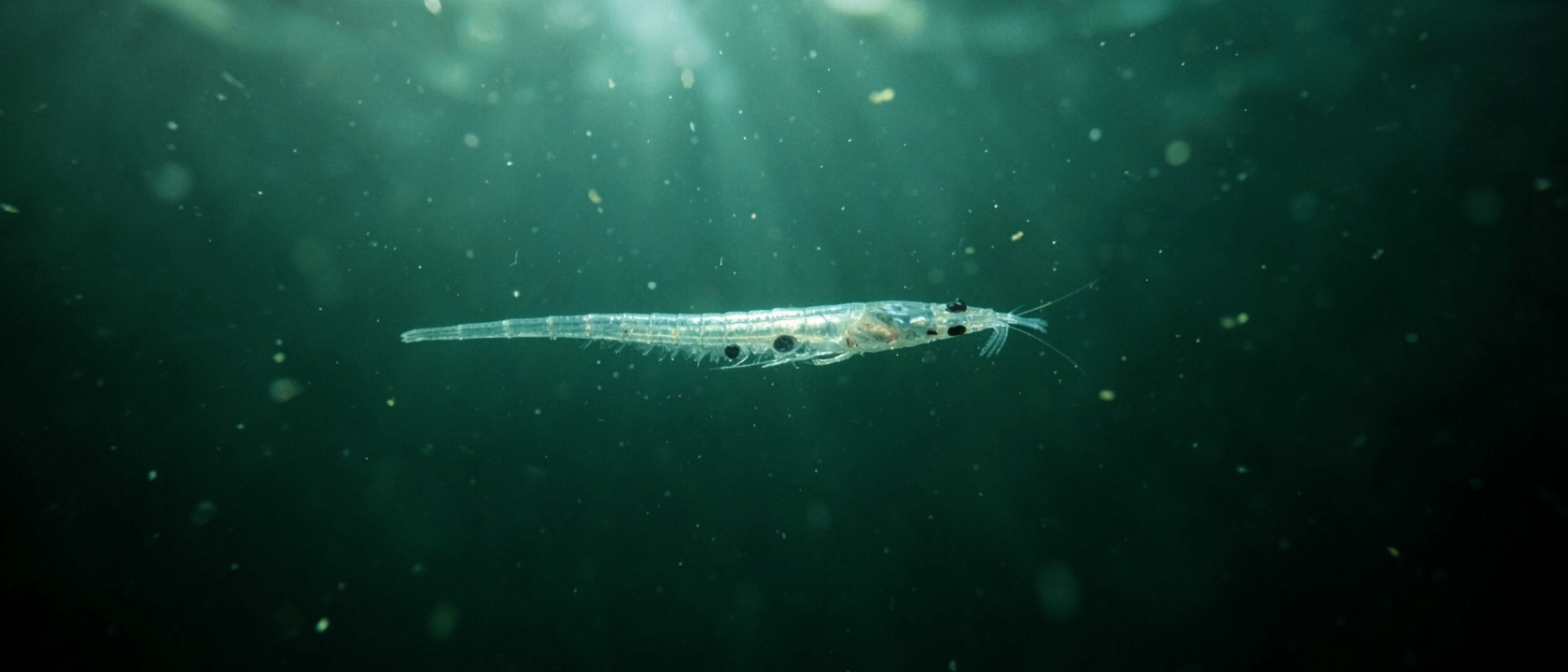
The only insect that truly floats
Chaoborus, the genus known as the phantom midge, holds a strange record: its larvae are the only insects classified as truly planktonic. They do not cling to a leaf, swim hard against the current, or sink to the bottom. They hang suspended in open water, neutrally buoyant, for long stretches at a time. The larvae grow up to 0.8 inches (2 cm) long and are almost entirely transparent, which is how they earned the nickname “glassworm” and their ghostly common name.
The anatomy behind this trick has been known since 1911, when Nobel laureate August Krogh described two pairs of internal, gas-filled sacs inside the larva’s body: one pair in the thorax, one pair tucked into the seventh abdominal segment. So the puzzle was never whether Chaoborus floats. It was how an animal with no blood, no hemoglobin, and no swim bladder in the fish sense could fine-tune that float with such precision for over a century without anyone working out the mechanism.
What a UV lamp gave away
A 2022 study in Current Biology, led by Evan McKenzie and Philip Matthews at the University of British Columbia, with co-authors Garfield Kwan and Martin Tresguerres, put the larvae’s air sacs under ultraviolet light. The walls glowed blue. That blue glow is the signature of resilin, a rubber-like elastic protein found elsewhere in insects wherever stored elasticity matters, including the structure that powers a flea’s jump. On its own, the glow did not explain how buoyancy was controlled. It just told the researchers they were looking at the wrong kind of material for a simple gas-filled balloon.
A buoyancy engine with no moving gas
The mechanism the team worked out is this: the larva changes the pH of the air sac’s wall itself. When that wall turns alkaline, the resilin inside it swells. When it turns acidic, the resilin contracts. Because the resilin bands are interlaced with bands of cuticle, that swelling and shrinking is forced in a single direction, along the sac’s long axis, which changes the sac’s volume and the larva’s overall buoyancy. An endothelial layer wrapped around the sac runs the chemistry: a proton pump called vacuolar H+ V-ATPase acidifies and shrinks the sac, while a cyclic AMP signaling pathway drives the alkaline, expanding state. Not a single molecule of gas is pumped in or exchanged with the water to make any of this happen. The researchers call it a mechanochemical engine, converting a pH shift directly into mechanical work.
Why a larva would bother floating so precisely
This pH switch gives Chaoborus something closer to a dial than a lever. Buoyancy can be nudged in tiny increments, fine enough to let the larva sit motionless in midwater instead of merely drifting. UBC researchers point to this as the payoff: the larva can travel vertical distances through the water column at essentially no energy cost, since it never has to swim to get there, and that gives it access to a mid-water zone that most insects simply cannot use. In lakes, Chaoborus larvae often spend daylight hours buried in bottom mud, then rise through the water column at night to hunt copepods and cladocerans (small crustaceans drifting in the water). They are not chasers; they take whatever prey enters their strike zone. Researchers suggest this stillness helps the larva avoid detection by prey, since it expends no energy or motion to hold its position. Researchers note that hovering this way appears to cost no more energy than resting in mud, which is a remarkable thing for an ambush hunter to pull off in open water rather than on a solid surface.
The swim bladder theory, finally disproved
For more than a hundred years after Krogh’s description, the default assumption was that these air sacs worked the way a fish’s swim bladder does, with gas actively secreted in to inflate the sac and withdrawn to deflate it. An earlier idea, that muscles squeezed the sac walls to change their volume, also did not hold up; no musculature was ever found that could do the job. The 2022 study closed both questions at once. The gas inside the sac is always the same composition as whatever is dissolved in the surrounding water, meaning nothing is being secreted or exchanged at all. The volume change is driven entirely by the resilin’s response to pH, a physical principle that has nothing to do with fish buoyancy and nothing in common with any other insect’s known way of handling flotation.
What the study doesn’t answer
The 2022 paper identifies the pH shift as the driver of the volume change, but it does not say what causes that pH shift to start in the first place. Something must tell the proton pump or the cAMP pathway when to switch on, whether that is depth, light, or some internal cue, and on what timescale this happens over the course of a night’s vertical migration. None of that is addressed in the study. It stays an open question.
Caught by accident in a cattle tank
The discovery itself started with nothing more purposeful than catching dragonflies. In the spring of 2018, Philip Matthews was working at UBC’s experimental ponds in Vancouver when he noticed ghost-like shapes drifting in a rainwater-filled cattle tank nearby. He did not identify the resilin glow on the spot. That came later, back at a microscope whose UV lamp happened to already be switched on from a previous experiment. The light hit the larvae, the air sacs lit up blue, and a structure first described in 1911 finally gave up how it works.