
One Mother, Two Species
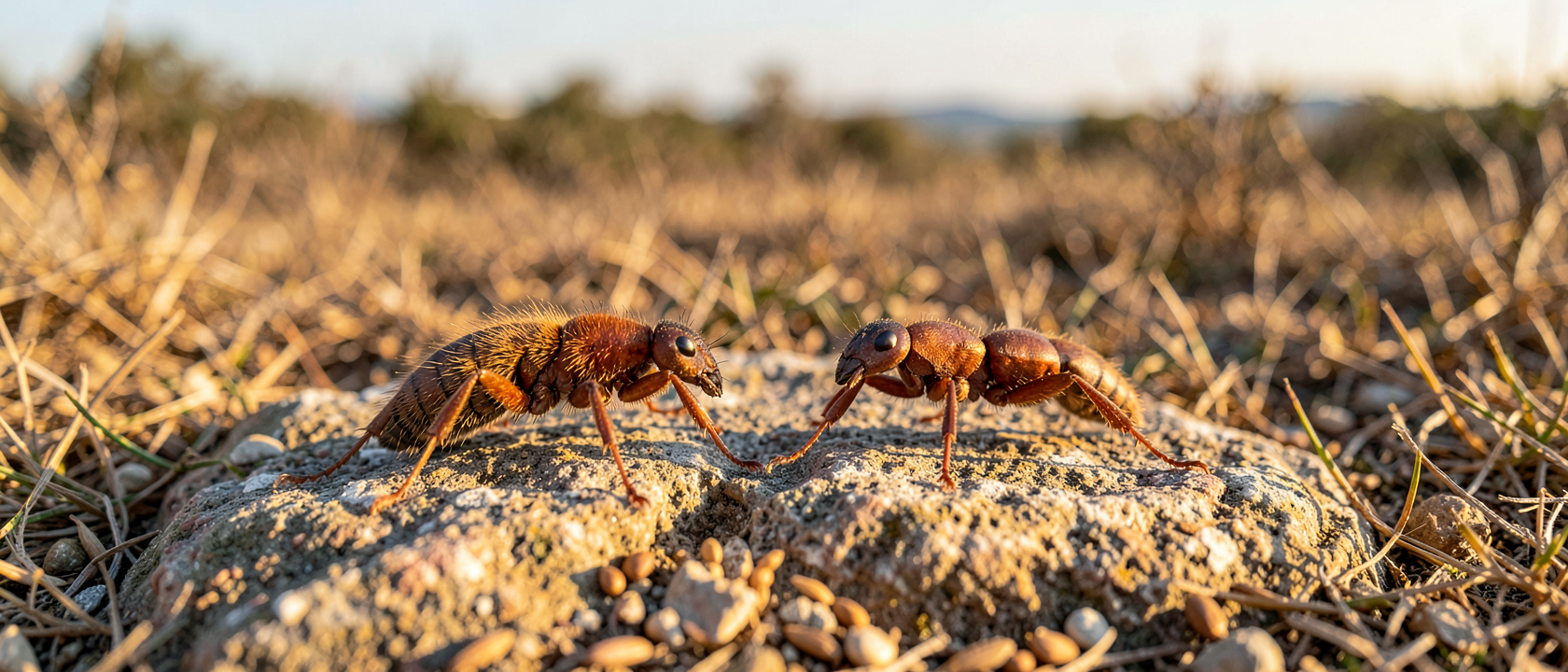
A single ant queen in Sicily raises sons from two different species. One kind is Messor ibericus, the Iberian harvester ant she is herself: reddish brown, hairy, unremarkable. The other is Messor structor, a species that split from hers more than 5 million years ago. Geneticists sequenced both kinds of sons and found exactly what five million years of separation should produce: two populations as distinct as any two species get.
Here is where it stops being a curiosity and starts being a problem. The nearest wild population of Messor structor lives 621 miles (1,000 km) from these Sicilian colonies. She has not mated with one in the ordinary sense. There is not one nearby to mate with.
The finding comes from a study led by Yannick Juvé and Jonathan Romiguier at the University of Montpellier, published in Nature on September 3, 2025, after the team sequenced hundreds of ants from more than 120 populations across Europe.
The Four Settings on the Queen’s Body
Four settings decide what hatches from a Messor ibericus queen, depending on which egg she lays.
Setting one: she clones herself, no sperm involved, producing another copy of her own queen line.
Setting two: she fertilizes an egg with M. ibericus sperm. Both parents are her own species, and the result is a future queen.
Setting three: she fertilizes an egg with M. structor sperm. The result is a worker, carrying M. ibericus genes from her and M. structor genes from him.
Setting four is the one nobody expected. She takes an egg, strips her own nuclear DNA (the genetic material carried in the cell’s core) out of it, and leaves only the DNA from M. structor sperm. What grows is a living, hairless M. structor male, not a hybrid and not a copy of her, but a clone of an entirely separate species, built inside her own body. She then mates with that clone to make more workers.
One thread runs under all four settings: every offspring, whichever route produced it, carries the queen’s mitochondrial DNA (the small, separate set of genes passed down only through the mother). Two species come out of her. Only one mother ever goes in.
She Stole a Species’ Job
Researchers studying this species coined a term for it, xenoparity: producing offspring of another species to keep your own colony’s workforce running. It likely began as something ants do more quietly elsewhere, sperm parasitism, where one species leans on another’s sperm to make workers. That usually costs the dependent species something, since it ties a colony to wherever its sperm donor happens to live.
M. ibericus is thought to have started the ordinary way, picking up wild M. structor sperm during mating flights. What it did next is the extraordinary part: it evolved the ability to grow M. structor males from scratch, inside its own queens, with no M. structor colony required within 621 miles. The dependency never disappeared. It got absorbed.
The study’s authors call this “sexual domestication,” comparing it to how one species can come to manage another’s reproduction for its own benefit. They describe the outcome as a “two-species superorganism,” a colony that functions, genetically, as a single unit built from two separate genomes under one mother’s control.
Not a Hybrid. A Hijacking.
It is tempting to call the M. structor males hybrids, since an M. ibericus queen made them. Entomologist Jessica Purcell says that is the wrong word. Genetically, these males match wild M. structor, not some blend of the two species. They look slightly different from males raised by real M. structor queens, but underneath, they are M. structor, full stop.
Purcell compares the process to a kind of horizontal gene transfer (the movement of genetic material between lineages outside normal inheritance): not two species mixing, but one species folding a second species into its reproductive cycle intact. Whether that makes the M. structor males a true hybrid lineage or something else is still debated among the entomologists working on these colonies.
If your first reaction was “one mother, two species, so the offspring must be some middle thing,” you were reading it at the wrong resolution. Nothing here is a blend. Two full species are running side by side, off one body.
What Nobody’s Found Yet
The molecular step the queen uses to strip her own nuclear DNA out of an egg, the actual biochemical mechanism that turns a fertilized egg into a clean genetic copy of the father, is not described. The outcome is documented. The machinery behind it is not.
When M. ibericus first captured this M. structor sperm line, and how long it spent as an ordinary sperm parasite before evolving full internal cloning, is also unresolved. One researcher on the team has floated an idea involving a selfish genetic element pushing larval development toward queens, but that is a proposed hypothesis, not a dated timeline.
And the paper does not say how many individual Sicilian colonies were checked for this specific four-setting cycle, as opposed to the broader European sampling behind the genetics. Three real gaps, left open instead of papered over, which usually means a finding is still being worked on rather than finished.