
A Lifespan Long Enough to Get Rounded Up
The Greenland shark (Somniosus microcephalus) is considered the longest-lived vertebrate known to science, and the number behind that title is more interesting than the round figure that usually gets repeated. A 2025 preprint led by a University of Tokyo research team puts the species’ estimated lifespan at 392 years, plus or minus 120. The “500-year shark” line that circulates online comes from rounding up to the far edge of that margin, not from the actual estimate, which sits closer to four centuries with plenty of room for error in either direction. A separate 2024 preprint from the Leibniz Institute on Aging, built from its own independent genome assembly, landed on a similar figure: roughly 400 years. Two labs, two shark genomes, two numbers that agree without being the same study.
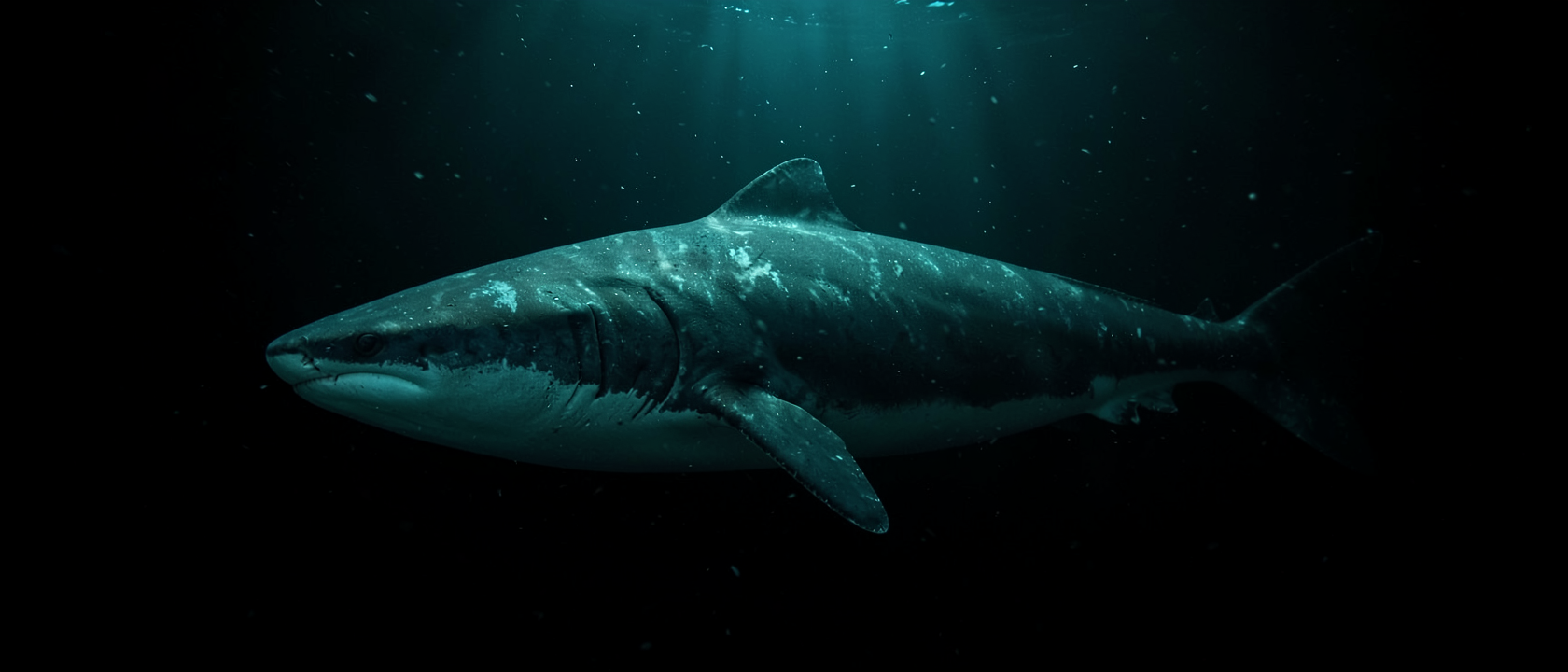
The body carrying that age is built on the same unhurried scale. Greenland sharks grow past 19.7 feet (6 meters) long and can weigh more than 2,205 pounds (1,000 kilograms), with a small, blunt head, which is where the species gets its name: microcephalus means “small head.” They belong to the sleeper shark family, slow-moving, cold-water, deep-diving animals that do almost everything, including growing up, at a fraction of the pace other sharks manage.
One Shark, Sampled and Released, Built the Reference Genome
The 392-year estimate now comes with an actual genome attached to it. A team based at the University of Tokyo, including Kaiqiao Yang, Kazuya Nishiwaki, Hideaki Mizobata, Kazutoshi Yoshitake, Shigehiro Kuraku, and Shigeharu Kinoshita, produced the first chromosome-level genome assembly for Somniosus microcephalus, posted as a preprint on bioRxiv rather than in a peer-reviewed journal so far. Their material came from a single adult female shark, caught in Kongsfjorden, in the Svalbard Archipelago, as part of an ongoing tracking study. Researchers took a fin clip and a blood sample, then released her back into the fjord. The resulting assembly carries an N50 length (a standard measure of how long and unbroken the sequenced stretches are) of 233 megabases, predicts 37,125 genes, and covers an estimated 86.5% of the species’ expected protein-coding genome. That is a workable draft of the genome, not a finished one, and still the only one of its kind for this species.
Why the Genome Looks Stacked, Not Just Old
Comparing that genome against shorter-lived shark species, the researchers counted 549 gene families that had expanded in the Greenland shark and 1,461 that had shrunk. Three of the expanded families, TNF, TLR, and LRRFIP, all help regulate a pathway called NF-κB signaling: a cellular control system that decides whether a damaged cell gets repaired, left alone, pushed to self-destruct, or flagged for an immune response. The Greenland shark carries more copies of these genes than the shorter-lived species it was compared against. It also showed mutations in genes that normally act as brakes on tumor growth, which the researchers link to the same story. Their argument is that the NF-κB pathway sits close to the center of it all, since it touches cell division, DNA repair, cell death, and immune defense at once, the exact list of processes tied to cancer and chronic inflammation.
What Four Centuries of Dividing Cells Actually Costs
Every extra year of life means more cell divisions, and every division is another chance for a copying mistake to become a tumor. An animal that lives this long does not get a free pass on cancer risk. If anything, the math works against it: four hundred years of cell turnover is four hundred years of chances for something to go wrong. Extra copies of DNA-repair and immune genes, stacked on top of an already reinforced NF-κB system, look less like a lucky accident and more like the cost of keeping a body’s cells in line across a lifespan far longer than almost any other vertebrate attempts. A separate explanation for where the duplications came from shows up in that 2024 Leibniz Institute preprint, a different research group entirely: it points to an expansion of retrotransposons, DNA sequences that copy themselves and reinsert elsewhere in the genome, as a likely driver of the duplication itself. Different team, same shark problem, another layer of the same answer.
One Genome Is a Data Point, Not Yet a Pattern
Every claim above rests on one female shark, and the paper has not been peer-reviewed; it remains a bioRxiv preprint. The researchers say plainly that the genetic basis of the species’ longevity is still unresolved, and that the obvious next step is sequencing more individuals, from different regions, sexes, and ages, before anyone can say this gene-copy pattern describes the species rather than one animal’s particular genome. Whatever any of this might mean for human aging research is not a finding here. It is a door the authors leave open and nothing more.
She Went Back Into the Fjord
The shark behind the whole map is, as far as anyone knows, still out there. A fin clip and a blood sample were taken in Kongsfjorden, and then she was released, unremarked, back into the water she came from. As far as anyone can tell, she is still swimming it, one shark, maybe among many others like her, quietly outlasting the funding cycles of the people who study her.