
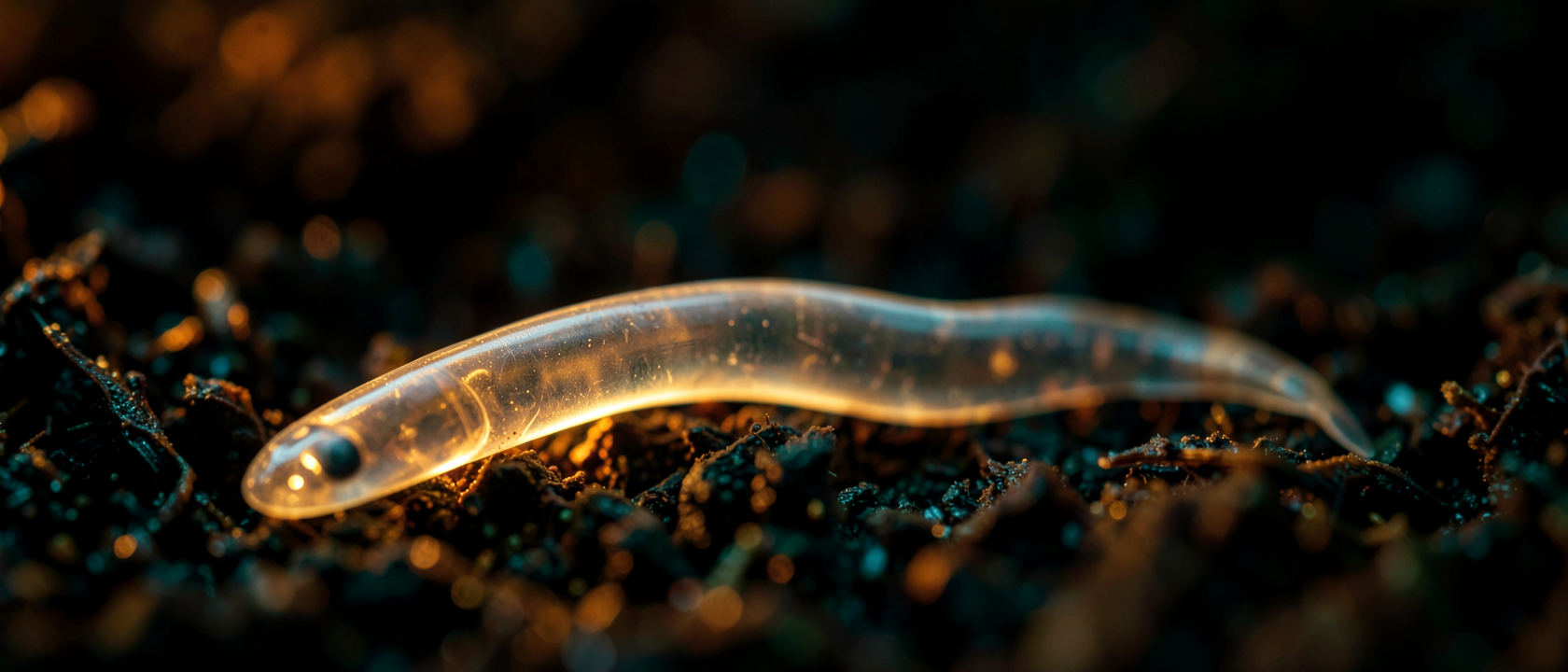
A Worm That Keeps Making the Same Mistake
A male Caenorhabditis elegans worm will eat a bacterium that is actively making him sick, over and over, long after a hermaphrodite worm of the same species has already walked off the same plate. Both are the identical species: a thread-thin roundworm about 1 millimeter long, invisible without a microscope, that labs have used as a model organism for decades. Both get the same training: days of feeding on a toxic bacterium called PA14, then a free choice between that bacterium and a safer, less appealing one. The hermaphrodites learn fast. The males, it turns out, mostly don’t. At least not yet.
That asymmetry is the finding of a 2025 study led by Meital Oren-Suissa at the Weizmann Institute of Science, with Sonu Peedikayil-Kurien as lead author, published in Nature Communications (volume 16, article 662). C. elegans is a useful animal for this kind of question because its nervous system is fully mapped down to a few hundred neurons, identical in both sexes at birth, and diverges only once the worms mature. There is no hormonal fog to sort through, just genetics. So when males and hermaphrodites responded differently to the same toxin, the researchers could chase down exactly which neurons, and eventually which gene, caused the gap.
One Receptor, Switched Off
The trail led to a single receptor called NPR-5. In males that survived exposure to the toxic bacterium, the team found that NPR-5 expression dropped in the nervous system. Male worms engineered to lack NPR-5 entirely learned to avoid the toxin about as well as hermaphrodites did. Put the receptor back, just in the sensory neurons, and the learning disappeared again. That’s as close to a smoking gun as nematode genetics gets: remove it, the behavior changes; restore it, the behavior reverts.
There was a complication. The team also built hermaphrodites with male-patterned nervous systems, expecting the brain swap alone to erase their fast learning. It didn’t, not by itself. The hermaphrodites only lost their edge once the sex identity of their gut was switched to male too. Changing the brain wasn’t enough; the digestive system had to agree. Peedikayil-Kurien’s reading is that the gut and the nervous system are talking to each other, probably through neuropeptides, and that this conversation, not the brain alone, is what suppresses learning in males.
The Bet Behind the Bite
Here is the part that turns a strange lab result into a worm running a strategy. Let a male mate with a hermaphrodite while he’s still being exposed to the toxic bacterium, and his learning ability comes back. The same nervous system that shrugged off repeated poisoning starts paying attention again, the moment reproduction is off the table.
Oren-Suissa’s reading of this: it isn’t a broken circuit. NPR-5 works like a dial, not a glitch, and in a virgin male it’s turned toward one priority over another, chasing a chance to mate over learning to avoid a bacterium that keeps hurting him. Male C. elegans are already known to abandon food to go searching for a mate; this looks like the same impulse working from the other direction. The worm isn’t failing a test. By this reading, it’s running a cost-benefit calculation evolution wired into it, one that gets canceled, fast, the instant mating happens.
What Nobody Has Wired Up Yet
The exact circuitry between gut and brain, how a digestive system’s male identity reaches back into sensory neurons and mutes a learning signal, isn’t confirmed. The brain-gut swap result shows that both have to agree before learning drops, but not how that message actually travels.
Oren-Suissa has also been explicit about the limits of the comparison: human behavior, in her words, is “far more complex,” and this worm finding only “lays the groundwork.” One thread worth watching, without over-claiming it: NPR-5’s mammalian counterpart responds to a neuropeptide called NPY, already tied to learning, memory, and stress sensitivity in mammals. The researchers note that earlier studies found female mice carry lower NPY levels than males, a possible link to differing stress sensitivity. A parallel, not a proof.
The Worm’s Side of It
Picture it, purely as a thought experiment, because no one counted the actual bites: a virgin male has been sick off this exact bacterium more times than anyone bothered to tally, and he keeps going back, because somewhere in that smell there might also be a hermaphrodite. That’s not the worm doing math, it’s a dial turned one way by a single receptor, and the data show the dial flips the moment mating happens and his brain finally starts logging the lesson. Whether you find that reckless or oddly familiar probably says more about you than about the worm.