
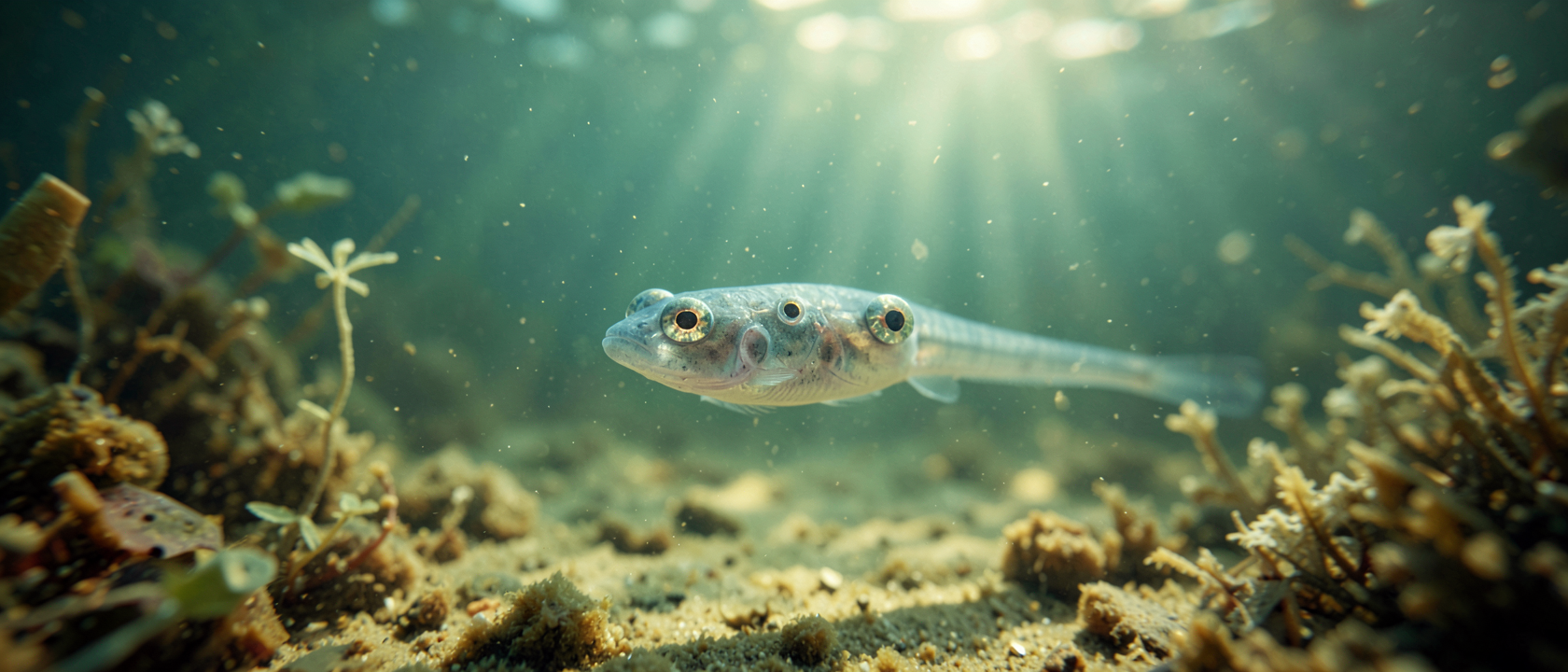
The Fish with Four Eyes
Two Cambrian fish species had four eyes, not two. Fossils of Haikouichthys ercaicunensis and an unnamed myllokunmingid, both pulled from the Chengjiang fossil beds in Yunnan province, southern China, and dated to roughly 518 million years ago, show two large eyes on the sides of the head and a second, smaller pair set between them. The work comes from a paper led by Peiyun Cong of Yunnan University with Jakob Vinther of the University of Bristol, published in Nature in 2026, based on ten specimens collected between 2019 and 2024: six H. ercaicunensis and four slabs carrying fossils of myllokunmingiids too incomplete to assign to a species.
These animals were tiny. Haikouichthys measured about 1 inch (2.5 cm) long, soft-bodied, eel-shaped, with no jaw, no fins, and no bone yet to speak of. It is one of the oldest known vertebrates on record, a creature that predates almost everything we associate with having a backbone. Cong has said the team set out simply to study the large, obvious eyes on either side of the head, and found a second, fully formed pair hiding between them. By her account, it was not the result they went looking for.
Not Light Patches, Actual Eyes
A smudge of light-sensitive tissue is not the same thing as an eye, and the team had to prove which one they were looking at. Using high-powered microscopes and chemical analysis, Cong and Vinther’s group showed that the smaller central eyes were round, carried light-absorbing pigments, and had lenses, the curved structure needed to bend light into a focused image rather than just register that light is present.
All four eyes, large and small, contained melanosomes: organelles that make and store melanin and manage how much light an eye absorbs. That composition, paired with the lens, put the small central pair in the same functional class as the large lateral ones. The paper describes all four as camera-type eyes, the design found in humans and most living vertebrates, where a single lens and iris work together to focus light onto a receiving surface. Soft tissue like an eye almost never survives half a billion years in the fossil record. That the team found four of them, in working order, on a single animal, is itself the rarer part of the discovery.
Why Bother With a Second Pair
Extra eyes are expensive to grow and run, so there is likely a reason. Vinther has proposed that in a dangerous Cambrian ocean, where larger predators were starting to appear, a wider field of view mattered more than it ever would later. A second, differently aimed pair of eyes could have let these small, soft, armorless animals catch movement from above or behind that the lateral eyes alone would have missed. As Vinther put it, the picture of early vertebrates as visually simple animals doesn’t hold up: these were animals navigating a genuinely dangerous world with real imaging equipment.
The researchers go further. They propose that this central pair of eyes is the evolutionary ancestor of the parietal eye, a light-sensing structure still present today under the skin on top of the skull in some living reptiles, amphibians, and fish, and tied to the pineal gland. That is the real thread running through this fossil: an organ built for sight in the Cambrian may never have disappeared. It changed jobs.
Your Pineal Gland Used to See
The pineal gland in the human brain is usually filed under one heading: it reads light levels and produces melatonin to regulate sleep. The long-standing assumption has been that this structure, and the so-called third eye it echoes in some modern animals, started out as a simple light-sensing patch that never amounted to much more. This finding contradicts that. According to Cong, what the fossils show is that the pineal complex in early vertebrates began as a genuine pair of image-forming eyes, round, lensed, pigmented, built the same way as the eyes on the sides of the head. Only later, she adds, did they shrink, lose the ability to form images, and settle into their current role managing sleep.
The myth being retired here isn’t about the fish. It’s about what people assume evolution does with an organ it no longer needs for its original job. The usual story is that it withers into irrelevance. The fossil record suggests something more specific happened to this one: a working eye was demoted to a clock.
What the Fossils Don’t Tell Us
No fossil captures the moment this happened. There is nothing in the Chengjiang beds showing the central eyes mid-shrink, losing their lenses, sinking inward, and becoming the gland carried in the brains of later vertebrates, including us. That transition, however it unfolded, sits somewhere in the hundreds of millions of years between these fish and the animals that came after them, and the fossils in hand simply don’t reach that far.
It is also not clear how common four-eyed vision was among early vertebrates beyond Haikouichthys ercaicunensis and this one unnamed myllokunmingid. Whether this was a body plan shared widely across Cambrian seas and lost almost everywhere, or a rarer experiment that happened to survive in exactly these fossils, is a question the current evidence can’t settle. There’s even some standing debate over how distinct these myllokunmingiid species really are from each other, with earlier work arguing Haikouichthys and its relative Myllokunmingia may be the same animal preserved in different conditions. For now, the four eyes are confirmed. The road from them to the gland behind your eyes is still missing most of its mile markers.