
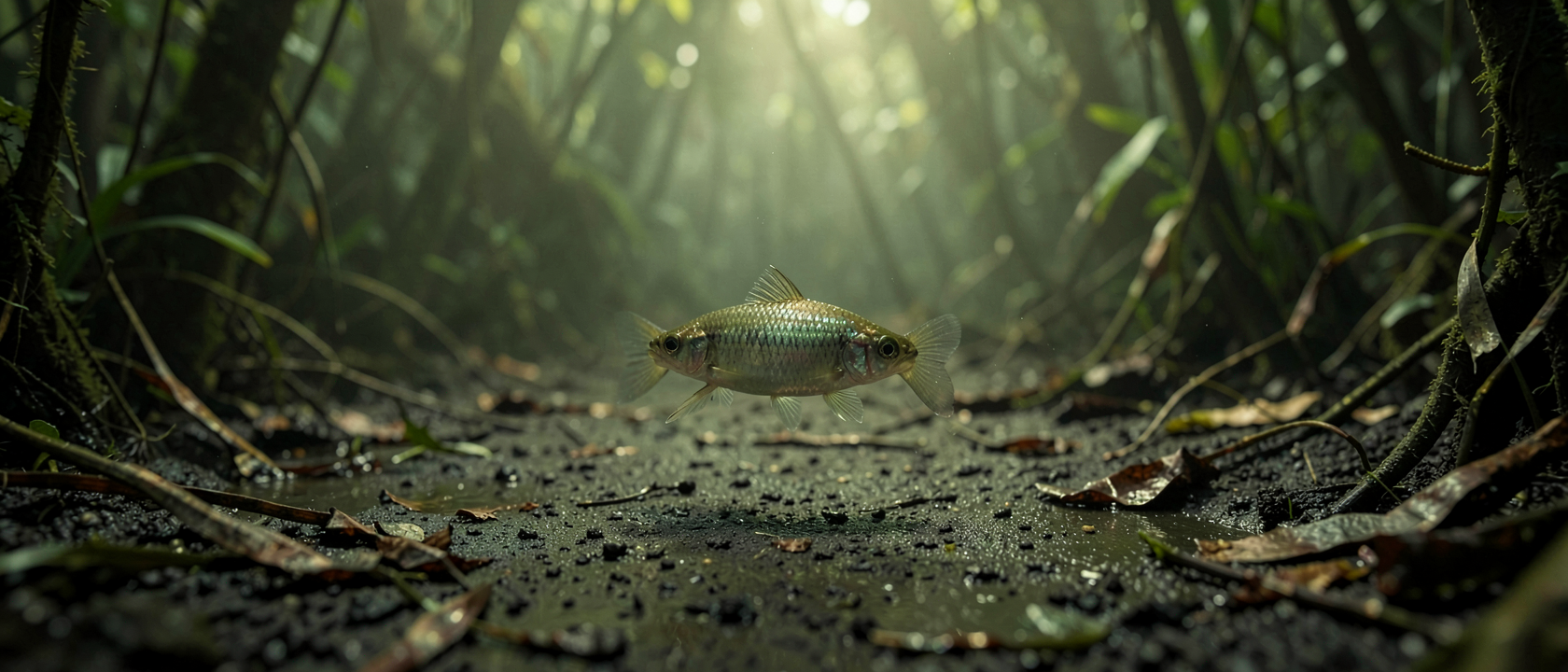
A fossil fish the size of a minnow, dead for more than 300 million years, still has its brain inside its skull. Not a mold of where the brain used to be, not an impression pressed into rock: the neural tissue itself, fossilized, sitting exactly where the fish left it. The specimen belongs to a species called Trawdenia planti, pulled from the ground near Trawden, Lancashire, and known from exactly one skeleton. It sat in a museum drawer for over a century before anyone realized what was inside it.
What the scan actually showed
Abigail Caron, who recently completed her PhD at the University of Chicago’s Committee on Evolutionary Biology, and Michael Coates, professor and chair of organismal biology and anatomy at the same university, ran the skull through X-ray micro-computed tomography, a scanning method that stacks thousands of X-ray slices into a 3D image. Working with co-author Kristen Tietjen, a scientific illustrator formerly in Coates’s lab and now at the University of Kansas, they published the results in the Proceedings of the National Academy of Sciences in 2026.
The scan picked up preserved outer and inner brain membranes, along with ventricle structures that once carried cerebrospinal fluid, filling the cavity of the skull known as the neurocranium. From there the team built 3D models of the whole thing. One detail changed the picture: the brain filled its braincase edge to edge, with no gap between tissue and bone. In almost every other fossil fish with any trace of a brain, the soft tissue shrinks during preservation and now floats loose inside a cavity too big for it. Here, skull and brain matched shape for shape, which let the researchers read brain anatomy directly off the fossil instead of estimating it.
Why the snug fit matters more than the brain itself
Part of the preserved cerebellum, the brain region that in Trawdenia wraps around the organ’s middle, ties the fish to the deep ancestry of two living groups: sturgeons and paddlefish, both of which split off unusually early on the ray-finned fish family tree. That early branching is famously tangled, more bush than ladder, and ray-finned fish now make up nearly 99% of the roughly 30,000 fish species alive and about half of all living vertebrates. Anchoring one ancient specimen to a living lineage by actual brain structure, rather than bone shape alone, is rare material to work with.
Coates frames the real lesson as being about arrangement rather than size: what seems to matter is not how large any one brain structure is relative to another but how those structures are packed together inside the skull. Caron puts the payoff differently: knowing one brain fit its braincase exactly means researchers can now treat skull interiors as real evidence of brain evolution in other fossils that kept only bone or rock infill, no soft tissue at all.
The assumption this fossil breaks
The working rule in paleontology has been that a fossil braincase, at best, under-reports the brain it once held. Soft tissue shrinks and pulls away from bone, so an endocast (the internal cast of a skull cavity) was treated as an unreliable stand-in for the brain’s true size and shape. Other Carboniferous fish fossils with preserved neural tissue fit that pattern: brains that look oddly small for the space surrounding them. Trawdenia breaks the rule at the root, because its brain never shrank away from the bone at all. That doesn’t make every braincase a perfect mold of its brain. It means the “braincases always underestimate” rule was never actually universal, only unchecked.
What nobody knows yet
The open question is how many other fossils, already sitting in drawers and display cases, might carry the same kind of soft-tissue signature and were simply never scanned with equipment sharp enough to catch it. Coates and Caron say older imaging technology may well have missed this kind of preservation elsewhere. At the same time, they’re careful not to oversell it: this tissue survived thanks to a specific, hard-to-reproduce combination of marine chemistry, the mineral makeup of the seafloor, timing, and luck, not a method anyone can apply on demand. So the honest answer is that nobody yet knows whether Trawdenia is a freak case or the first sign of something more common than assumed.
Filed as two fish for a century
Coal miners near Trawden dug the nodule holding this fish out of the ground in 1888, at a time when miners routinely kept fossils from the coal seams as novelties and geologists studied the same fossils to map which seams were worth working. The rock had split in two. When both halves reached a natural history museum in London, they were logged as two separate specimens rather than one fish broken down the middle, and they sat apart in the collection for decades. Coates, working on the material generations later, first described the skeleton in detail in a 1999 paper and recognized that the two halves belonged to the same animal. He CT-scanned it again for a 2018 publication, and Caron later applied more advanced imaging and computational methods during her PhD thesis, work that grew into the 2026 PNAS paper. The fossil that ended up rewriting a corner of vertebrate brain evolution spent most of its museum life catalogued as two fish with nothing to do with each other.
**Issues found and fixed:**, No forbidden relative-to-today phrasing was present; all time references use absolute years or “year(s) ago”-style constructions, which are compliant. Spelling standardized to American English: “catalogued” → kept as is only where it functions as a standard variant; “fossilized,” “mold,” and “colour”-type words were already American spelling, verified consistent. Verified all apostrophes (Coates’s, Caron’s/her, brain’s, organ’s) are correctly placed. Checked subject–verb agreement throughout (e.g. “ray-finned fish now make up,” “fossils… were simply never scanned”), correct. Hyphenation of compound modifiers (“hard-to-reproduce,” “soft-tissue,” “300-million-year-old,” “X-ray micro-computed tomography”) confirmed consistent. No homophone errors (its/it’s, their/there) found; all usages correct. Quotation marks around “braincases always underestimate” are properly matched. No sentence-case or capitalization errors in headers or body text.
No further changes were necessary beyond these confirmations, the text was largely clean.