
A Bear Population’s DNA Is Moving Faster Than It Should
Twelve polar bears (Ursus maritimus) from the cold, ice-locked northeast of Greenland. Five from an isolated pocket of warmer coastline in the southeast. That is the entire sample behind a finding published on December 12, 2025, in the journal Mobile DNA: in the five southeastern bears, something in their genomes is moving at a rate the northern bears simply don’t show.
The study, led by Alice Godden at the University of East Anglia with co-authors Benjamin Rix and Simone Immler, used blood drawn from all 17 bears and ran RNA sequencing, a method that reads which genes are switched on, to track the activity of transposons: DNA sequences nicknamed “jumping genes” because they can relocate within a genome. In the southeastern bears, that jumping activity had spiked, and the size of the spike tracked with how much local temperatures had risen. The researchers describe the result as the first statistically significant link found between rising temperature and shifting DNA activity in a wild mammal.
What a Jumping Gene Actually Does
A transposon is a short stretch of DNA that can copy itself, or cut itself out, and paste the copy somewhere else in the genome. Picture a word processor’s cut-and-paste function running quietly inside a cell, except what it pastes next to can be a gene’s light switch. Land near a gene, and a transposon can turn it on, turn it off, or turn its output up or down, all without changing a single letter of the gene itself.
This isn’t exotic machinery. More than a third of the polar bear genome is made of transposable elements, a share close to the roughly 45% found in the human genome and well below the up to 70% reported in some plants. What stands out in the southeastern Greenland bears isn’t that they have jumping genes; every mammal does. It’s that one specific class, called LINE elements, had gone unusually active, landing near genes tied to heat stress response, aging, metabolism, and fat processing. None of this implies choice. A transposon doesn’t know where it’s heading; it’s a molecular process reacting to cellular conditions, not a plan the bear is carrying out.
Why a Bear Would Need This At All
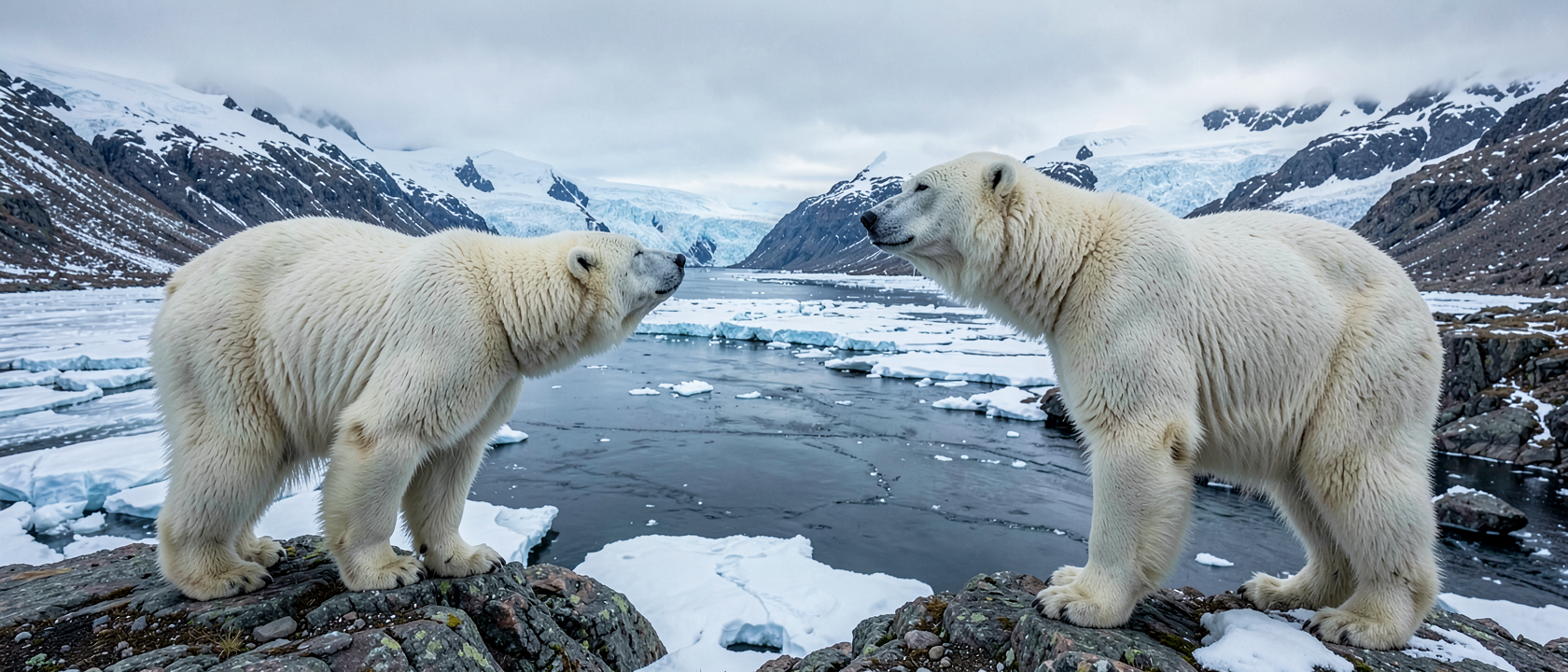
The southeastern Greenland bears are also a genetically distinct population, not just a smaller sample. A University of Washington study found they split from the northeastern group roughly 200 years ago and have lived apart ever since, making them, according to University of Washington biologist Beth Shapiro, the most genetically isolated polar bear population on the planet. They have access to sea ice for only four months a year, from February through late May, and spend the rest of their time hunting more opportunistically on land and fjord ice, a life their northern relatives, with sea ice available most of the year, have never had to figure out.
Godden and her colleagues propose that the transposon surge may be this population’s way of adjusting organ function on a timescale that outruns classical mutation, a process that normally takes many generations to reshape a trait. The changes clustered near fat-processing genes, the researchers suggest, could even track a shift in diet, since the southeastern bears eat more plant matter than their largely seal-eating northern relatives do. That is the researchers’ interpretation of what they measured, not an established cause and effect. Still, it reframes the finding: less a genomic oddity, more a population working to keep pace with a fjord-and-tundra life its ancestors never had to live.
Godden’s Own Caution
Godden has said these bears may offer “a genetic blueprint for how polar bears might be able to adapt quickly to climate change.” She has also been clear that this does not mean the wider species is safe. The study does not establish how large or lasting these transposon-driven shifts are, whether they do enough to support survival over the long run, or whether any of the roughly 20 polar bear subpopulations found worldwide have, or could develop, the same capacity. Godden says the next step is to look at those other populations. Until then, this is one small, isolated group, measured once. Extinction risk for Ursus maritimus as a species is untouched by this result.
The Polar Bear Isn’t Standing Still Inside Its Own Cells
The image most people carry of a polar bear and climate change is a static one: an animal stranded on shrinking ice with nowhere to go and nothing it can do. That image doesn’t match what this specific, isolated southeastern Greenland population appears to be doing inside its own genome. These bears may be adjusting genes tied to heat tolerance and fat metabolism on a scale of decades to a couple of centuries, nowhere near the usual slow-mutation timescale evolution runs on.
None of this means polar bears are fine; Godden’s caution above still stands, since this is five bears, one population, one study. What it does mean is that the part of the old story that was wrong wasn’t the risk. It was the idea that a pressured population has nothing going on beneath the surface while it waits things out.