
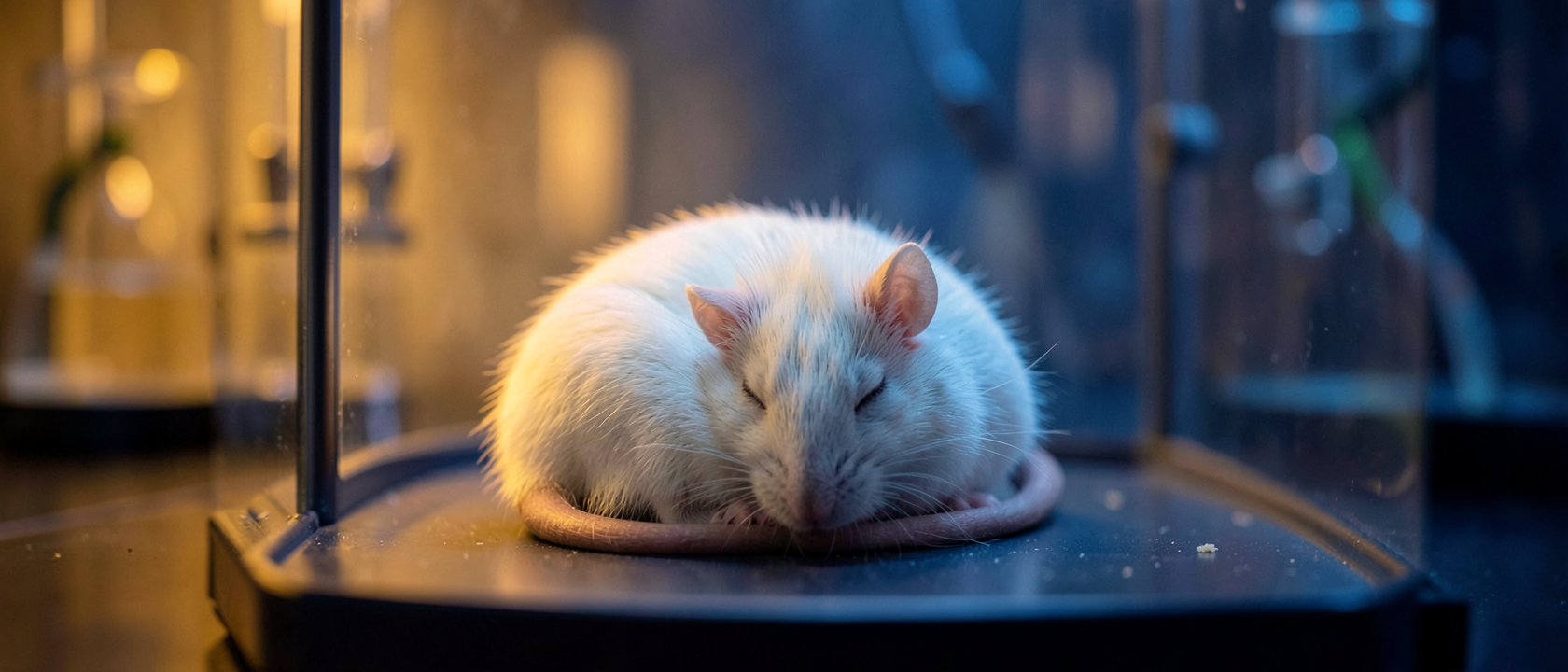
The mice that forgot how to remember, and didn’t
Laboratory house mice (Mus musculus) lost more than half of the synapses in their hippocampus, the brain region that files away new memories, within 24 hours of being pushed into a two-day artificial hibernation. A synapse is the junction where one neuron hands a signal to the next; losing half of them should gut a memory. It didn’t. A team led by Kazumasa Tanaka at the Okinawa Institute of Science and Technology had trained the mice on two tasks beforehand: freezing in a box where they’d once felt a mild shock to the paw, and finding sugar pellets hidden in a maze. After two days of hibernation and a brain that had quietly deleted most of its hippocampal wiring, the mice still froze in exactly the right spot and found the pellets just as fast as mice that had never hibernated. The study ran in Science, volume 393, on August 13, 2026.
Biologists already knew that animals actually built for this, alpine marmots (Marmota marmota) and European ground squirrels (Spermophilus citellus), come out of winter dormancy still remembering mates and food caches, even though hibernation prunes their brains hard. That finding killed the idea that heavy pruning should erase memory, but it never explained why. Tanaka’s team wanted the mechanism, and they went looking for it in an animal that never hibernates in the wild at all.
Not all synapses are equal when the brain starts deleting
House mice don’t hibernate naturally, so the researchers used a technique built by Takeshi Sakurai at the University of Tsukuba: activating a cluster of hypothalamus neurons called Q neurons, which drops a mouse’s body temperature and metabolism into a hibernation-like state on command. Inside the hippocampus, activity collapsed by 70 percent. Pruning started within 30 minutes, and by the 24-hour mark more than half of all hippocampal synapses were gone, counted directly under electron microscopy, fine enough to resolve individual dendritic spines, the small knobs on a neuron where a synapse actually lands. The deletion wasn’t even, though. Two kinds of connections survived it: hubs, where one neuron’s output reaches several neighboring cells, and convergence points, where spines from several different neurons land on one shared target. A second group of mice, kept under long-term anesthesia plus a drug blocking long-term potentiation (LTP, the process that makes a repeatedly used synapse physically bigger and stronger), also lost synapses in large numbers. This time the hub and convergence clusters themselves came apart, and the memories went with them.
What memory might actually be made of
This is the authors’ own reading of it, offered as their interpretation rather than settled fact: a memory may survive not because any individual synapse holds onto its strength, but because a pattern of connectivity, a shape stamped across many synapses, stays recognizable even after most of the material is gone. “Neurons that fire together, wire together” through LTP may still explain how a memory gets built. It may not explain how that memory gets kept. Think of the hippocampus less as a locked box of reinforced wires and more as scaffolding: strip out most of the beams, and if the joints at the hubs and convergence points hold, the shape is still there to rebuild around. The synapses lost to hibernation were fully restored within two days of the mice waking up, which is part of why the team reads this as a managed teardown rather than damage.
Bigger, stronger synapses don’t make a memory stick
Neuroscience has long treated a large dendritic spine as the physical signature of a strong memory: more surface area, more receptors, a harder connection to erase. Tanaka’s team expected exactly that pattern, that the biggest, most reinforced spines would be the ones hibernation spared. They weren’t. Spine size made no measurable difference to whether a mouse remembered the shock zone or the sugar pellets. What mattered, every time, was only whether the hub and convergence clusters stayed intact. A small, unremarkable synapse can be the one a memory depends on, as long as it sits in the right position in the network.
What the brain is actually protecting, nobody knows
Three questions are still open. Nobody has identified what these spared clusters are molecularly made of, what marks them for protection while everything nearby gets pruned away. Nobody knows how the brain decides, apparently within the first 30 minutes of hibernation, which clusters make the cut. And nobody has yet disrupted the cluster architecture directly, leaving individual synapse strength untouched, to see what that does to the memory itself; the team names that as the next experiment. Tanaka has described the rewiring as dramatic even when the memory comes through unscathed: comparing the layout of hippocampal connections on day one of hibernation against day four or five, he has said, shows a network that barely resembles itself. Each stage of the study ran on between three and ten mice, a small number for a claim this size, and nothing here says whether the same hub-and-convergence protection shows up in a marmot or a ground squirrel going through an actual winter.