
The Jelly That Jumped the Line
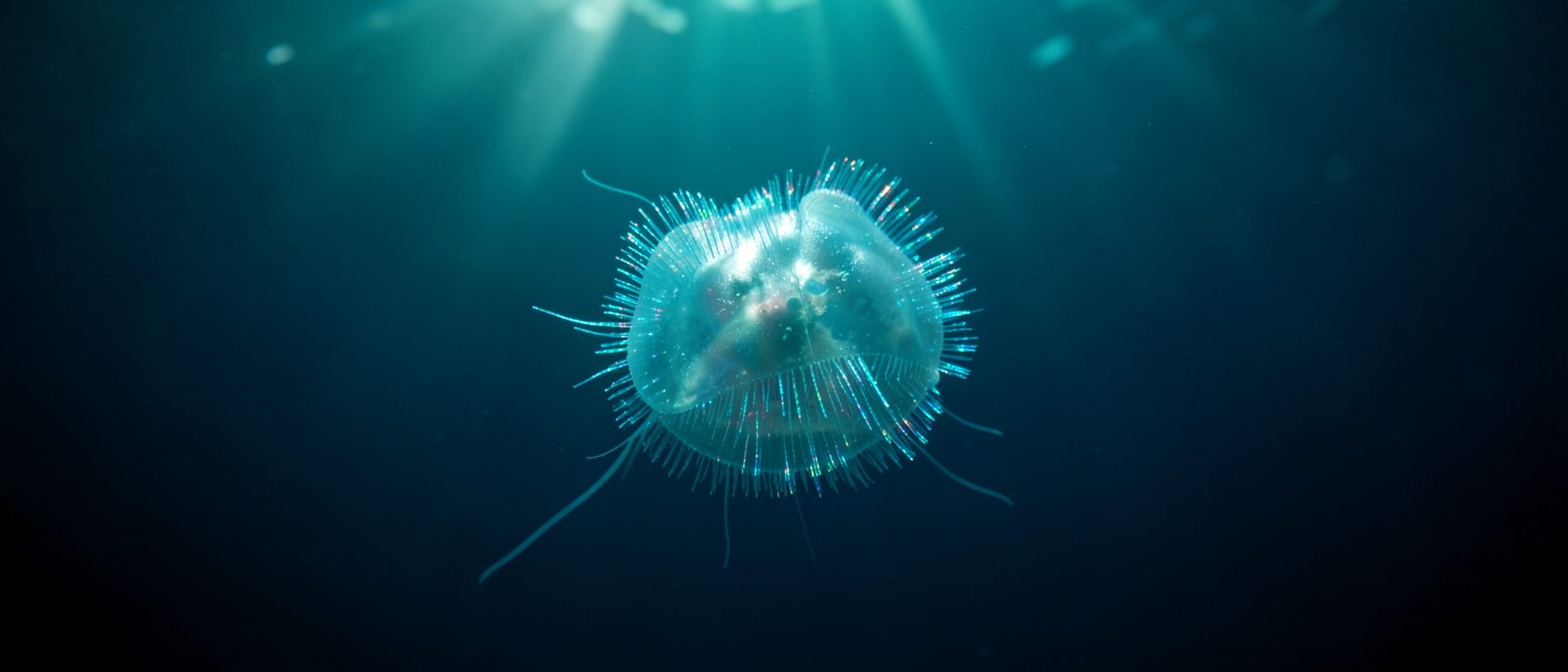
The first animal to ever branch off on the tree of life probably already had a nervous system and muscles. That is the finding, not a guess, and it knocks sponges off a pedestal they’ve held in biology classrooms for decades. Researchers from the University of Vienna, UC Berkeley, UC Santa Cruz, and MBARI, publishing in Nature on May 17, 2023, in a paper titled “Ancient gene linkages support ctenophores as sister to other animals,” found that comb jellies, not sponges, are the sister group to every other animal alive, meaning they split off the animal family tree first, somewhere around 600 to 700 million years ago, according to co-corresponding author Daniel Rokhsar of UC Berkeley. The species anchoring the work is Hormiphora californiensis, a sea gooseberry about 1 inch (2.5 cm) across that swims off the California coast on eight rows of beating cilia, its chromosome structure only worked out in 2021 by Darrin Schultz with Richard Green and Steven Haddock. Sponges have called themselves the first animal for a long time.
How You Prove Which Branch Came First
For more than 15 years, comparing DNA letter by letter between species kept giving contradictory answers about whether sponges or comb jellies branched off first. So the team of researchers, led by Schultz, Oleg Simakov, and Rokhsar along with Haddock, Jessen Bredeson, and Green, tried something else: comparing chromosome-level gene arrangements, which genes sit physically grouped together on which chromosome, across comb jellies, sponges, and three single-celled relatives of animals: a choanoflagellate, a filasterean amoeba, and an ichthyosporean, a parasite of fish. It’s less like comparing two sentences word for word and more like comparing which chapters got shuffled between two copies of the same book.
The result: ctenophores share the same ancient gene groupings still found in those single-celled cousins. Sponges, along with every other animal lineage, carry a different, rearranged set, identified across seven gene groups whose chromosomal linkage pattern told the two sides apart. Whoever carries the rearrangement split off after it happened, and whoever lacks it split off before.
Why Chromosomes Don’t Lie
This is why the chromosome method beats the old one. Individual gene sequences mutate constantly, and over hundreds of millions of years they can converge or mislead by pure chance, which is exactly why sequence-based studies kept flipping between “sponges first” and “comb jellies first.” Large chromosome rearrangements behave differently. They are rare, and once a chromosome fuses or reshuffles in a particular way, that exact pattern doesn’t undo itself and essentially never happens the same way twice by coincidence. For sponges to have branched first, with ctenophores just happening to share an unrelated arrangement with single-celled organisms, the same rare rearrangement would have to occur independently, twice, in unconnected lineages. The researchers call that vanishingly unlikely: a smoking gun, not a coincidence.
The Sponge Had the Job for Decades
Sponges have no nerves, no muscles, no gut, just pores, chambers, and filter-feeding cells, which made them the obvious stand-in for what the first animal must have looked like: simple, inert, barely an animal at all. The assumption shaped how textbooks described the dawn of animal life for decades. But the chromosomes tell a different story. Comb jellies have nerve nets, muscles, and a primitive mouth-and-gut arrangement, and if they, not sponges, branched off first, the earliest animal lineage may have already carried that complexity. Sponge simplicity starts to look like something that happened later, a simplification rather than a starting point.
Nobody Has Met the Ancestor
The actual last common ancestor of every animal alive, including the lineage leading to humans, was soft-bodied and left no fossils. Nobody knows what it looked like, and nobody knows for certain which of the comb jelly’s features, the nerve net, the muscles, the gut-like cavity, it actually carried versus which ones comb jellies evolved on their own afterward. It’s also still unresolved whether sponges lost a nervous system and muscles their ancestors once had, or never evolved them at all. Either nerves and muscles evolved once, early, and sponges lost them later, or they evolved more than once, independently, on separate branches of the animal tree. The chromosome evidence settles who branched first, not what that first branch actually had.