
Two Rivers, Two Rulebooks
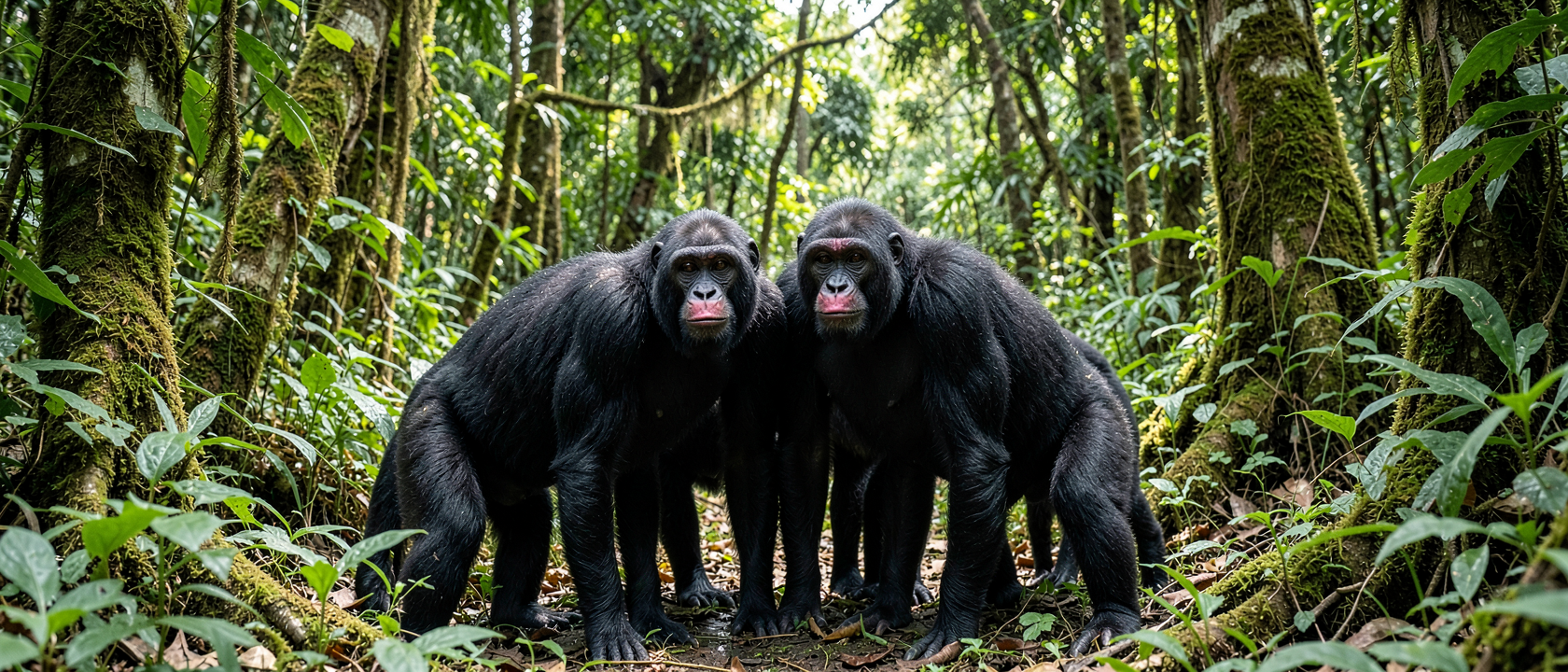
Female bonobos (Pan paniscus) at Kokolopori, in the Democratic Republic of the Congo, won 98.4% of their conflicts with males in 2020. In the same species, at a community called Ekalakala, males won 81.8% of the time in 2016. Ask someone which sex runs a bonobo troop and they’ll say female. Ask them why that’s only true in some communities and not others, and you’ve landed on a better question than the one you started with.
Both populations are the same species, with the same gap in body size between the sexes: the species stands about 3.8 feet (115 cm) tall when upright, and males weigh around 86 pounds (39 kg) against roughly 68 pounds (31 kg) for females. The numbers above come from Martin Surbeck, a researcher at Harvard University who has coordinated observations of six wild bonobo communities across nearly three decades, from 1993 to 2021. The work, published on April 24, 2025, in the journal Communications Biology with colleagues from the United States, England, Germany, and the Netherlands, is built on 1,786 recorded conflicts between a single male and a single female bonobo. Females won 1,099 of them. That’s a clear average. It also hides two communities that don’t look anything like each other.
The Mechanism: Strength in Numbers, Not in Arms
No single female bonobo out-muscles a male. What she has instead is backup. Surbeck’s team found that female dominance runs on coalitions, usually three to five females acting together, and that 85% of this coordinated female aggression targets males specifically, the same males who outweigh any one of them on their own.
The coalitions themselves are strange. Adult female bonobos are immigrants: they leave the community they were born into and arrive, unrelated, in a new one, without having grown up alongside the other females there. They don’t need to be close to back each other up. What the data show is a measured relationship, not a guess: females who received more support from other females over time climbed higher in the community’s rank hierarchy. Males are sometimes let into these coalitions, usually to gang up on other males, but the researchers never recorded one leading a coalition.
Surbeck has pointed out how unusual this kind of coordinated group action is for a wild animal at all: “You just don’t see coalitions forming that much in the wild.”
The Second Why: What Power Actually Runs On
Averaged across all six communities, female bonobos outrank males in 70% of hierarchical relationships. Compare that to the common chimpanzee (Pan troglodytes), the bonobo’s heavier-built close relative, where adult males dominate adult females without exception, and where a female’s sexual attractiveness tends to draw more aggression from males, not less.
Surbeck’s team reads the contrast as evidence about the lever itself, not just about bonobos. They call the findings “the first evidence that female solidarity can invert the male-biased power structure that is typical of many mammal societies.” The data suggest that size is just one lever among several, and that cooperation can outweigh it: a strategy open to any species able to recognize an ally and pay the favor back later.
Surbeck and colleagues go further, and they flag this part clearly as interpretation rather than finding: early human ancestors may have used comparable coalition tactics to build influence of their own. Nothing in the data proves it. But it reframes what matters most here: cooperation, not just muscle, can decide who runs the room.
The Myth: There Is No Such Thing as “The Matriarchal Ape”
The popular version of the bonobo story treats the species as the one great ape that flipped the script for good: peaceful, female-run, settled. The data don’t support that as a species-wide rule. Fruth, a researcher on the study, put it plainly: with females winning 61% of conflicts and outranking males in 70% of relationships on average, this pattern is “by no means the rule.” Eyengo in 1998, where females were never beaten or dominated by a male, and Kokolopori in 2020 look like matriarchies. Ekalakala in 2016 does not.
Surbeck’s own framing cuts both ways. Calling this “the first evidence that female solidarity can invert the male-biased power structure” is a direct hit against the idea that male dominance is some evolutionary default. But the same finding means female dominance isn’t a fixed trait of bonobos either. It gets built, community by community, coalition by coalition. The myth that dies here isn’t “bonobos aren’t matriarchal.” It’s the idea that any one bonobo community can tell you what bonobos, as a species, do.
What Nobody Has Explained Yet
Nobody has explained why Ekalakala sits so far outside the pattern, with males winning more than four out of five conflicts in 2016 while other communities point the opposite way. The researchers flagged it. They didn’t resolve it.
The spark that sets a coalition in motion isn’t even consistent from site to site. At Wamba, females tend to band together after males act aggressively toward adult females. In three of the other communities studied, it’s male aggression toward infants that triggers the same response. No single trigger has turned up across all six. Fruth has said as much about the larger puzzle underneath it: “I’m still puzzled why, of all animals, bonobos were the ones to form female alliances. We might never know.”