
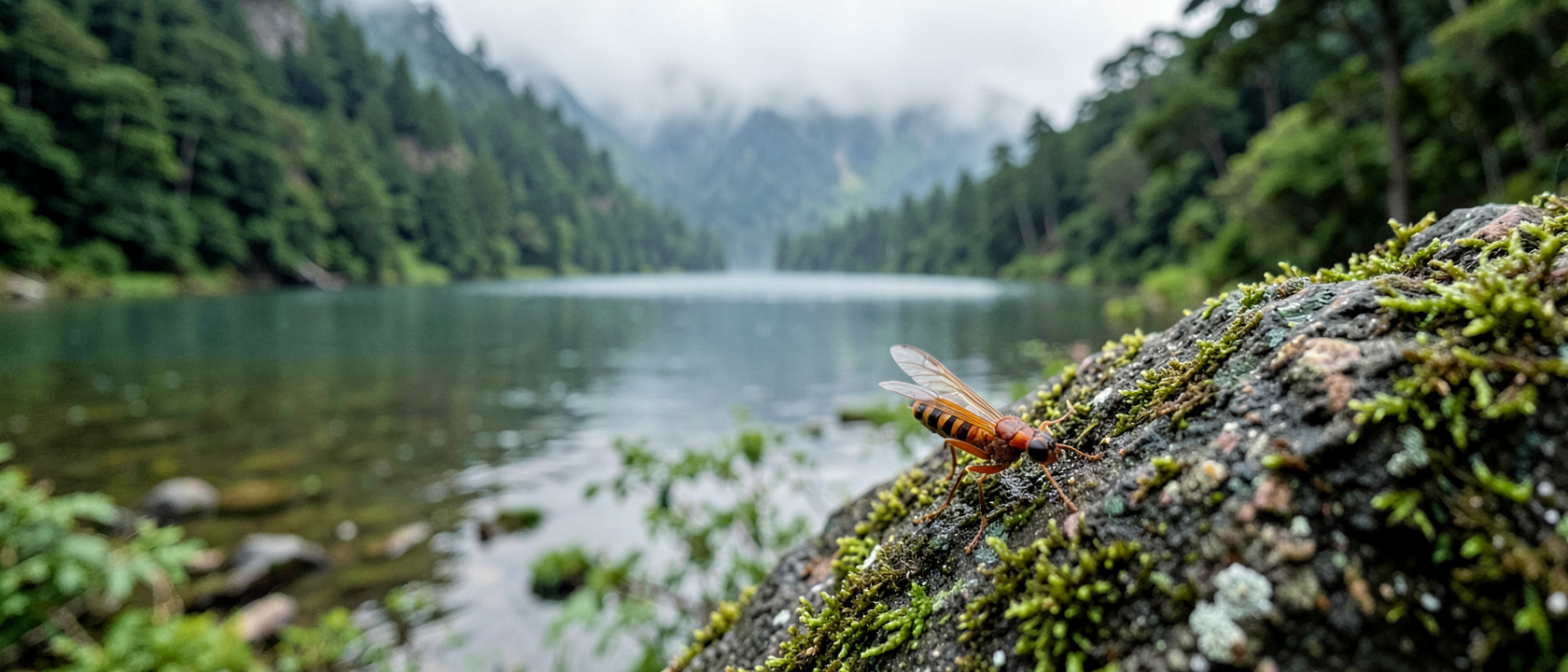
One wasp, collected in Chile’s Valdivia province, sat in a museum drawer for four decades before anyone noticed it wasn’t what the label said. It turned out to be an entirely new genus of parasitic wasp, and scientists at the Natural History Museum in London have named it Attenboroughnculus tau, timed to Sir David Attenborough’s 100th birthday on May 8.
The Drawer That Waited Decades
The wasp belongs to Ichneumonidae, the parasitic wasp family nicknamed “Darwin wasps,” found all over the world. Within that family sits Pedunculinae, a small, little-studied subfamily that, before this find, held only three recognized genera. The specimen had been filed there since it was collected in Chile’s Valdivia province, part of the Patagonian lake region, most sources, including the Natural History Museum, give 1984 as the collection year, though the describing paper and a few outlets cite 1983, and that discrepancy has never been resolved.
It took a volunteer, Augustijn De Ketelaere, working through the museum’s ichneumonid collection, to notice this wasp didn’t match its neighbors. He brought it to Dr. Gavin Broad, principal curator of insects at the Natural History Museum, who confirmed it represented a fourth genus in Pedunculinae, not merely a new species inside one already known. The find was formally described in the Journal of Natural History in 2026, with Broad, De Ketelaere, and science communications manager Jennifer Pullar as co-authors. It now carries the name Attenboroughnculus tau, with “tau” taken from a T-shaped mark across its abdomen, and the naming was timed to land on Sir David Attenborough’s 100th birthday, May 8.
How You Tell a New Genus From a Groove
Attenboroughnculus tau measures 0.14 inches (3.5 millimeters) long, a size at which “different” only shows up under a microscope. The first clue, the one that placed it inside Pedunculinae at all, is a polished groove at the tip of the hind tibia (the shin segment of the leg), a trait every member of the subfamily shares and nothing outside it has. The second clue, the one that separated it from the three other Pedunculinae genera already on record, is a pronounced curve at the base of the abdomen, paired with fine toothlike structures on the ovipositor, the needle-like organ the wasp uses to lay its eggs, plus distinct details in the wing and leg shape.
None of this is a judgment call. Genus-level identification in a wasp this small comes down to exactly this kind of millimeter-scale anatomy, checked trait by trait against every other genus in the subfamily, under a microscope, not by eye. That one groove and one curve, invisible until somebody went looking for them specifically, are what decades of shelf time came down to. As Pullar put it, the hope is that the find nudges other scientists to look harder at what’s already sitting in their own collections.
Closer Cousins in Perth Than Next Door
Here’s the part that doesn’t line up with a map. Attenboroughnculus tau’s nearest living relatives aren’t in the Chilean forest around it; they’re in Australia, thousands of miles across open ocean from the lake country where the specimen was found. Pedunculinae wasps turn up today in Chile, Argentina, Australia and New Guinea, a scatter of locations that looks random until you stop thinking of them as separate continents.
Those four places were once joined, as pieces of the ancient southern supercontinent Gondwana, which began splitting apart roughly 200 million years ago. Dr. Broad describes the wasps’ spread as a Gondwanan distribution, the kind of pattern left behind when a landmass pulls itself apart and carries the ancestors of a species to opposite coastlines over tens of millions of years. Australia and South America stopped being neighbors a very long time ago. The wasps’ family tree is the paperwork on that breakup, still being processed 200 million years later.
Nobody Knows What the Groove Is For
The polished groove that helped identify the genus has no known function. Nobody has observed a live Pedunculinae wasp using it, and nothing in the published record explains what it’s for. That gap sits in the science, not in this article.
There’s one thread researchers can point to. A single Australian species in the subfamily has been reared from a spider egg sac, which hints that at least some Pedunculinae wasps parasitize spiders, laying eggs that develop at the spider’s expense. That’s one data point from one species, not a rule for the whole group, and researchers are careful to note that other pedunculine species could be doing something else entirely. As for Attenboroughnculus tau itself, there is effectively no biology on record. There’s exactly one specimen of it in existence, and it hasn’t turned up again since it was first collected.
A Five-Year-Old, a Book, and a Debt Repaid
Broad has his own account of how he ended up on the other end of this discovery. Around age five or six, he was given a copy of Attenborough’s “Life on Earth.” In it, Attenborough mentions taxonomists and what they do, almost in passing, and Broad was hooked. “He has been a massive influence on so many of us, and me as well,” Broad has said. “When I was young, five or six maybe, I was given the Life on Earth book. In it he mentions taxonomists and what they do, and I was hooked.” Elsewhere he’s put the same debt more plainly: as a kid he decided, on the strength of that book, to become a taxonomist, and, amazingly, that’s exactly what happened.
It’s a fitting loop, too, since Attenborough himself gave parasitoid wasps airtime long before this one had a name, describing them in The Trials of Life as “body snatcher wasps.” Naming this one after the man whose book sent him into the job, Broad calls it “paying something back.” Attenboroughnculus tau joins more than 50 species already carrying Attenborough’s name, including an echidna, a semi-slug and a small Peruvian frog. This one is a 0.14-inch wasp that waited in a drawer for decades before anyone opened the right book on it.