
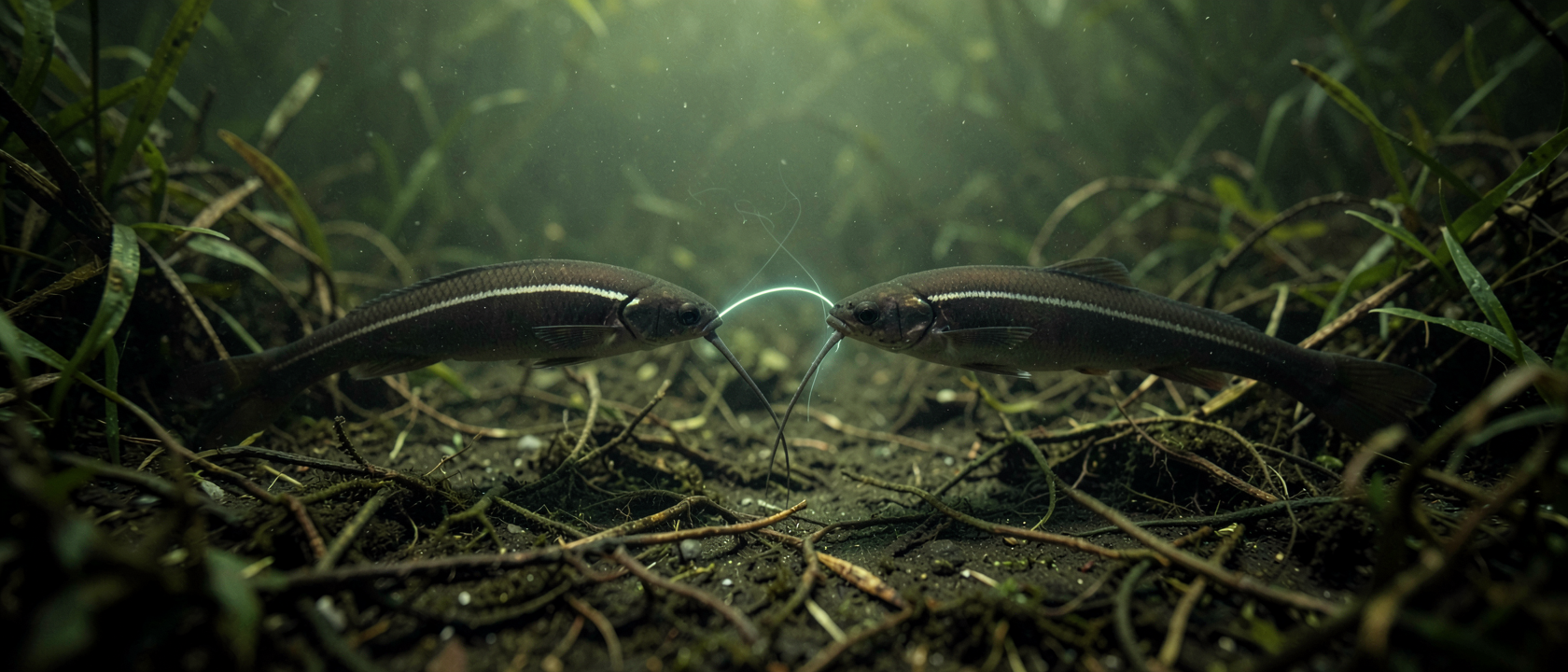
The Fish That Reads Its Neighbor’s Mail
An elephantnose fish does not read only its own electricity. It also reads yours, if you happen to be another elephantnose fish swimming close by. Federico Pedraja and Nathaniel Sawtell, at Columbia University’s Zuckerman Institute, published the finding in Nature on March 6, 2024, in a paper titled “Collective sensing in electric fish.” Individual Gnathonemus petersii, they found, can detect objects in the water using the electric fields generated by nearby fish and not only their own. Computer simulations in the same paper showed that borrowing a neighbor’s signal can stretch an individual’s effective sensing range out to three times what it could manage working alone.
How You Borrow a Signal You Didn’t Send
Gnathonemus petersii produces a weak electric field from an organ at the base of its tail, in the narrow stalk called the caudal peduncle, then reads how that field bends around nearby objects through electroreceptors built into its skin. This is electrolocation, and the species relies on it because it lives on the dark, muddy river beds of West and Central Africa, where eyesight is close to useless.
The new part is what happens in the brain. Recordings from the electrosensory lateral line lobe, the region that processes these signals, showed neurons firing not only to the fish’s own discharges but to external pulses too, whether those came from a real neighbor or from an electrode built in the lab to mimic one. The simulation had already predicted which positions relative to a neighbor would combine two fish’s electric images into the sharpest possible picture: lined up nose to tail, or at a right angle. In the tank, the fish arranged themselves in exactly those formations. The model and the fish had reached the same answer independently.
Why Not Just Jam Each Other
A group of electric fish sounds, on paper, like a recipe for static: overlapping pulses ought to interfere with each other the way two radios on one frequency talk over each other. That was the standing assumption among some researchers, as Axios reported on March 10, 2024, when it covered the study, until Pedraja and Sawtell found the opposite: the fish benefit from each other’s pulses instead of being jammed by them. Gnathonemus petersii already had a documented habit called the echo response, a fast, alternating shift in discharge timing whenever another fish is nearby. It had always been explained as defensive, a way to dodge interference. The new paper proposes a second job for it: timed correctly, the echo response may let two fish’s electric fields complement each other rather than collide, turning a loose pair of fish into something closer to one instrument scanning the same stretch of river. The authors raise this as a new possibility, not a settled mechanism.
Perception Was Supposed to Be a Private Thing
Most sensory biology works from one assumption: an animal builds its picture of the world out of its own body’s signals, its own eyes, its own whiskers, its own electric pulses, and nobody else’s. The Pedraja and Sawtell recordings suggest Gnathonemus petersii doesn’t fully respect that boundary. A neighbor’s electric discharge gets processed in the same neural stream as the fish’s own signal, not decoded as a separate message from another animal, but used as raw material for the fish’s own sense of what’s out there. The researchers describe this kind of collective sensing as something not previously documented in any species. Two fish aren’t trading two separate pictures. They may be building one.
What Nobody Knows Yet
Nobody has worked out how the fish’s brain sorts its own pulse from a neighbor’s, or how it merges the two into something useful rather than a scramble. Gnathonemus petersii also carries an unusually large brain relative to its body size for a fish, and Sawtell’s team has floated the idea that this might be connected to supporting this kind of shared processing. The study does not establish that link. It’s a question the researchers raised out loud themselves, and left open.