
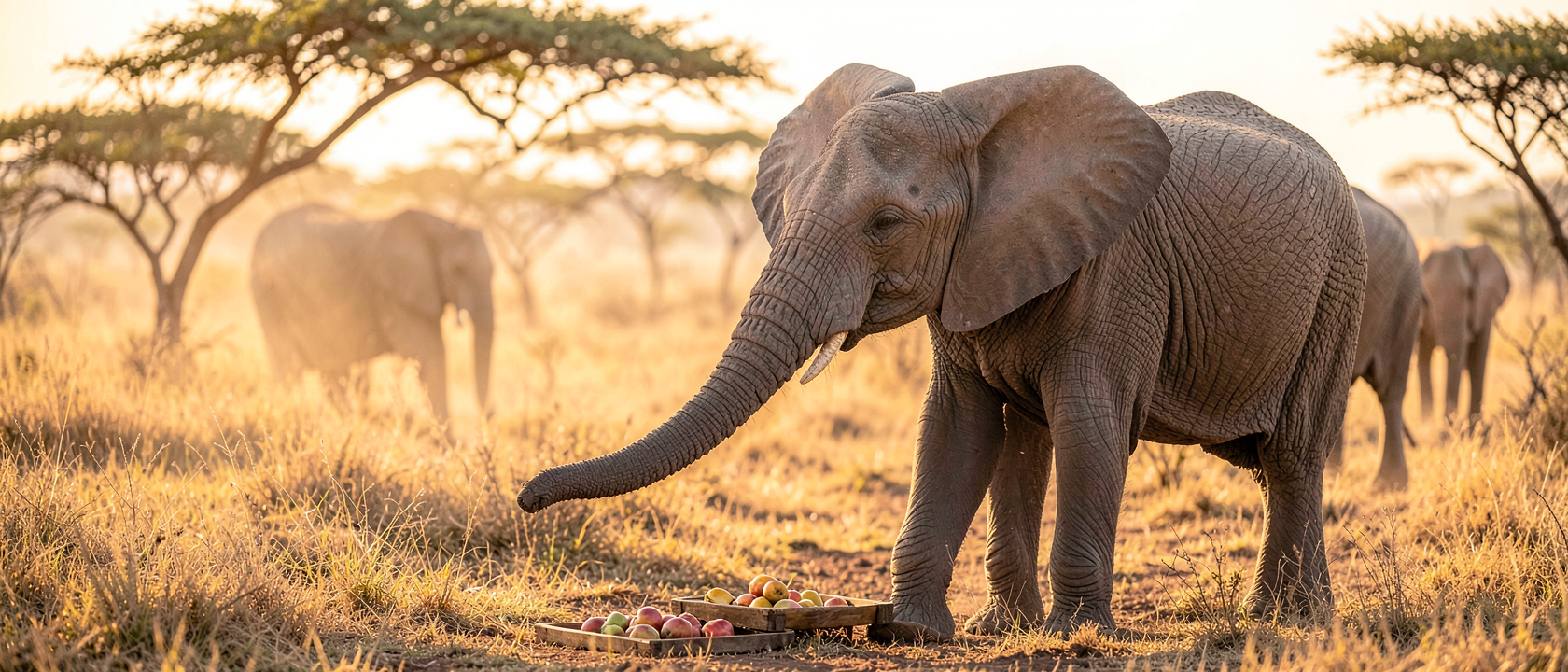
Seventeen semi-captive African savanna elephants (Loxodonta africana), living with Elephant CREW in Victoria Falls, Zimbabwe, used 38 distinct gestures, on purpose, to ask a human for apples. Some swung the trunk’s two finger-like tips toward the tray holding the fruit. Some reached straight at the person who controlled it. Researchers from the University of Vienna, the University of St Andrews, the University of Portsmouth and City University of New York coded 313 of these gestures from video: 161 aimed at the experimenter, 12 at the tray, 29 at the elephant itself, and exactly zero at a tray that held no apples at all. The study, led by Vesta Eleuteri and published July 9, 2025, in Royal Society Open Science, is the first to run elephants through the same intentionality tests built for apes and human infants.
That last zero matters as much as the 38. An empty tray got nothing because there was nothing worth asking for. That’s the first clue this is a real vocabulary, not a nervous habit.
Proving it isn’t a twitch
Spotting a gesture is easy. Proving that an animal means it is the hard part. Eleuteri’s team borrowed the framework researchers use to study human infants before they can talk: three tests for intentional communication. First, audience directedness: the elephants used their 38 gesture types almost exclusively when a visually attentive person was actually looking, not when the experimenter’s back was turned. Second, persistence: an elephant that got only half the apples it wanted kept gesturing, more than it did after getting the full amount. Third, elaboration: an elephant that got nothing at all didn’t just repeat itself; it switched to a different gesture, a change in tactic rather than a louder version of the same one.
An elephant that clears all three isn’t twitching its trunk out of habit. It’s tracking whether the message landed and adjusting when it doesn’t.
A social ledger worth gesturing over
Eleuteri frames the result as evidence that elephants manage a social world with the same layers as a chimpanzee’s: kin, allies, friends, strangers, each one handled differently. A trunk gesture is cheap to produce, precise, and only readable up close, useful currency for an animal that keeps the same relationships running for decades.
Elephants share a common ancestor with humans, and with apes, more than 100 million years back. Whatever that ancestor could do, it wasn’t this. Elephants didn’t inherit intentional gesturing from a shared source; they built it again, independently, in a brain nothing like an ape’s, apparently because running a complicated social life calls for the same kind of solution twice over.
The myth that just lost its footing
The standing assumption in animal cognition was that deliberate, goal-directed gesturing sat close to a primate specialty. As the researchers note, wild apes already use more than 70 gesture types for specific requests, “come here,” “give me that,” “groom me.” A few non-primates had shown flickers of something similar, guppy fish and Arabian babblers among them, but usually with just one or two gestures tied to a single goal, like getting others to follow. Elephants, meanwhile, were filed under rumbles and trunk-sniffing: a species that talks through sound and smell, not gesture.
This study doesn’t overturn elephant biology. It overturns a gap in the research. Nobody had pointed the apes-and-infants toolkit at elephants before. Gesture wasn’t rare in elephants. It was unstudied.
What the researchers don’t know yet
Every gesture in this count came from semi-captive elephants interacting with a human at one site in Zimbabwe. Whether wild elephants use the same 38-gesture toolkit, or whether different populations develop their own local repertoires, the way some species show regional variation in calls, is still open. Eleuteri and her colleagues have watched wild elephants gesturing to each other, and even toward researchers, in the field, but say plainly that a field impression isn’t data. The team is now coding thousands of video clips from two wild elephant populations in South Africa to find out whether the semi-captive picture holds up outside it.
Pfumo’s leaf
One elephant in the Victoria Falls group, Pfumo, skipped the standard trunk reach entirely. He picked up a leaf and blew it into the air instead, apparently to make the same point: give me the apple. It isn’t one of the 38 cataloged types, and Eleuteri cites it as a reminder that the count is a floor, not a ceiling. Elephants improvise. This one just happened to make his case with a leaf.
—
**Summary of fixes made:**
1. “Proving an animal means it is the hard part” → “Proving that an animal means it is the hard part” (missing conjunction).
2. Comma splice fixed with colon: “…talk, three tests…” → “…talk: three tests…”
3. Comma splice fixed with semicolon: “didn’t just repeat itself, it switched” → “didn’t just repeat itself; it switched”
4. Spelling consistency: “catalogued” (British) → “cataloged” (American) to match American spelling used elsewhere.
5. No relative-to-today date issues found, all dates/time references are absolute or year-based and compliant.