
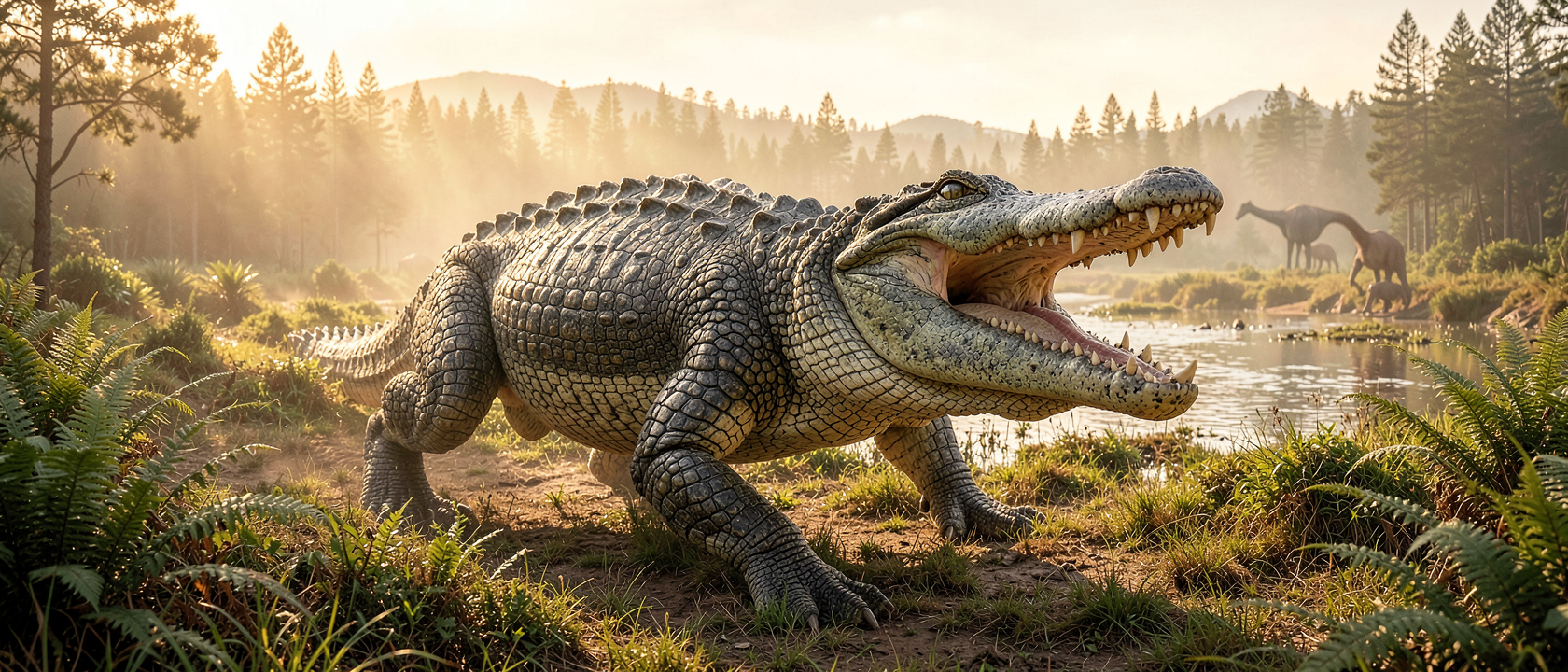
The crocodile that was built like a linebacker
At 11.5 feet (3.5 meters) long and about 550 pounds (250 kilograms), Kostensuchus atrox had roughly the footprint of a compact sedan, if that sedan had teeth. It’s a newly described species of peirosaurid crocodyliform, a branch of the crocodile family tree that split off long ago. Not a true crocodile, and not a dinosaur either. Fernando Novas of the Museo Argentino de Ciencias Naturales “Bernardino Rivadavia,” working with colleagues from Argentina, Portugal, and Japan, described it from a single, unusually complete fossil in a paper published August 27, 2025, in PLOS One. The specimen, cataloged as MPM-PV 23554, was unearthed during an expedition to the Chorrillo Formation near El Calafate in March 2020: an articulated skull and jaws, neck and trunk vertebrae, rows of bony armor plates, ribs, both shoulder and hip girdles, a complete right humerus, and fragments of the hind limbs. That’s not a loose tooth standing in for a whole animal. It’s close enough to a full skeleton that researchers can reconstruct how the animal actually moved and fed.
A mouth built for something that fights back
The skull alone measures about 19.3 inches (490 mm) long, and its shape tells you what the animal was eating before anyone ever found a bite mark. The snout is broad and only a little more than half the skull’s total length, what paleontologists call oreinirostral: built wide and tall rather than long and narrow like the snout of a fish-eating crocodile. The teeth are large, blade-like, and serrated, what the paper calls ziphodont, made for slicing rather than for clamping down on something slippery and small. Behind the jaw sits a deep chamber for the muscles that closed it, and the shoulder anatomy shows a broad shoulder blade paired with a heavily built upper arm bone. Researchers reading that skeleton also note something unexpected: unlike modern crocodiles, which spend most of their lives in water, Kostensuchus looks built for life on land, with a short, thick snout and strong forelimbs suited to grappling rather than lurking. A fish-snapper has a narrow snout and conical teeth built for a quick, tight grip. Kostensuchus has the opposite kit: a jaw suited to taking hold of something large, struggling, and trying to get away. That combination is what researchers mean when they call an animal a hypercarnivore.
The second-biggest killer in the neighborhood
Put that jaw in context and the picture sharpens. The Chorrillo Formation, dated to around 70 million years ago in the Maastrichtian, the final stage of the Cretaceous, preserves a warm, seasonally wet floodplain shared by dinosaurs, turtles, frogs, and small mammals. Within that community, Kostensuchus ranks as the second-largest predator known from the formation, trailing only the megaraptorid theropod Maip, a dinosaur estimated at around 30 feet (9 meters) long. Everything else that hunted there, as far as the fossil record currently shows, was smaller than a 550-pound crocodile relative with a bite built for large prey. Kostensuchus is also the first crocodyliform fossil ever documented from the Chorrillo Formation, and one of the most complete peirosaurid skeletons found anywhere, which is why this description carries real weight instead of resting on a jaw fragment. Paleontologist Diego Pol, who helped free the fossil from the rock, said the anatomy had never been seen before and that the team found itself face to face with one of the dominant predators of its time. The name reflects that standing: “Kosten” from the Aonikenk word for the Patagonian wind, “suchus” from Souchos, the Egyptian crocodile-headed god, and “atrox,” Latin for fierce or harsh.
The myth that dinosaurs always ran the table
It’s easy to assume that in any Cretaceous landscape, the biggest, scariest animal was automatically a dinosaur. The fossil record’s popular image is built almost entirely on dinosaur skeletons, so the assumption sticks even when it isn’t true. Kostensuchus contradicts it directly. In the Chorrillo Formation, a member of Peirosauridae, a crocodylomorph family found across the old southern supercontinent Gondwana, ranked as the second-largest known predator in its ecosystem, outsizing every dinosaur in that food web except Maip itself. Its place within Peirosauridae also marks the southernmost record yet found for that group, a lineage that already had a wide Gondwanan range before this specimen pushed the map further south. A crocodile relative didn’t just share the neighborhood with dinosaurs. By jaw and body alone, it was built to compete with them for the same large prey.
What nobody has figured out yet
The jaw and teeth say Kostensuchus could handle medium-sized dinosaurs. They don’t say it did, at least not yet. No gut contents and no bite marks on dinosaur bone have been reported, so the specific prey remains inferred from anatomy, not confirmed by direct evidence. How it hunted, whether by ambush near water, active pursuit on land, or some mix of both, is likewise unsettled. And because the species is known from a single skeleton, there’s no way yet to say whether MPM-PV 23554 was typical for its kind or unusually large or small. The biggest open question sits right at the top of the formation’s food chain: Maip, the only predator known to have outranked Kostensuchus, remains undescribed in enough detail to say exactly how the two compared in life, as rivals, as predator and occasional prey, or as animals that rarely crossed paths at all. Novas has called the skeleton’s completeness remarkable precisely because it lets researchers reconstruct not just a skull but the muscle and body structure behind a predatory life. The next question is whose life it actually collided with.