
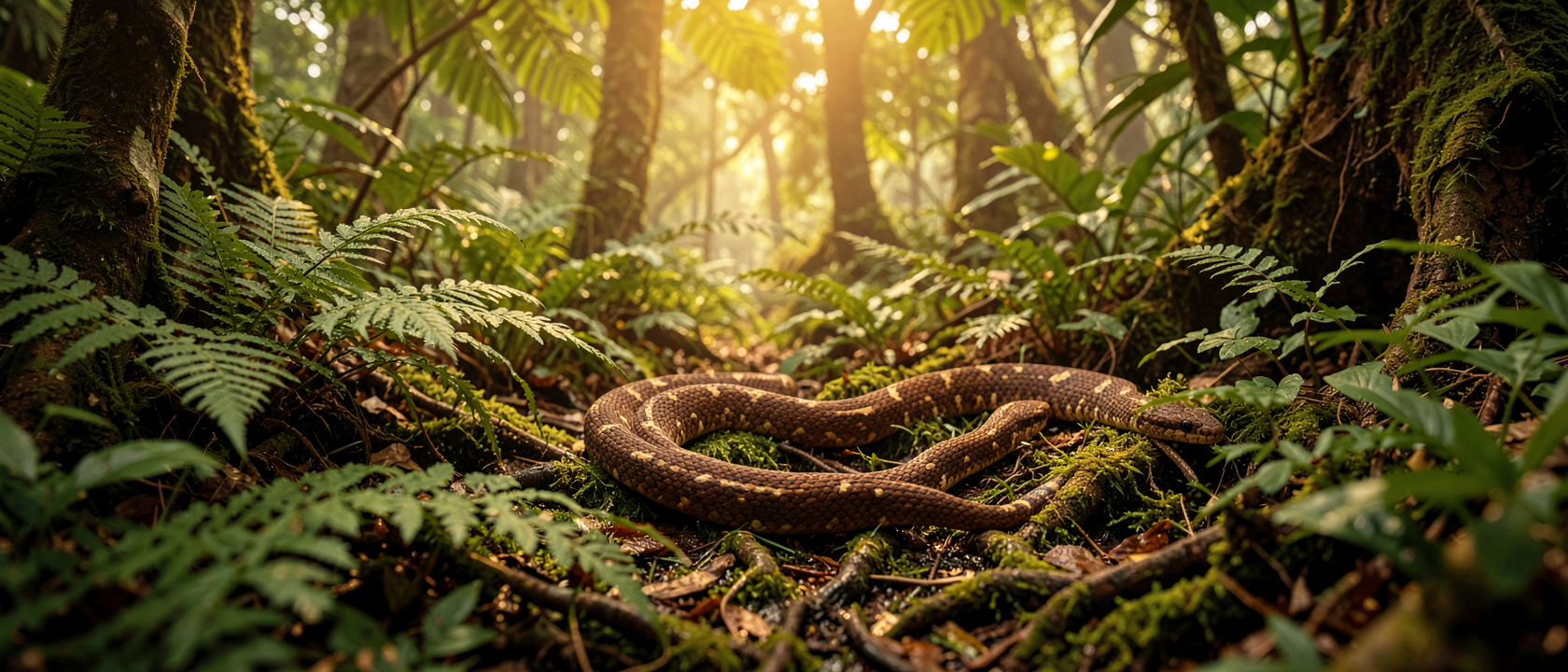
A Drawer at the Natural History Museum, Open for 44 Years
Thirty-one fossil vertebrae, each only a few millimeters long, came out of Hordle Cliff on England’s south coast in 1981. They went into a museum drawer and stayed there, unidentified, for 44 years. In 2025, Dr. Georgios Georgalis of the Institute of Systematics and Evolution of Animals at the Polish Academy of Sciences and Dr. Marc Jones, curator of fossil reptiles and amphibians at the Natural History Museum, worked out what they were looking at: a snake species new to science. They named it Paradoxophidion richardoweni and published the description in the journal Comptes Rendus Palevol. It lived roughly 37 million years ago, in the late Eocene, and was likely under three feet (one meter) long. The entire species rests on these 31 bones. No skull. No skin impression. No second specimen, anywhere, ever found.
How 31 Random Bones Become One Snake
A snake’s vertebrae do not stay the same shape along its body. The ones behind the skull look different from the ones near the tail, changing gradually, bone by bone, the whole length of the spine. That gradient is what let Georgalis and Jones read 31 loose, unlabeled fossils as a single animal rather than a grab bag of random snakes. The bones fit a continuous taper from one end of the body to the other, and they share features that show up in no other known species. To check that reading, the team ran the vertebrae through a CT scanner and built 3D digital models from the scans, now posted online for anyone to examine and rotate on a screen.
A Snake From Before Snakes Decided What Kind of Snake to Be
Here is the part that makes this fossil worth a name like “paradox snake.” The vertebrae do not sort neatly into any one modern snake lineage. They carry a mix of traits that today are split across different groups, as if someone had shuffled a deck before snakes had agreed on the rules. Paradoxophidion sits very early in the evolution of Caenophidia, the lineage that contains the large majority of living snakes, cobras, vipers, colubrids, and the rest. It comes from before that lineage branched into those separate, recognizable patterns. Georgalis describes the mix of features as something that “baffles classification,” and the reason is not that the fossil is incomplete. It is that the split it predates simply had not happened yet. The species name, richardoweni, honors Sir Richard Owen, who named the first fossil snakes ever found at Hordle Cliff, including a constrictor called Paleryx, and who helped establish the Natural History Museum itself. A find like this is why a drawer sits for 44 years: recognizing a mosaic takes knowing what the pieces usually look like apart.
What the Bones Won’t Say
No skull was recovered, so nobody knows what Paradoxophidion ate. The vertebrae show no obvious adaptation for burrowing, which rules out one tidy guess about how it lived. There is one tantalizing lead: the vertebral shape closely resembles that of Acrochordids, the aquatic “elephant trunk snakes” alive today in Southeast Asia and northern Australia. If Paradoxophidion belonged to that family, it would mean an aquatic snake was living in Eocene England, a geographic jump odd enough on its own to raise eyebrows. Georgalis is upfront that this is speculation, not a conclusion. The resemblance is suggestive. It is not diagnostic. Georgalis has said he plans to go back through other unexamined snake bones in the museum’s collection, including material Richard Owen himself once studied, looking for more species hiding in plain sight.
The Museum Visit He’d Wanted Since He Was a Kid
Georgalis has described visiting and researching at the Natural History Museum as a childhood dream, one he’d held onto for years before he ever got to work with its collections. Spotting these 31 odd little vertebrae and realizing they belonged to something nobody had ever named gave him, in his own words, “a fantastic feeling.” Most drawers stay drawers. This one, after 44 years, turned out to hold a snake from before snakes had settled on what kind of snake to be.