
The bite still in its jaws
A theropod dinosaur died with another animal’s arm bone wedged between its teeth. The specimen is Joaquinraptor casali, a newly described megaraptorid described by Lucio Ibiricu of the Patagonian Institute of Geology and Paleontology (IPGP), Argentina, and colleagues, published in Nature Communications in 2025. It comes from the Lago Colhué Huapi Formation in Chubut Province, Patagonia, and the surrounding rock dates to roughly 68 million years ago, making this one of the youngest megaraptorid fossils on record.
The skeleton recovered is unusually complete for this family: a partial skull, both lower jaws, forelimbs, legs, ribs and a run of tail vertebrae, amounting to about 20 percent of the animal’s full skeleton. The animal measured more than 23 feet (7 meters) long and, based on the thickness of its thigh bone, is estimated at around 2,284 pounds (1,036 kilograms). Pinned against its lower jaw bones, touching the teeth, researchers found the humerus, or upper arm bone, of a crocodyliform, an ancient relative of modern crocodiles. The bone carries tooth marks.
Built to grab, not to crush
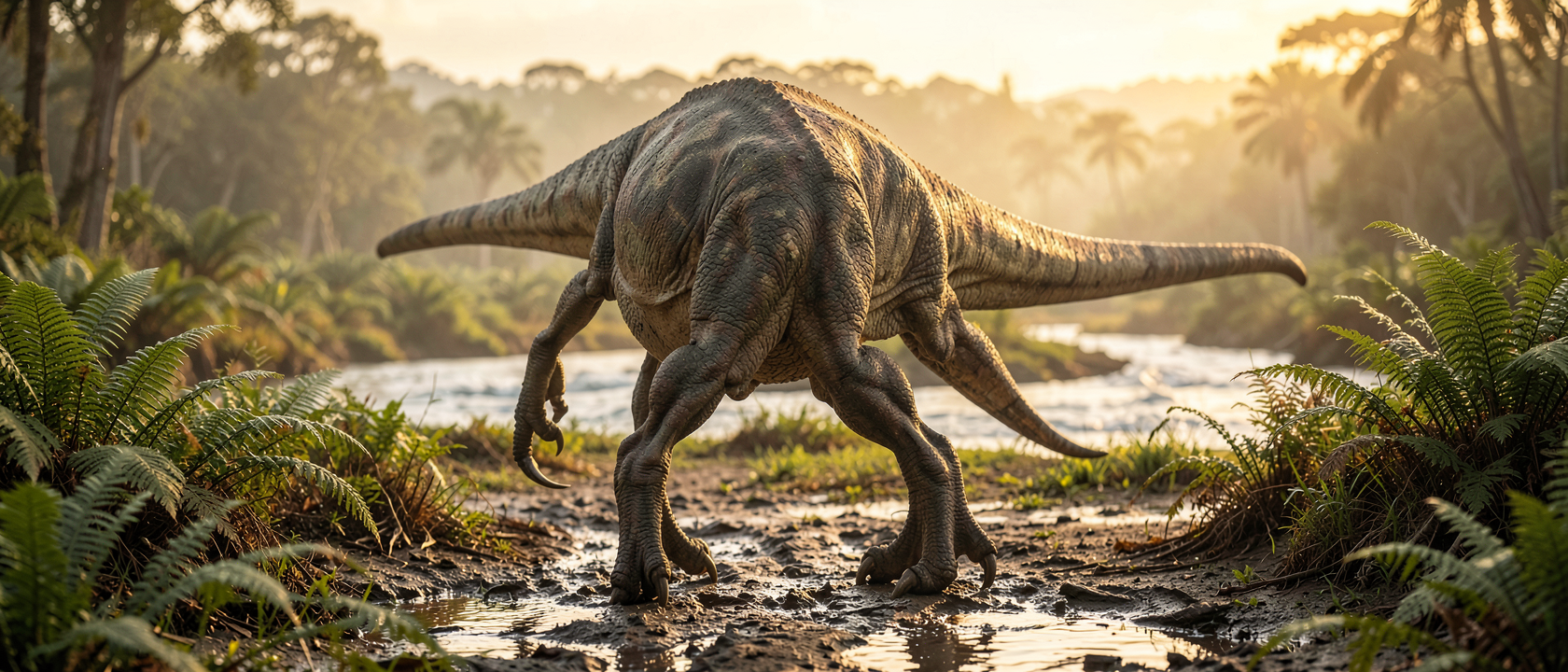
Megaraptorids are not small tyrannosaurs wearing a different name. The anatomy described in the paper shows a lean-bodied animal built for speed on long legs, with a relatively lightly built skull and jaw, but forelimbs blown up out of all proportion: thick, muscular arms ending in oversized, curved claws on the first two fingers. Ibiricu told ScienceAlert the claws may have let the animal reach soft tissue or help it capture and manipulate prey, a proposed function rather than a proven one.
That build points to a different hunting style than the one most people picture when they hear “giant predatory dinosaur.” A tyrannosaur subdued prey with a skull built to crack bone. A megaraptorid built like Joaquinraptor looks designed to grab and slash first, with the jaws finishing the job rather than crushing it.
A predator that never stopped growing up
Slice a thin section through a limb bone and the inside looks a little like a cut tree stump: rings called lines of arrested growth, or LAGs, mark pauses in bone deposition, usually one per year. Counting them in the tibia, or shinbone, of this individual, the research team arrived at a minimum age of 19 years.
The braincase sutures had already fused, a sign of sexual maturity. But the spacing between growth rings in the limb bones had not yet tightened the way it does in a fully grown adult. Put together, the authors read this as an animal that could reproduce well before it finished growing, a long runway into adulthood rather than a hard stop. Megaraptorid biology has stayed murky mostly because complete skeletons are rare; a 19-year-old that was mature but still growing gives the group an actual data point instead of a guess.
Last meal, or last resting place?
Here is the part the paper does not settle. The crocodyliform humerus sat against the megaraptorid’s teeth, and the bone bears tooth marks, which fits with Joaquinraptor feeding on it close to the moment of death. But the authors are explicit that this is an assertion, not a conclusion: a limb bone can also drift into a dead animal’s open jaws as a carcass settles underwater, long after the tooth marks were left during some earlier, unrelated meal.
Nothing in the fossil separates the two stories. It could be a last bite, caught mid-action. It could be a feeding that happened earlier for a different reason, with the bone and the jaw only brought together by decay and current. The paper leaves it open, which is the honest place to leave it.
No T. rex required
It is easy to assume the top predator in any Late Cretaceous ecosystem has to look like a tyrannosaur: oversized skull, bone-crushing bite. Not in this part of Patagonia. No tyrannosaurs are known from the Lago Colhué Huapi Formation at all. The apex role here belonged to something built on a completely different plan, a lighter-bodied animal running on long legs with its weapons in its hands instead of its jaw.
Joaquinraptor casali is the record of what that looks like: more than 23 feet of animal, over a thousand pounds, no crushing bite on offer, and still, apparently, the last thing anything else on that floodplain wanted to meet.