
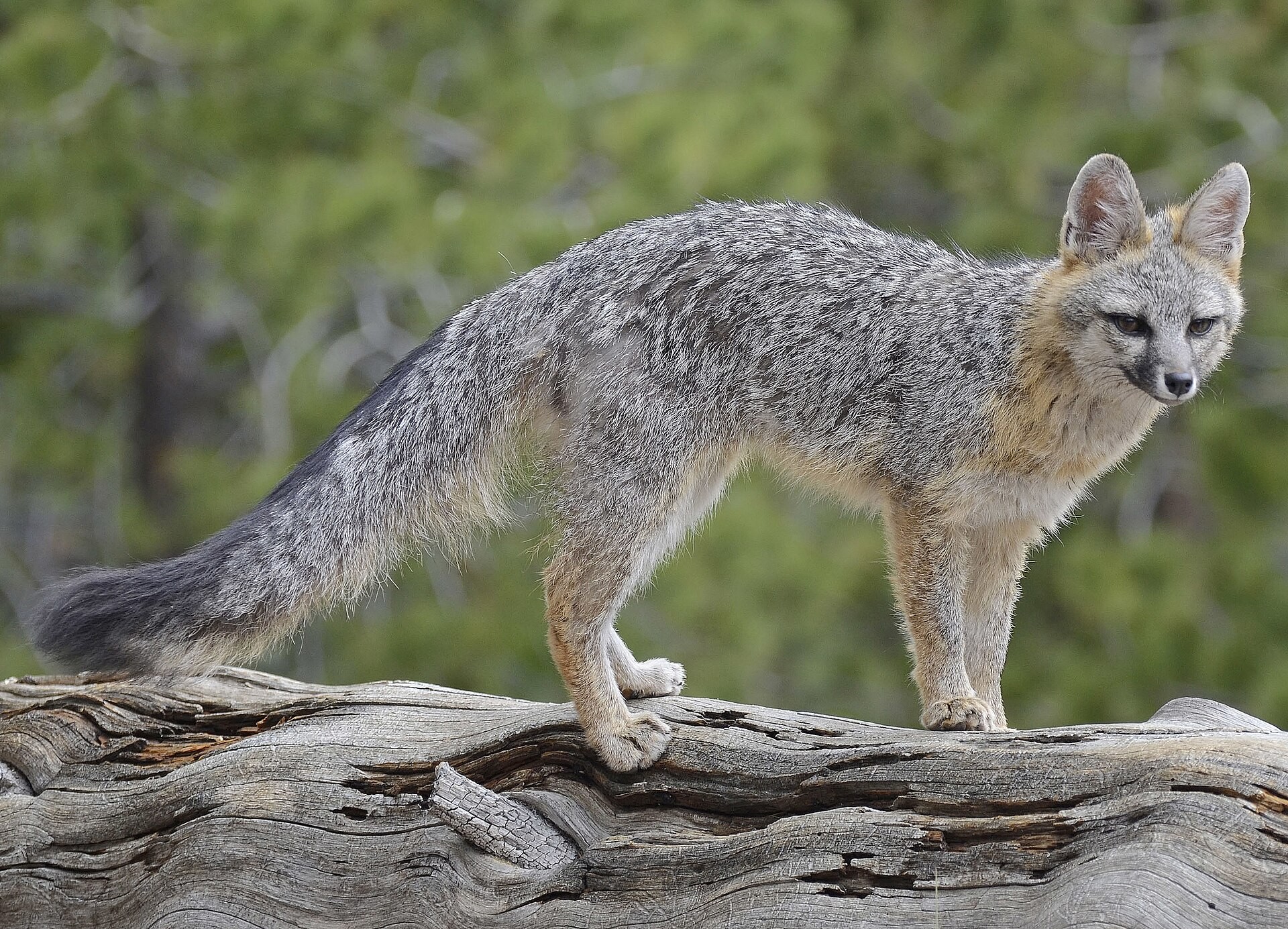
The grey fox, Urocyon cinereoargenteus, is a canid found across North America, occupying deciduous forests, brushy woodland edges, and rocky terrain below 3,000 m in elevation. Its genus, Urocyon, diverged from all other canid lineages during the Miocene, between 8 and 12 million years ago, making it the most basal extant canid lineage on Earth. The grey fox routinely climbs trees, using hooked claws and rotating wrists to ascend into the canopy; den sites have been recorded up to 10 m above the forest floor. Home ranges average 2.1 km², varying between 1 and 7 km² depending on geographic region.
Key facts
- Scientific name: Urocyon cinereoargenteus
- Kingdom: Animalia
- Phylum: Chordata
- Class: Mammalia
- Order: Carnivora
- Family: Canidae
- Genus: Urocyon
- Taxonomic rank: species
- Mass: 86 g
- Gestation period: 63 days
- Main food: tree squirrel; mouse; domestic rabbit; bird
Taxonomy and Evolutionary History
Johann Christian Daniel von Schreber formally described the species as Canis cinereoargenteus in 1775, in his work Die Säugethiere, with the type locality recorded as Carolina and the warmer regions of North America. The species was later moved to the genus Urocyon, which stands apart from all other extant canid genera. Molecular clock estimates place the divergence of the Urocyon lineage from the rest of Canidae at 8 to 12 million years ago, during the Miocene epoch.
Mitochondrial DNA analysis published in 2015 showed that grey fox populations in eastern and western North America are deeply divergent lineages, separated by Pleistocene aridification events. Californian populations carry roots extending approximately 100,000 years back to the previous interglacial period. The island fox (Urocyon littoralis) of California’s Channel Islands is a direct descendant of the grey fox, having reached the northern islands by rafting or human introduction approximately 9,200 to 7,100 years ago.
Physical Characteristics
The grey fox carries 42 teeth, consistent with the dental formula I 3/3, C 1/1, PM 4/4, M 2/3 × 2. Among its more unusual anatomical features is its musk gland, located along the upper surface of the tail. This gland is the largest of any North American canid; in some males it extends more than half the length of the tail, and researchers believe it functions in individual recognition.
Additional scent glands are present on the face and on the pads of the feet. Together with urine and feces deposits, these glands allow a mated pair to mark the perimeter of their entire home range, all travel routes between points within it, and key landmark trees.
Behavior and Ecology
The grey fox is one of the most frugivorous canids in North America, yet it also pursues animal prey including tree squirrels, mice, domestic rabbits, and birds. Its hooked claws and rotating wrists, the same structures used to climb trees for resting and foraging, allow it to chase squirrels directly up trunks rather than abandoning pursuit at the base.
Grey foxes preferentially occupy deciduous forests interspersed with brushy, woodland areas and edge habitats where forest meets open field. Dens are established in hollow trees or logs, in crevices between or under large rocks, and in underground burrows; den sites recorded in the lower forest canopy have been found up to 10 m above the forest floor.
Scent communication more broadly covers the full spatial extent of a pair’s territory. Urine and feces mark ownership and sexual status, while facial, pedal, and tail glands leave chemical signatures at every significant point within the home range.
Reproduction and Life Cycle
Grey foxes are typically monogamous. Male-female pairings form in autumn, with breeding occurring from January through March; pairs may remain bonded for life. The gestation period is 63 days. Parturition peaks in April, with litters ranging from one to seven pups born between March and May; average litter size is 3.8 pups.
Both sexes reach sexual maturity by 10 months of age, soon after dispersal from the family group in the autumn following birth.
Conservation Status and Population Pressures
The IUCN lists the grey fox as Least Concern, with a global population assessed as stable. Periodic threats to local populations include canine distemper, rabies, canine parvovirus, and regulated hunting and trapping for fur.
A 2022 peer-reviewed study published in Ecology and Evolution found that grey fox populations in the midwestern United States have declined, with severe local extirpations coinciding geographically with high occurrence of coyotes and domestic dogs. The mechanism behind this pattern was not resolved in that study and remains an open question.
In October 2024, Virginia Tech researchers deployed more than 400 trail cameras across 40 counties in the Virginia Appalachian mountain region specifically to assess potential population declines in the species. That effort represents one of the most spatially extensive monitoring campaigns targeting the grey fox to date.
Did you know
- The grey fox has scent glands on its face, the pads of its feet, and along its tail. Combined with urine and feces markings, these glands allow a mated pair to label the entire perimeter of their territory, all travel routes within it, and key landmark trees. (discoverwildlife.com)
- Mitochondrial DNA analysis published in 2015 revealed that grey fox populations in eastern and western North America represent deeply divergent lineages separated by Pleistocene aridification. Californian populations carry roots extending approximately 100,000 years back to the previous interglacial period. (ncbi.nlm.nih.gov)
- Despite being one of the most frugivorous North American canids, the grey fox can chase prey such as squirrels directly up trees, using the same hooked claws and rotating wrists it employs when climbing to rest or forage. (2newthings.com)
Data sources
Data updated: 2026-10-29