
144 Lights, All Pointed the Same Way
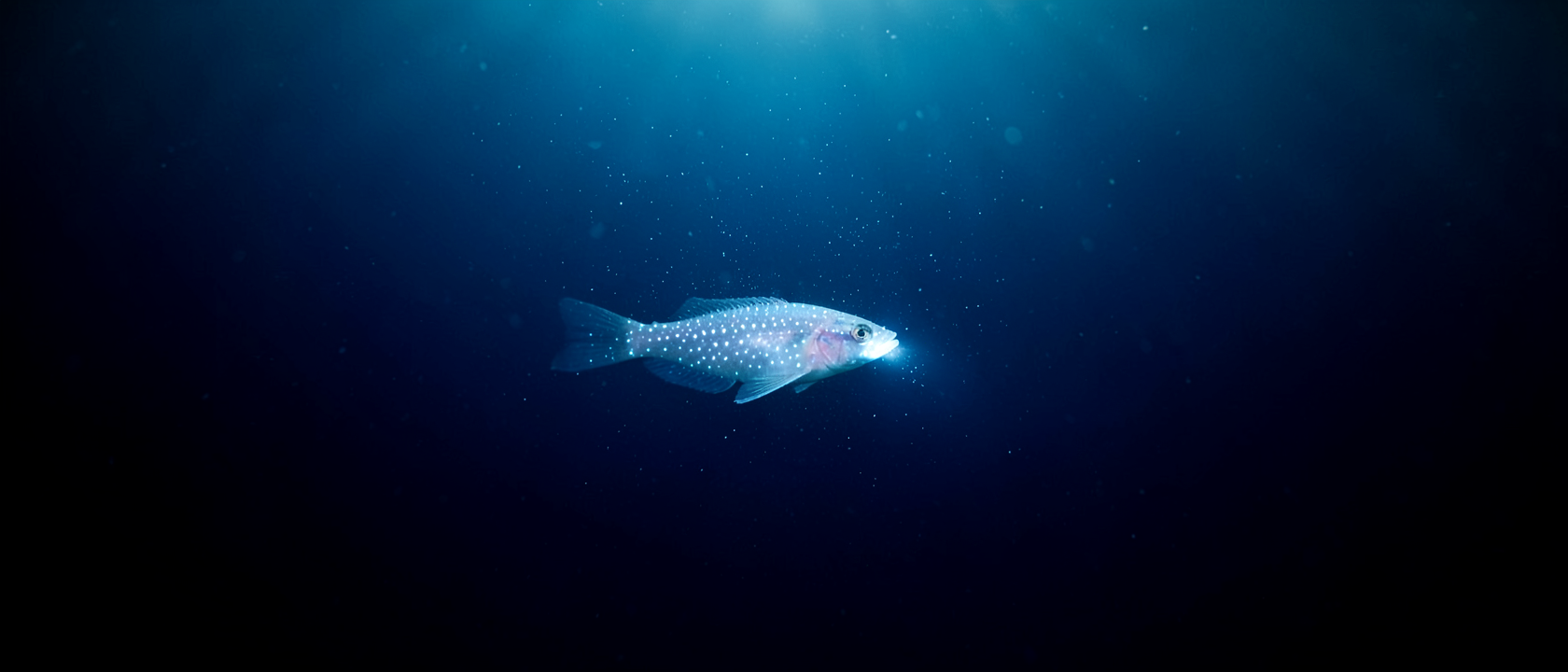
Vinciguerria mabahiss, a mesopelagic fish, meaning it lives in the dim middle layer of open water between the sunlit shallows and the black deep, is found only in the Red Sea and has no common name. A study published in Ichthyological Research in March 2025 gave the species its first close anatomical look. Led by Dr. Todd Clardy, Collections Manager of Ichthyology at the Natural History Museum of Los Angeles County, with co-authors Jinoy Gopalan and Lotfi Jilani Rabaoui, the team examined five juvenile specimens, counting their photophores, light-producing organs, one by one. Each fish carried between 140 and 144 of them, scattered across the head, belly, and sides. Every photophore, on every one of the five fish, pointed down. None aimed sideways. None aimed up. The juveniles measured about 0.24 inches (6.2 mm) long; adults of the species reach roughly 1.1 inches (2.9 cm), small enough to balance on a fingernail while carrying more than a hundred lights, all aimed the same way.
How You Build a Light That Doesn’t Leak
Each photophore turned out to be a small, precise structure, not just a glowing dot. The light itself comes from a bacterial reaction that biologists already understand well. Behind it sits a thick pigment layer that keeps that light from leaking back into the fish’s own tissue. Reflective cells line the organ and bounce the glow outward. A lens at the front focuses it into a single direction. “They have this thick pigment layer to block the light from entering the fish, reflective cells that amplify the light, and a lens that lets the light pass through,” Clardy explains. His team found photophores of three different size classes spread across the body, then ran histological examination, the microscopic study of tissue structure, on all of them. Regardless of size or location, every photophore shared the same four-part composition. That consistency is the real finding: V. mabahiss isn’t improvising a new organ for each body region. It is running one blueprint, copied at different scales, head to tail.
Disappearing From Underneath
Open water offers almost no cover. Clardy sums up the geometry simply: “We live in basically a two-dimensional world,” meaning the danger that matters in the ocean comes from directly above or directly below, rarely from the sides. A predator cruising through open water scans upward, watching for a dark shape crossing the brighter water near the surface. A shadow is a target. The downward-facing photophores of V. mabahiss produce blue light tuned to match the ambient glow filtering down from above, breaking up its own outline so there’s no shadow left to catch anyone’s eye. Researchers describe this as counterillumination, using light to erase a shape precisely from the one angle that threatens it. An even glow spread across the whole body would do nothing for a fish worried only about its underside. Only a precisely downward-aimed light solves that particular problem.
The Anglerfish Comparison Falls Apart
Bioluminescence, the biological production of light, has evolved roughly 27 separate times across the history of fishes, for luring prey, for communication, for finding mates. The image most people carry around is the anglerfish, a lure dangled to pull something close enough to eat. The chemistry and the organ are identical to an anglerfish’s lure. Only the purpose has flipped: V. mabahiss runs the same bacterial glow, the same kind of light-producing structure, toward the opposite job. Its light attracts nothing. It hides the fish producing it, erasing the silhouette rather than advertising one.
Five Fish, One Life Stage, No Answers Yet
Every specimen in Clardy’s study was a juvenile, five fish total, because V. mabahiss is genuinely hard to collect, even for researchers who focus on it. That leaves real gaps. Nobody yet knows what switches the light on or off, or whether the fish actively controls its glow versus running it continuously. Whether adult V. mabahiss keep using the same downward strategy past 1.1 inches (2.9 cm), or shift it as they grow, hasn’t been tested. In related fish, certain photophore types fire in short bright flashes tied to startling predators or signaling between males and females, a pattern nobody has looked for in V. mabahiss at all. Clardy frames the rarity itself as the reason the paper exists: to give other scientists a foundation to build on, for a fish most of them will never get the chance to examine firsthand.