
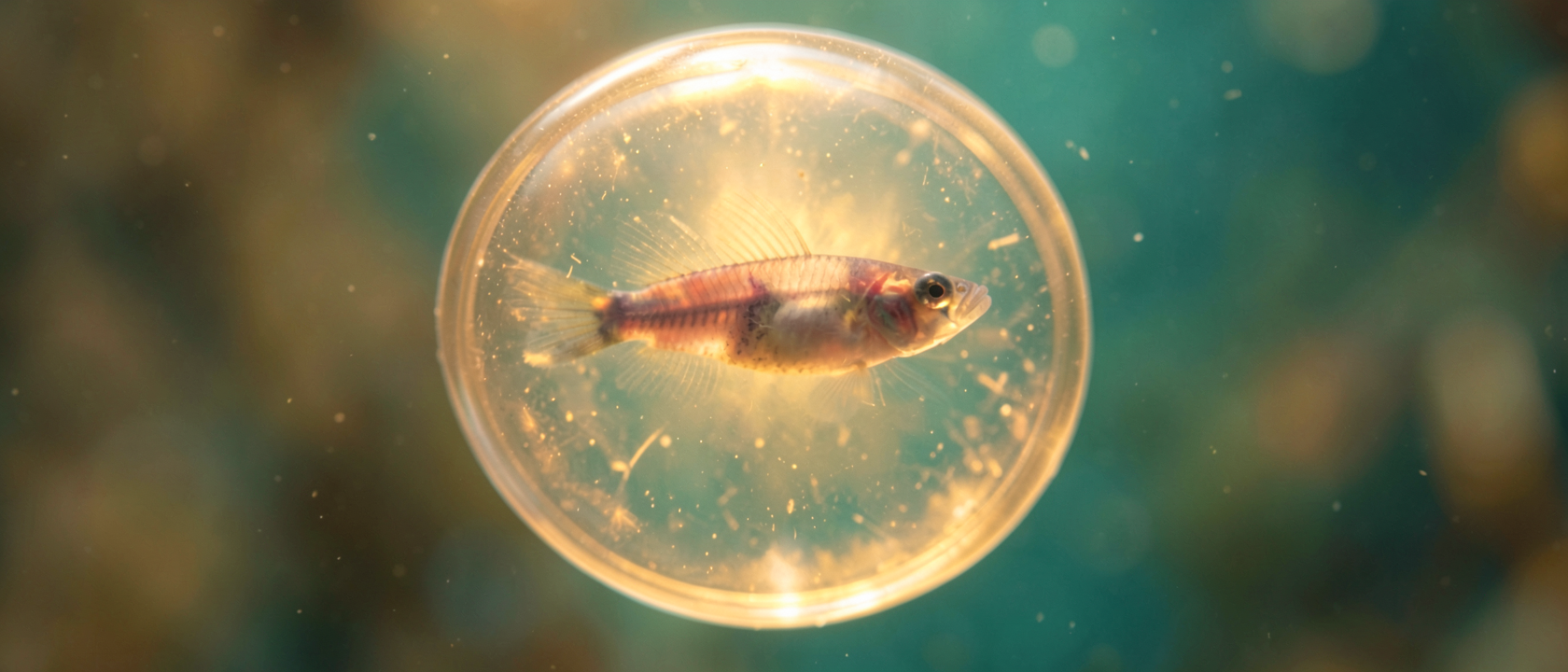
The Egg Decides When It Hatches
A zebrafish (Danio rerio) embryo, still curled inside its chorion (the tough outer wall of the egg), controls the exact moment it hatches by releasing a hormone. That hormone is thyrotropin-releasing hormone, or Trh, the same molecule that regulates the thyroid in humans. In zebrafish, it does something else entirely: it tells the egg wall to dissolve.
The usual assumption is that hatching is a passive event, the embryo simply grows until the shell can no longer hold. A team at the Hebrew University of Jerusalem, led by Dr. Matan Golan of the university’s Robert H. Smith Faculty of Agriculture, Food, and Environment with the Volcani Institute, published in Science in 2024, found the opposite. The embryo isn’t waiting for the shell to fail. It is releasing the exact signal that makes it fail, on its own timetable.
How a Hormone Opens a Shell
Trh is made in the embryo’s own brain and travels through its bloodstream to a structure called the hatching gland. There, it triggers the gland to release enzymes that break down the chorion from the inside out. In zebrafish, that job falls to a single enzyme called ZHE1. Once the wall is thin enough, the larva pushes free.
The team confirmed the hormone’s role by breeding zebrafish carrying one working copy of the Trh gene and one broken copy; those fish grew up and bred normally. Embryos that inherited two broken copies developed fine inside the egg and then simply couldn’t get out. They died there, chorion intact, unless researchers applied Trh directly, which was enough on its own to trigger hatching.
What runs the whole operation is a neural circuit that doesn’t exist for most of the embryo’s life. Immunostaining, a lab technique that lights up specific proteins so they show up under a microscope, revealed a small brain circuit that assembles itself just before hatching and disappears shortly after. It is built to fire exactly once, then it is gone.
Two Fish, 200 Million Years Apart, Same Trick
The Hebrew University team found the identical Trh-triggered signal in medaka (Oryzias latipes), a Japanese rice fish whose lineage split from zebrafish more than 200 million years ago. The two species don’t hatch the same way at all. Zebrafish break out of a thin chorion after two to three days as free-swimming larvae. Medaka, better provisioned with yolk, stay inside a tougher chorion for about seven days and emerge as young fish already able to feed. Medaka hatching enzyme isn’t a single protein but two, MHCE and MLCE, working in tandem, versus the lone ZHE1 in zebrafish.
Different gland, different enzymes, a different internal clock. And yet in both species, a transient brain circuit forms right before hatching, releases Trh, and vanishes right after. That kind of match across 200 million years of separate evolution isn’t the kind of thing that happens to a minor detail. It suggests that having a switch for your own exact moment of birth was worth keeping, even as everything around it, glands, enzymes, timing, was rebuilt from scratch twice over.
What Nobody Knows Yet
The Hebrew University researchers haven’t pinned down what actually triggers the call to hatch, the internal signal that decides now is the moment. They also don’t know how far the Trh system reaches beyond zebrafish and medaka, and they say studying other species is the next step. Plenty of fish time their hatching to cues that have nothing obvious to do with a hormone: clownfish and halibut wait for darkness, and California grunion wait to be washed out to sea on a tide. Whether Trh sits underneath those triggers too, or whether this is strictly a two-species story, is exactly what the team wants to test next.
There’s a heavier open question sitting next to that one. Warming water is already documented, in separate research, to shift when aquatic embryos hatch. Nobody has yet tested what happens when a hatching system this precisely tuned, built around a single hormonal pulse and a circuit that only exists for a few hours, meets water warmer than the one it evolved in.
The Embryo’s Internal Monologue
None of this is a claim about what a zebrafish embryo perceives or intends. But if it could narrate the decision: two days curled up in the dark, yolk running low, and somewhere a switch flips. Not the thyroid switch this molecule usually runs, a different job for the same hormone. One pulse of Trh, the gland gets the message, the enzymes start eating the wall from the inside. Ruin the shell on purpose, on schedule. Then the circuit that made the whole call quietly deletes itself, job done, never to fire again.