
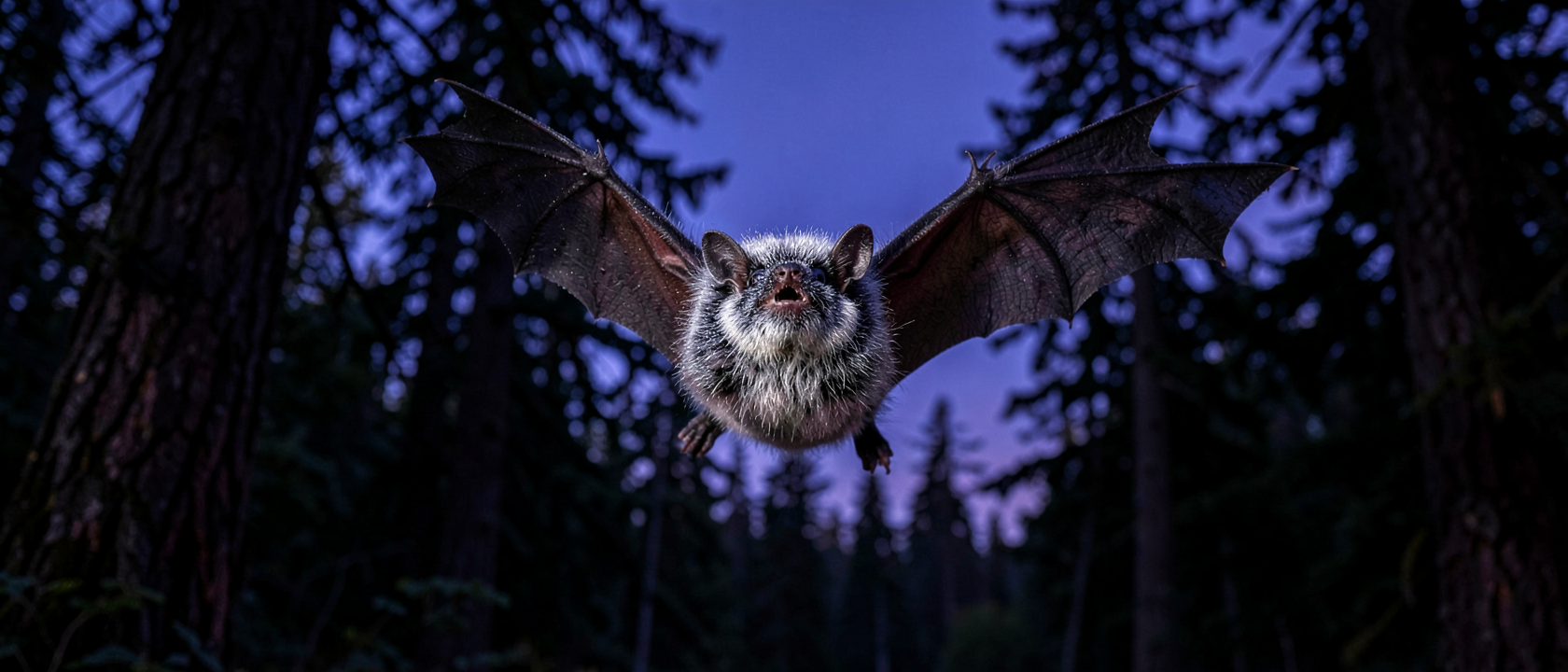
A dolphin can drown, a horse can’t vomit, and a silver-haired bat sings a love song pitched so high no human has ever caught it with a bare ear. The silver-haired bat (Lasionycteris noctivagans), one of the most common bats in the forests of Canada and the United States, produces a structured, three-part courtship song entirely in the ultrasonic range. Nobody noticed for years, until a Canadian biologist slowed a recording down and found a song hiding inside what sounded like static.
It’s an unremarkable-looking animal to be hiding a secret like that. Black fur, including the wings and ears, tipped with white hairs that give it a frosted look; a wingspan of about 10.6 to 12.2 inches (27 to 31 cm); a body about the weight of six playing cards. It ranges from southeastern Alaska in summer down to northeastern Mexico in winter, which means the sound at the center of this story isn’t a local oddity. It’s happening across most of a continent.
A pattern near an abandoned mine
In winter 2010, biologist Cori Lausen was recording bat activity near an abandoned mine in British Columbia, the kind of site silver-haired bats use as a hibernaculum, a shelter where they spend the winter. Night after night, her bat detector, a device built to pick up and translate ultrasonic calls into something researchers can actually analyze, kept registering the same odd pattern. It came too fast and too regular to be ordinary echolocation, the click-and-listen navigation bats use to find insects and dodge obstacles. It had structure, like something built from parts rather than one sound on repeat. Lausen logged it for years before anyone outside her team paid much attention. The detail worth sitting with: this is one of the most common bats on the continent, and it had apparently been doing this the entire time, unheard.
What the slowed-down recording reveals
The pattern breaks into three distinct parts: a steady lead tone, a sound that resembles water dripping, and a closing burst of repeated chirps. At the speed and pitch a silver-haired bat actually produces it, none of this reaches a human ear. It lives entirely in the ultrasonic range, which is why a bat detector is needed just to register that the sound exists at all. Slow the recording down, and the three parts resolve into something with real melodic shape, structured enough that Lausen and her co-authors described it formally in Wildlife Society Bulletin in December 2023. The bat didn’t have to evolve anything new to pull this off, as far as anyone can tell from the recordings; it simply had the capacity to sing all along, pitched somewhere humans were never built to hear.
Why it counts as song, and not just noise
A sequence of sounds isn’t automatically a song, and that distinction kills a common assumption: that any repeated animal call, mating-related or not, counts as “song.” Mike Smotherman, a biologist at Texas A&M University, draws the line at structure instead: a true song is built from distinct syllables that carry meaning, not a single call looped over and over, the way a frog calls. By that standard, song is rare outside humans and birds. The bats Lausen recorded were actively mating at the time, which supports the idea that this three-part pattern functions as courtship, rather than echolocation or alarm. Only one other North American bat had been documented singing before this study, the Mexican free-tailed bat, which makes the silver-haired bat the second confirmed case on the continent; several European bat species are known singers too, but on this continent, the company is thin. Only a handful of mammals do anything like what songbirds do, and on this continent, this bat is one of them, singing a melody you will never catch at a campsite no matter how quiet the night gets.
What nobody has figured out yet
Confirming the structure doesn’t answer the obvious next questions. Lausen’s team doesn’t yet know whether males sing, females sing, or both; the recordings alone don’t say. Courtship may not even be the song’s only job. Some of these songs turned up outside the period when silver-haired bats are known to mate, which keeps the courtship explanation from being a sure thing, and Lausen has also noted cases of lone bats singing with no other bat anywhere nearby, a pattern she says leaves the researchers genuinely puzzled.
There’s a practical edge to the uncertainty. If these songs turn out to reliably mark where silver-haired bats are active, they could, in theory, help researchers map populations of a species currently being assessed as endangered by Canada’s Committee on the Status of Endangered Wildlife, information that matters because bats are killed by wind turbines in large numbers. None of that is established yet. It’s a listed gap, not a guess dressed up as one.
The armpit story
Field work looked different before current handling protocols existed. Lausen remembers a once-common fix for warming up a captured bat before release: tuck it under your own armpit until it was ready to fly again. One of the graduate students she watched do exactly that is, she jokes, now her husband. It’s one researcher’s memory of how the work actually got done before anyone wrote the rules down, not a method and not a recommendation.