
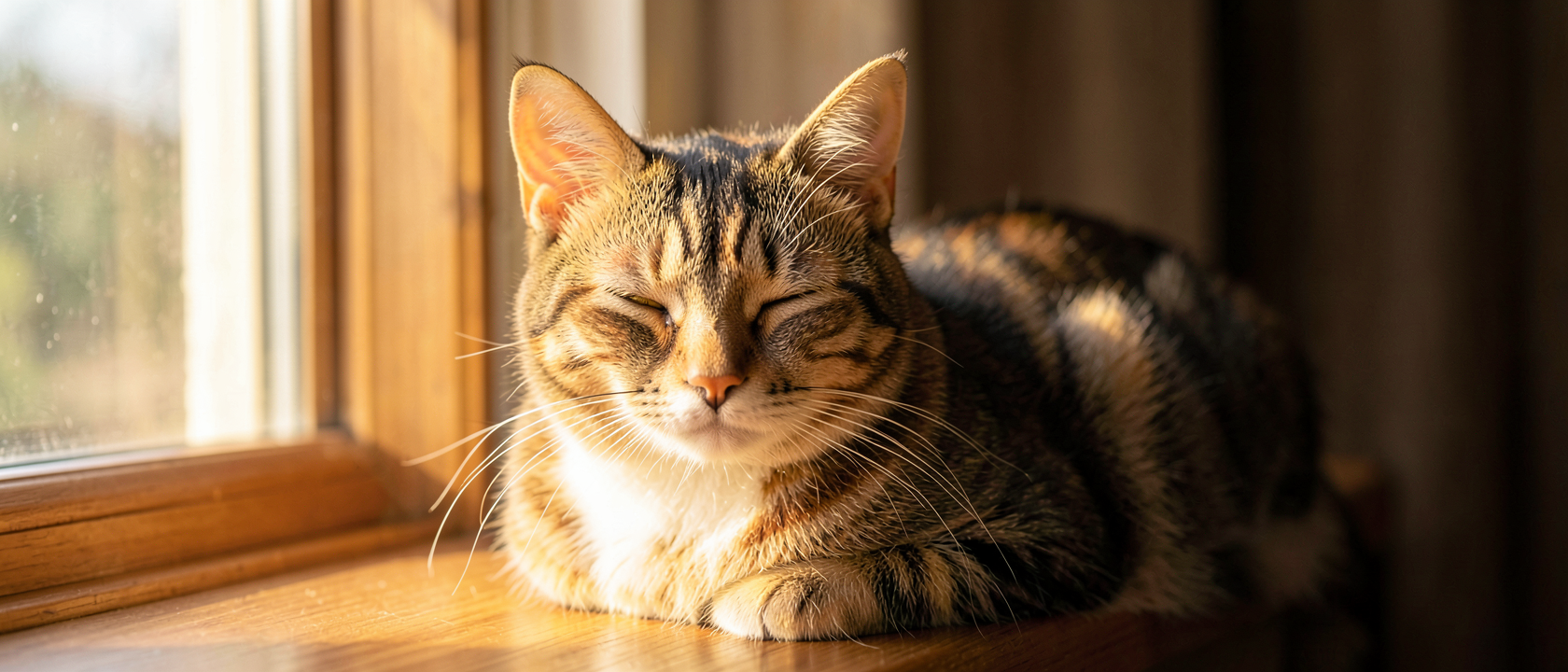
A cat that has known you for five minutes can still smile at you. In a 2020 experiment, cats met a researcher they had never seen before, got a slow blink and an open hand, and slow-blinked right back, then walked toward that stranger’s palm. No history, no bond, same gesture people assume a cat saves for its favorite human.
The Cat Smile Experiment
The Fact: Strangers Get the Same Smile
Psychologists Tasmin Humphrey and Karen McComb, working with Leanne Proops, Jemma Forman, and Rebecca Spooner at the University of Sussex, ran the first controlled experiment on slow blinking as cat-to-human communication, published in Scientific Reports in 2020. In the first experiment, 21 cats from 14 households sat about 3 feet (1 meter) from their own owners, who slow-blinked at the cat each time it looked their way while cameras recorded both faces. The cats slow-blinked back more often than they did in a no-interaction control. Then came the part that changes the story. In a second experiment, 24 cats from eight households met a researcher none of them had ever seen before. That stranger slow-blinked and held out a hand, compared against a condition where the stranger simply stared at the cat without blinking. The cats slow-blinked back at the stranger too, and they approached the outstretched hand more often after a slow blink than after a plain stare. Familiarity wasn’t what drove the response; the gesture was doing the work on its own.
The Mechanism: Why a Half-Closed Eye Isn’t a Threat
Cats already narrow and soften their eyes when they’re relaxed and not performing for anyone. The eye closures the researchers tested ran longer than half a second, long enough to read clearly on camera, and the experimenters demonstrated the motion to each participant beforehand, coaching them on how to perform it convincingly. What seems to make the gesture legible, the team suggests, is contrast with the one expression cats are wired to read as dangerous. A sustained, open-eyed stare is the posture of a threat, the look a predator or a rival holds while sizing you up. A slow blink can’t be that, because for a moment the eyes are shut and the animal sending the signal is looking at nothing. That brief blindness is a small, visible cost, and it’s probably exactly what makes the gesture trustworthy: an animal on guard wouldn’t willingly give up its view of you. The slow blink isn’t decoration layered onto ordinary cat behavior. Structurally, it’s the opposite of a stare, built from the same eye muscles pointed the other way.
The Second Why: Built In, or Trained Into Us?
Humphrey and McComb are upfront that the study doesn’t settle where the gesture came from. One hypothesis is that slow blinking started as a way to interrupt a stare and signal that no threat is intended, something built into feline behavior long before humans entered the picture. The other is that it’s a byproduct of living alongside us: cats that happened to slow-blink got calmer, friendlier responses from the people around them, and the behavior got reinforced generation after generation because it worked. The researchers don’t choose between the two, and they’re careful not to claim a slow blink means affection the way a human would mean it. As with a lot of domesticated-animal behavior, both forces could be running at once, instinct supplying the raw material and reward sharpening it over time. McComb, who is both a researcher and a cat owner, has said she’s glad to be able to show that cats and humans can communicate this way. How the mechanism actually arose stays an open question.
The Myth: “Aloof” Was Never the Right Word
Domestic cats get filed under aloof: the pet that tolerates a household rather than engaging with it, a reputation dogs usually get credited with disproving instead. This experiment doesn’t fit that story. The cats in the second group initiated and returned a specific social signal with a person they’d met moments earlier, with no bond and no history to draw on. Humphrey has pointed out that understanding these positive exchanges changes how cats get perceived and has real implications for feline welfare. Separate research on cat behavior has found that cats register the moods of the people they live with and respond more to people who are themselves responsive toward them. A cat slow-blinking at a stranger and then walking toward an open hand isn’t a loophole in feline indifference. It’s what a socially attentive animal looks like when nobody’s filming it for a punchline, and it says something about the kind of attention cats have been paying to us all along, while most of us assumed it ran the other way.
From the Cat’s Side
As far as the cat is concerned, you just failed to stare it down and didn’t attack. Good talk.