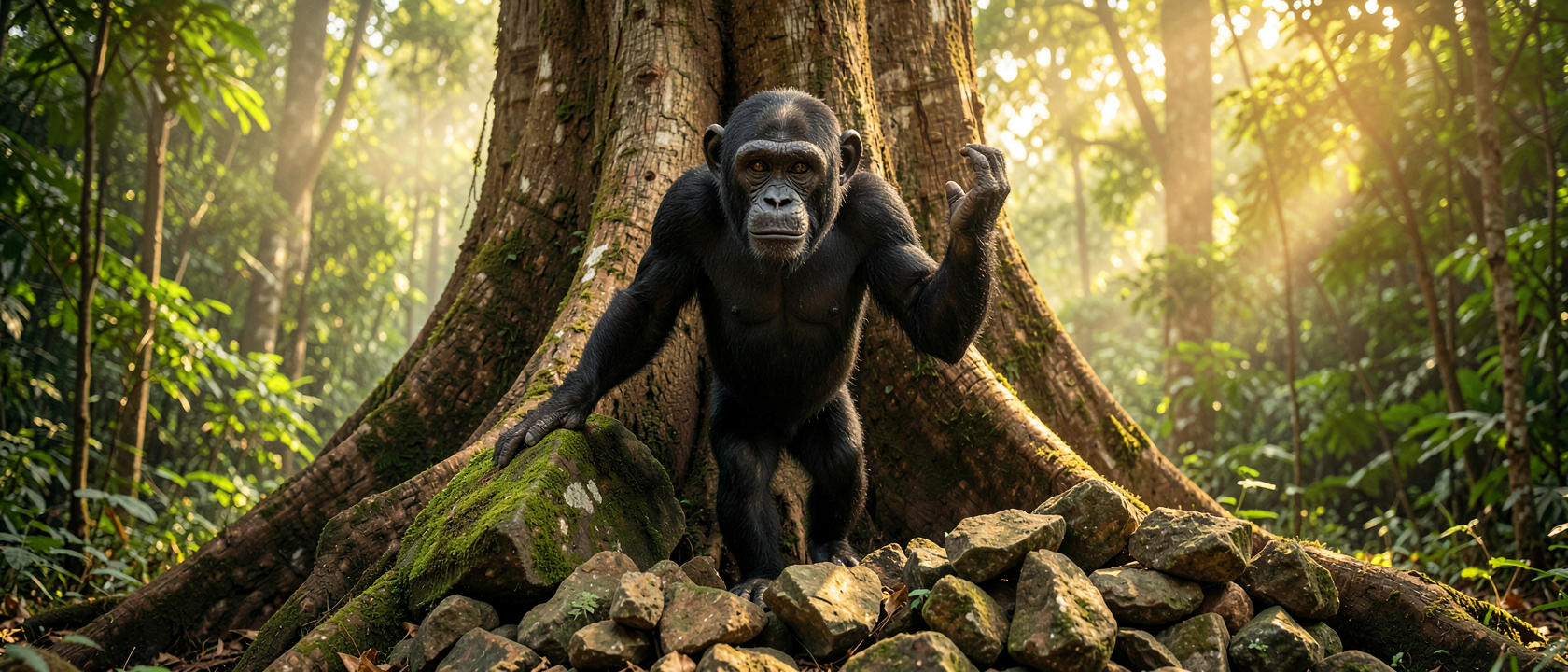
They Keep Coming Back to the Same Trees
Stone piles sit at the base of specific trees in the savanna-woodland of Boé National Park, Guinea-Bissau. The bark above them is gouged and scarred. Some of those piles have been there since the mid-2010s, and the western chimpanzees (Pan troglodytes verus) that built them have been returning ever since. The sites were first documented by the Pan African Programme, revisited in 2017, and confirmed still active during fieldwork in 2026 by Robyn Nakano, a PhD candidate, and Ammie Kalan, an assistant professor in the Department of Anthropology, both of the Great Ape Behaviour Lab at the University of Victoria. Over ten years of repeated, deliberate stone throwing at the same trees, by the same species, at the same locations. The sites persist long after any individual visit ends.
The chimpanzees are not cracking nuts or processing food. Rocks are there because individuals keep picking them up and hurling them at specific trees, hard enough to scar the bark. What remains, after a decade, looks very much like a monument, even if the piles themselves stay largely the same size, each visit adding one more stone to a collection that was mostly already there.
How You Hurl a Rock, and Why That Matters
The throwers are almost always adult males. When they throw, they pant-hoot and some perform buttress drumming, striking the flanged root bases of large trees with hands and feet to produce deep, resonant booms. Both behaviors are established components of the male display repertoire. Accumulative stone throwing fits the same logic: it is loud, it is forceful, and unlike a vocalization or a drumming session, it leaves something behind. The scarred bark and the persistent pile remain long after the chimpanzee has moved on.
In 78 percent of the camera-trap events documented in the original 2016 study by Kühl, Kalan, Arandjelovic, and a team of roughly 80 researchers, published in Scientific Reports (vol. 6, article 22219), the stones were picked up at the trees rather than carried to them. That single detail reframes the whole picture. The piles are not stockpiles assembled from elsewhere. They are persistent records: each rock represents an individual decision to pick up a stone that was already there and throw it at the same tree again. The pile does not substantially grow, it endures.
To capture who throws and when, and to record how nearby chimpanzees respond, Nakano and Kalan deployed two video cameras at each site, backed by audio recorders. The chimpanzees at Boé are unhabituated, which makes direct observation impossible and the remote setup essential. The goal of the 2026 data collection is to identify the age and sex of individual throwers and, crucially, to document audience reactions: what do the other chimpanzees actually do when a stone hits a tree?
Four Groups in All of West Africa, and the Rocks Don’t Explain Themselves
The behavior has been recorded in only four chimpanzee populations across West Africa. Suitable rocks and large trees are not scarce across this region. If the behavior were simply environmental opportunism, sites would be far more widespread. The pattern of isolated pockets, where behavior persists despite resource availability elsewhere, is how researchers identify a learned, socially transmitted cultural tradition rather than an instinct or a habitat response.
What the behavior accomplishes for those four populations remains unresolved. Researchers have proposed that the sites mark important territorial locations, functioning as durable signals to neighboring groups. They have proposed that the sound of a heavy rock hitting a tree communicates something about the thrower’s size or vigor. Some researchers have cautiously raised the word “symbolic”: a behavior carrying meaning beyond any immediate, practical payoff. If wild chimpanzees maintain a learned tradition that physically marks the landscape across a decade, then the evolutionary conditions behind human stone use, monument building, and non-utilitarian communication look less like a sudden departure and more like a gradient with deep roots.
Stone Tools Were Supposed to Be About Food
The working model of primate stone tool use, built from decades of field research at sites including Bossou in Guinea and Taï Forest in Côte d’Ivoire, is almost entirely utilitarian. Chimpanzees crack hard-shelled nuts with hammer stones, process foods, and occasionally dig. The cognitive significance attached to these behaviors rests on dietary return: the animal uses the tool, gets a calorie, and natural selection keeps the behavior circulating.
Accumulative stone throwing does not fit inside that framework. The behavior produces no food and costs real energy. By any strict utilitarian accounting, it is a net loss. The sites at Boé do not amend the existing model of chimpanzee stone use; they sit in a different category entirely. The utilitarian framework was never the complete picture, it was just the only picture researchers had found until the Pan African Programme set up its first camera traps at Boé in the mid-2010s.
What It Means to the Chimpanzees, Nobody Actually Knows
The 2026 video and audio data are still being analyzed. No published finding yet establishes how nearby chimpanzees respond to a stone-throwing event at Boé, whether groups other than the builders visit the existing piles, or what an individual’s behavior looks like approaching an active site versus a neutral tree. The supplementary materials from Kühl et al. (2016) include footage of at least one adult female performing the behavior at Boé, though whether females participate regularly has not been established.
Researchers have the “what” with high confidence: specific sites, repeated visits, durable accumulations, a ten-plus-year time span. They have the “how” well supported: adult male display behavior extended into a physical and lasting channel. What keeps this tradition alive across generations remains open. The answer will likely require years of follow-up observation, and the honest account of what is known stops, for now, at the piles themselves.
A Long Hike into the Savanna, and Then a Bore Hole
To reach the Boé study sites, Nakano, Kalan, and field assistants cycled and hiked deep into the savanna-woodland of Guinea-Bissau, establishing a bush camp beside a river. While the team was positioning camera traps beside those accumulations, they found the ground punctured with bore holes from active bauxite mining exploration.
The IUCN uplisted the western chimpanzee from Endangered to Critically Endangered in 2016, following a population decline of approximately 80 percent between 1990 and 2014. Cultural sites active for over a decade sit inside the footprint of ongoing mineral extraction. That detail does not need a caption.