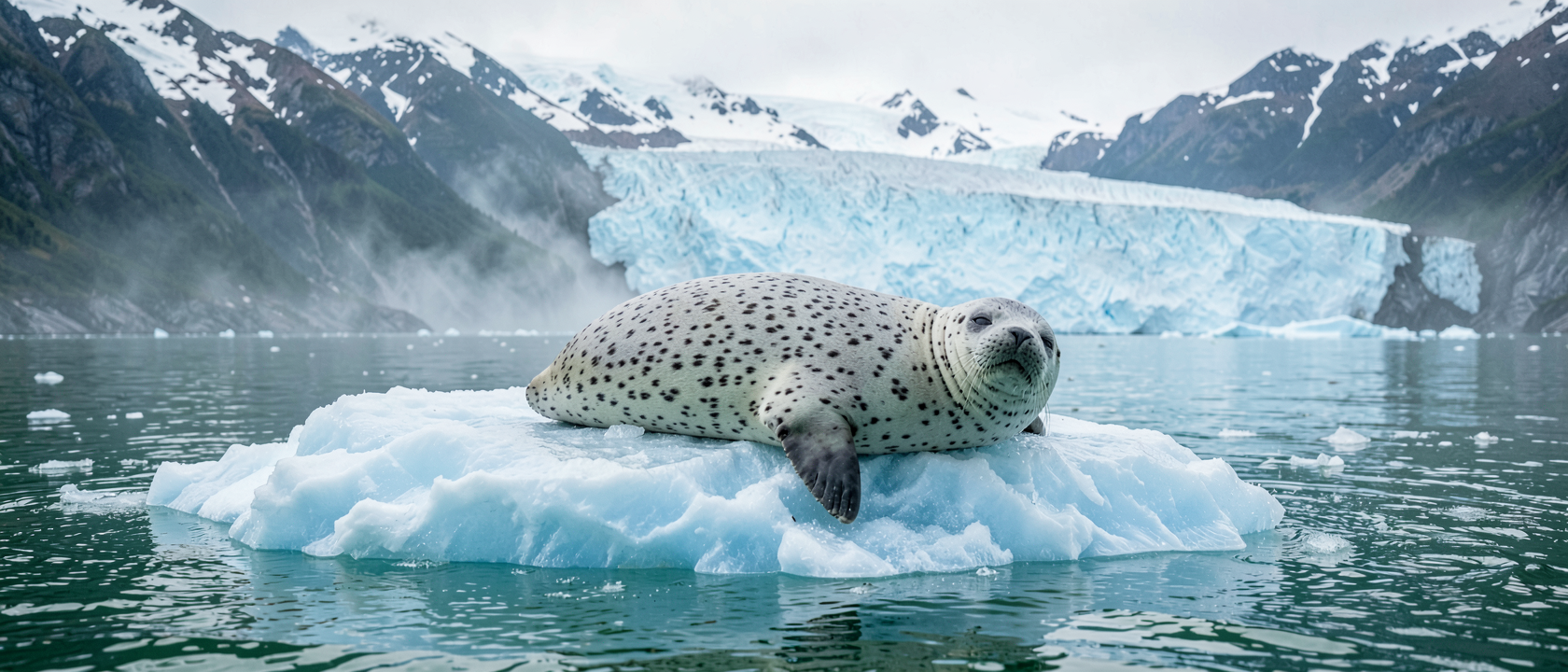
The Fact: Seals Are Picky About Ice
A harbor seal (Phoca vitulina) in Johns Hopkins Inlet, Alaska, does not climb onto the nearest floating iceberg. It picks one that matches the job it has that month. Lynn Kaluzienski, a postdoctoral fellow at the University of Alaska Southeast working with U.S. National Park Service collaborators, tracked this by flying aerial photo surveys along fixed routes through the fjord, with each non-overlapping frame covering about 262 by 394 feet (80 by 120 meters) of ice and water so no seal got counted twice. The team presented the findings at the American Geophysical Union’s 2024 Annual Meeting in Washington, D.C. on December 10, 2024. In June, at the height of pupping season, seals hauling out, climbing from the water onto ice to rest, stuck mostly to icebergs drifting slower than roughly 7 to 8 inches per second (0.2 meters per second). By August, during molting, when the seals shed and regrow their coat, the same population had largely shifted onto faster-moving bergs sitting in or sweeping through the glacier’s meltwater plume, a jet of runoff pushing up from the glacier’s base. The rulebook for what counts as good ice had rewritten itself in six weeks.
The Mechanism: What Makes Ice “Good”
Speed is the variable that gives the pattern away. A berg’s speed and path come from wind, ocean currents, and that plume of freshwater streaming out from under the glacier. The researchers propose that a slow berg, crawling under 7 to 8 inches per second, barely rocks, and they suggest that stillness matters most when the cargo on board is a newborn pup still learning to swim and regulate its own body heat. A fast berg, by that logic, is a worse nursery for the same reason: more motion, more chance of a pup sliding into water it is not ready for. But speed doubles as a location tag. The fastest-moving bergs tend to be the ones caught in that plume, and the plume, being more buoyant than the salty fjord water around it, rises as it spreads and drags plankton and small fish up toward the surface on the way. Fast ice sits near the food. Seals are not choosing “fast” or “slow” as a taste. They are choosing stability in June and a short commute to dinner in August, and iceberg speed happens to be the one visible clue that tracks both.
The Second Why: Different Jobs, Different Furniture
A nursery and a feeding platform do not want the same thing from a slab of ice. In June, the entire problem is keeping a pup out of open water until it can handle it, so a calm, slow-drifting berg wins even parked nowhere near food. By August, that pup is more independent, and the adults are deep in their molt, a process that raises how much energy their bodies burn just maintaining themselves. At that point, a smooth ride matters less than a short swim to a plume loaded with plankton and fish. Kaluzienski has framed the work as drawing a direct line between the glacier’s physical behavior, how fast its ice moves and where that ice ends up, and how the seals living off it change their habits within a single season. What looks like the same drifting patch of ice is, for the seals using it, two different pieces of furniture depending on the calendar.
The Open Question: A Glacier Doing the Opposite of Everyone Else
Johns Hopkins Glacier is one of the few glaciers on Earth currently advancing instead of retreating, which the researchers link to a wall of crushed rock and sediment at its front, called a terminal moraine, that keeps warmer ocean water from reaching and eroding the ice. That is good news for the glacier and a complication for the seals downstream, because an advancing glacier calves fewer icebergs into the fjord. Fewer icebergs means less of the exact real estate this whole system runs on: slow bergs for June, fast plume-adjacent bergs for August. Kaluzienski and her colleagues do not claim to know how this resolves. What they call for is continued long-term monitoring of how the glacier’s advance, iceberg size, iceberg speed, and overall iceberg supply shift over time, and what that does to where seals can pup and molt safely. That question is still open, not a forecast.
The Joke: House-Hunting on the Ice
Picture a seal mom running two listings six weeks apart, purely for laughs: the June listing wants a quiet cul-de-sac, zero traffic, absolutely no wake. The August listing throws all that out, demanding the penthouse next to the seafood counter, noise be damned. No individual seal is filling out a real estate form, and no single mother was tracked doing this; it is the whole population’s behavior that shifted. But long before anyone drew up a lease, harbor seals in Glacier Bay were already running the numbers on when stillness matters and when proximity wins, and now you know the difference between a nursery and a snack bar the next time someone calls an iceberg just an iceberg.