
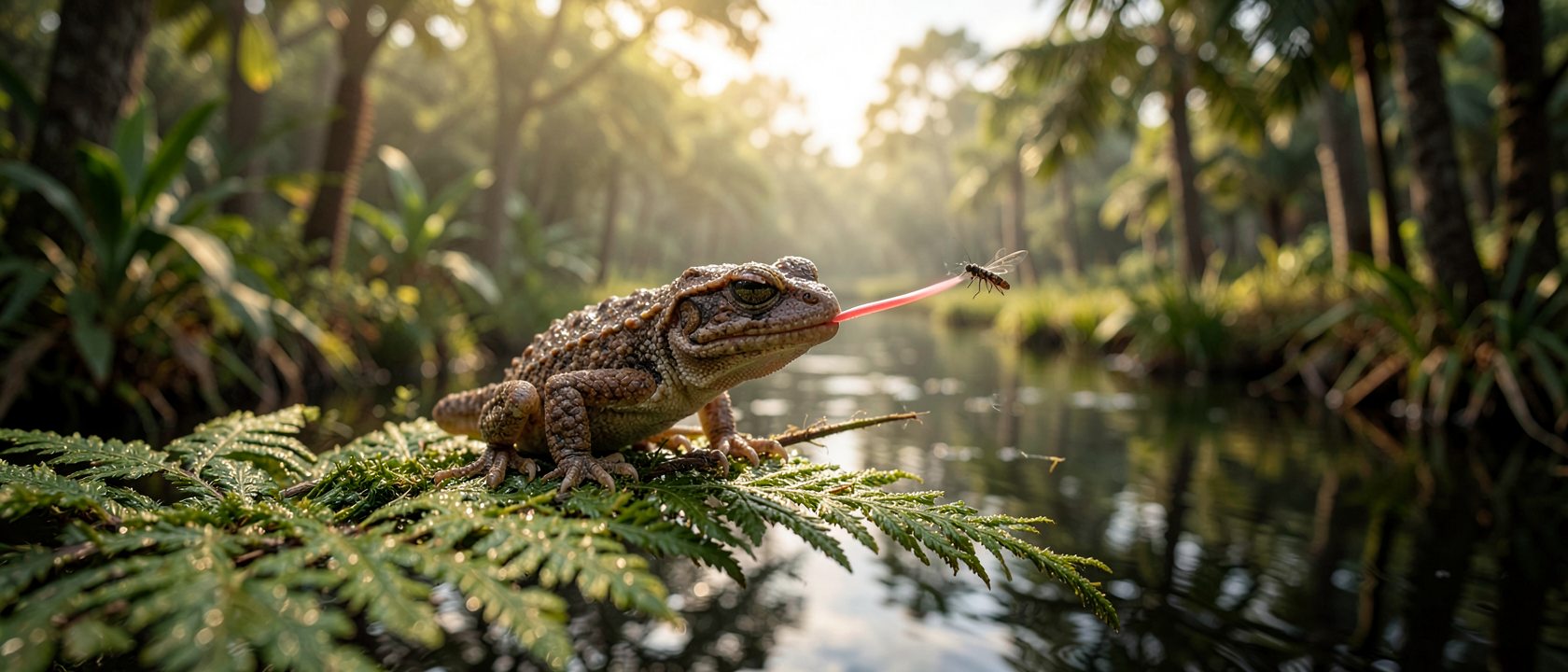
A pea-sized amphibian that hunted like a chameleon
Nabia civiscientrix measured under 2 inches (5 centimeters) long, small enough that one of the type fossils was photographed sitting on a one-cent coin for scale. Its skull anatomy, according to the team that described it, suggests it caught insects with a projectile tongue, the same ballistic strike modern chameleons use. The bones come from the Lourinhã Formation in Portugal, laid down roughly 150 million years ago in the Late Jurassic, in rock that also holds the theropod dinosaur Lourinhanosaurus, the ornithopod Hesperonyx, and the stegosaur Miragaia. The description was led by Alexandre R. D. Guillaume, a PhD candidate at NOVA School of Science and Technology and the Museu da Lourinhã, with Dr. Marc Jones, curator of fossil reptiles at the Natural History Museum in London, publishing the work in the Journal of Systematic Palaeontology.
Nabia civiscientrix belongs to the Albanerpetontidae, an extinct lineage of lissamphibians (the broader group that today includes frogs, salamanders, and caecilians). It looked like a small salamander, with dry, scaly skin, keratin-like claws, and eyelids, but it was not related to salamanders at all. It was doing something normally credited to a much larger, much stranger reptile, one grain of Portuguese sediment at a time.
How you read a feeding strategy off bone dust
Most of the diagnostic bones are smaller than a grain of rice, and some are under 0.04 inch (1 millimeter) wide. Dr. Jones described them as looking almost like tea leaves without magnification. Fragments that thin cannot be studied under an ordinary microscope, let alone by eye, so the best-preserved specimens from Lourinhã were sent to University College London, where Jones and Professor Susan Evans ran them through micro-computed tomography (micro-CT) and X-ray scanning. The process stitches thousands of X-ray slices into a 3D digital model of a bone without ever cutting the fossil apart.
Once assembled, those models let the team examine the skull and the hyoid, the bone that anchors and supports the tongue, in a way no hand lens ever could. What they found in how those bones sit together, the researchers report, matches the bony arrangement that lets a living chameleon fire its tongue at prey. That is an anatomical inference. No fossil freezes a strike in progress; this is a skeleton read for what it was built to do, not a snapshot of it doing it.
Why this fossil finally gets a whole body
Albanerpetontids as a group have mostly been known from scraps, a jaw here, a stray vertebra there, which has left much of their biology stitched together from assumptions. The bone material behind Nabia civiscientrix, from the Guimarota beds of the Kimmeridgian Alcobaça Formation, had been sitting in collections for a long time. Other paleontologists had already suspected it was its own species, but it had been folded into the genus Celtedens until Guillaume’s team’s earlier work on a single skull bone, the frontal, challenged that placement.
This paper finally gives it a body: 468 bones from the Lourinhã Formation alone, plus thousands more from Guimarota, reassembled into one of the more complete anatomical reconstructions ever made for this group. That completeness let the researchers revise the anatomy properly instead of patching together guesses, and it makes Nabia civiscientrix the oldest known albanerpetontid on the Iberian Peninsula, one of the oldest in the world, and potentially the third species of its kind described from the Jurassic anywhere, a data point for an entire lineage of small amphibians that lived underfoot among dinosaurs for tens of millions of years.
What the bones don’t tell us yet
The chameleon comparison sits at the level of overall skull and hyoid architecture, the bones lining up the way they do in an animal built to launch its tongue. The paper does not go further than that. It does not specify which joint locks, which bone triggers the strike, or how the launch was powered; the finer mechanical details simply are not described yet.
The researchers are also explicit that the genus Celtedens, which Nabia civiscientrix was pulled out of, still needs a full revision, since other specimens once assigned to it may or may not belong there. Both gaps are flagged honestly rather than filled in with speculation: how the tongue actually fired, and exactly which older fossils are which species.
Named for the people who dug her up
Most of the bones behind this description did not come from a professional dig crew with brushes and grid squares. They came out of the Micro Saurus citizen science project, run jointly at DinoPark Lourinhã and the Museu da Lourinhã, where volunteers sift fossil-bearing sediment for fragments too small to notice by accident.
The species name repays that debt directly: civiscientrix, “she who practices citizen science,” paired with Nabia, borrowed from a pre-Celtic river goddess for the wetland the animal lived in 150 million years ago. The same close, patient attention that makes someone stop scrolling to figure out what an animal was actually doing is the instinct that put a name on a Jurassic amphibian’s chameleon-style tongue.