
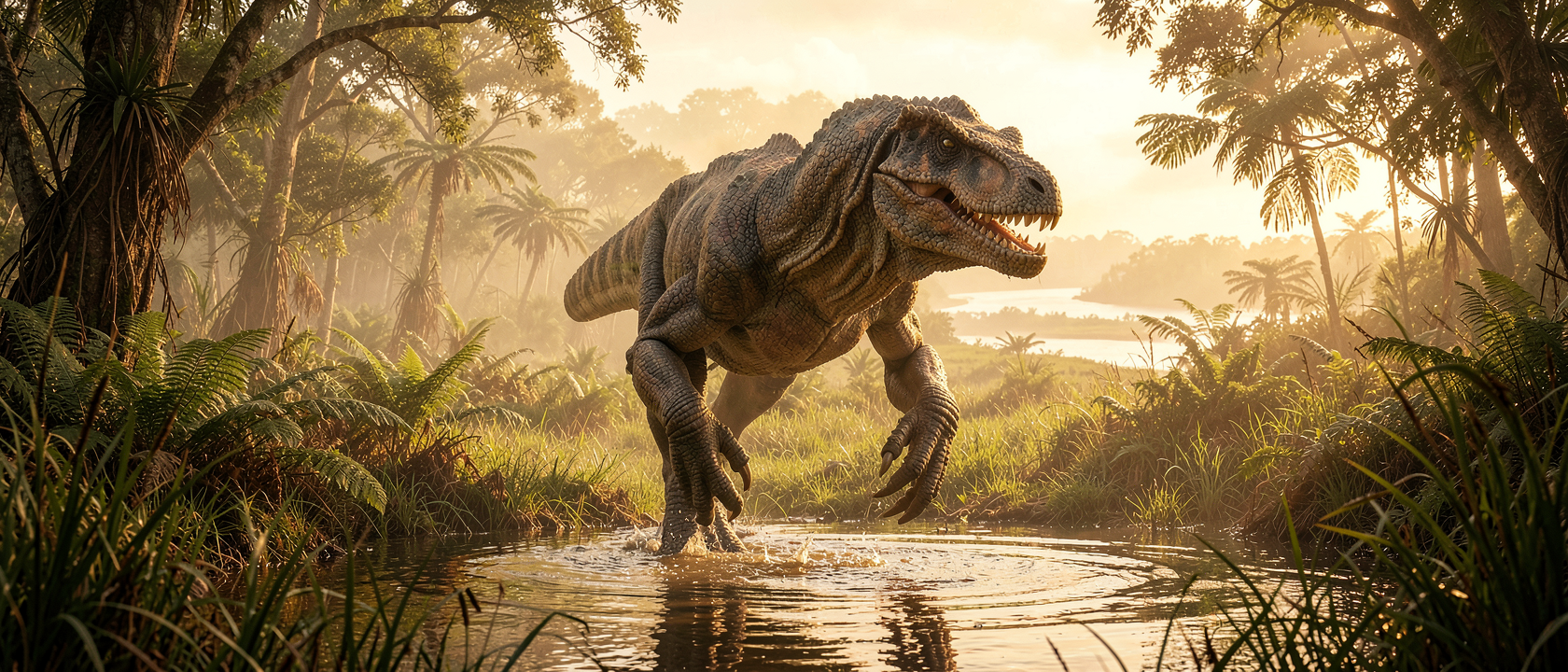
A 7-Meter Predator, Caught Mid-Bite
Joaquinraptor casali was a megaraptorid, part of a group of large, clawed, meat-eating theropod dinosaurs known mostly from South America, and it measured more than 23 feet (7 m) long while weighing over 2,200 pounds (1,000 kg). Paleontologists Lucio Ibiricu, of Argentina’s Patagonian Institute of Geology and Paleontology, and Matthew Lamanna, of the Carnegie Museum of Natural History, describe the species in a 2025 paper in Nature Communications, drawn from rock in Chubut Province dated to roughly 66 to 70 million years old, right at the end of the Cretaceous. The skeleton, first noticed in 2019 and excavated over the seasons that followed, preserves about 20 percent of the animal, including its skull, jaws, forelimbs, ribs, and part of its tail. That makes it one of the most complete megaraptorid skeletons ever recovered. A look at the internal structure of its shin and rib bones shows it was sexually mature and at least 19 years old when it died. None of that is the headline. The headline is what was still wedged between its teeth: the forelimb bone of a crocodile relative.
Why the Bone Isn’t Just Debris
A stray bone lying near a skull wouldn’t normally prove anything. Floodplain rivers mix and jumble remains from animals that never crossed paths in life. What makes this case different is what was there, and what wasn’t. The crocodylian forelimb bone sat in contact with Joaquinraptor’s teeth, in the exact position it held before the fossils were separated in the lab. A short distance away lay a second bone from the same crocodilian limb, its thigh bone. Nothing else turned up nearby: no scattered debris, no remains from any other animal. Ibiricu’s team reads that pattern as the signature of gentle-flowing water. A violent current scatters bones the way a flood piles up driftwood, mixing them in from everywhere; calm sediment lets a partly connected limb settle close to wherever it was dropped. That distinction is what separates “a crocodile happened to die nearby” from “this predator was still holding its last meal.”
What a Mouthful of Bone Confirms
Megaraptorids are built like grabbers: a long, low snout lined with serrated teeth, and forearms ending in two oversized, curved claws on the innermost fingers of each hand. Paleontologists have read that anatomy as a hunting toolkit for years, mostly by comparison, because so few megaraptorid skeletons survive complete enough to test the idea directly; the study authors themselves point to a lack of complete fossils as the field’s main obstacle. Federico Agnolin, of the Bernardino Rivadavia Argentine Museum of Natural Sciences, who was not involved in the research, said the new species fills a major gap by offering one of the most complete skeletons found so far. The lineage is thought to sit close to tyrannosaurs on the theropod family tree, yet megaraptorids only flourished in places, like Cretaceous Patagonia, where tyrannosaurs never showed up. Lamanna frames the contrast plainly. Tyrannosaurus rex hunted with a massive skull, bone-crushing teeth, and stunted arms. Joaquinraptor hunted with longer jaws, smaller teeth, and huge grasping forearms. Those are two different anatomical answers to the same evolutionary problem, how to kill and hold onto something bigger than yourself, worked out an ocean apart, with no tyrannosaur ever setting foot in Patagonia to compete with it. Most evidence for what an extinct predator ate comes from bite marks left on someone else’s bones. A mouth still closed around the meal is rarer proof, and it’s what turns a skeleton into a record of how an entire predator filled the role tyrannosaurs held everywhere else.
Whose Leg Was It, Really?
Ibiricu’s team is careful to call this a strong hint, not a verdict. An unlikely coincidence, a crocodile carcass settling by chance against a dead predator’s skull, in exactly the gentle current that would also explain a genuine meal, can’t be ruled out. The identity of the crocodile relative is unconfirmed too. Kostensuchus atrox, a crocodile relative described separately by paleontologist Novas and colleagues from rock of a similar age, is a candidate only because the dates line up, not because anyone has matched the bone to that species. Ibiricu describes the analysis as ongoing. Two larger questions stay open as well: exactly how megaraptorids hunted, and where they sit on the theropod family tree, both unresolved mainly because so few skeletons this complete exist to check them against. What killed this particular animal, more than 19 years old and apparently still capable of growing, is also unknown.
A Sliver of Bone in the Dirt
The whole discovery started with almost nothing. During a 2019 survey of Cretaceous rock in Valle Joaquín, team member Bruno Alvarez spotted a bone fragment barely breaking the surface, the kind of scrap that could have belonged to anything. It sent the crew back over multiple field seasons to dig out a 23-foot predator with its last bite still locked between its jaws. Ibiricu has called it one of the most important finds of his team’s career. What that fragment turned into is a rare kind of fossil: not just a skeleton, but a moment, the last few seconds of one animal’s life caught in the jaws of another.