
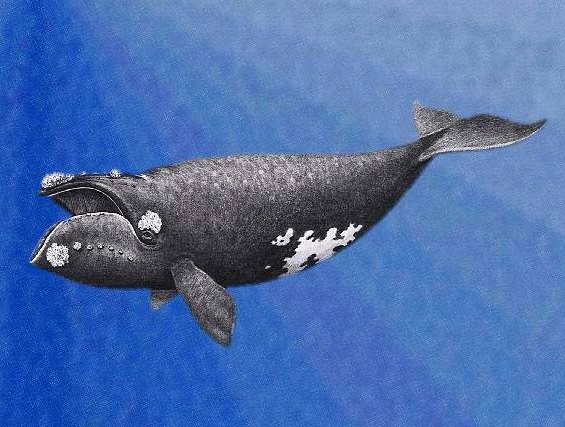
The North Pacific right whale (Eubalaena japonica) is a large, slow-moving baleen whale and one of the rarest marine mammals on the planet. Weighing between 70 and 100 tons and reaching lengths of up to 17 metres, it is built on a scale that makes its near-disappearance all the more striking: as of 2025, the entire photographic identification catalog for the Bering Sea population contains only 31 confirmed unique individuals. Formally described in 1818 by French naturalist Bernard Germain de Lacépède from a Japanese artist’s illustration, the species was for most of its scientific history lumped together with Atlantic and southern right whales under a single name — a grouping that genetic evidence published around 2000 dismantled entirely. What remains is an animal whose wintering grounds are still unknown, whose population numbers remain poorly resolved, and whose recovery, if it is coming at all, has not yet shown up in the data.
Key facts
- Scientific name: Eubalaena japonica
- Kingdom: Animalia
- Phylum: Chordata
- Class: Mammalia
- Order: Cetacea
- Family: Balaenidae
- Genus: Eubalaena
- Taxonomic rank: species
Taxonomy and Classification
Right whales were treated for most of the twentieth century as a single species, Eubalaena glacialis, distributed across three ocean basins. Strong mitochondrial and nuclear genetic evidence published around 2000 overturned that arrangement, supporting three distinct species: the North Atlantic right whale (E. glacialis), the southern right whale (E. australis), and the North Pacific right whale (E. japonica). The International Whaling Commission’s Scientific Committee formally adopted the three-species classification at its 2000 meeting in Adelaide, Australia.
The genetics also produced a surprising result about relationships within the group. E. japonica and E. australis are sister species, more closely related to each other than either is to E. glacialis. The split between North Pacific and southern populations apparently predates the split between either of them and the North Atlantic lineage — a pattern that no morphological study had predicted.
Physical Description
The North Pacific right whale is predominantly black, stocky to an unusual degree, and entirely lacks a dorsal fin. Its head accounts for almost one-third of its total body length, and the body girth can reach 60 percent of total length. Blubber thickness runs up to 71 cm, comprising as much as 45 percent of body mass — a proportion that reflects the species’ adaptation to cold, productive seas rather than any particular layer of insulation beyond what the numbers already convey.
Adult males measure between 14 and 17 metres; females are longer than males. On each side of the upper jaw, 200 to 270 narrow baleen plates approximately 3 metres long hang fringed with fine hairs, the filtering apparatus for the whale’s zooplankton diet. The two blowholes are widely separated and positioned on top of the head, producing the species’ distinctive V-shaped blow reaching up to 5 metres.
Large callosities — patches of raised, roughened skin — are present on the rostrum (the largest, called the bonnet, sits at the top), near the blowholes and eyes, and on the chin and lower lip. The callosity pattern is unique to each individual and does not shift its position throughout the animal’s life, a property that makes it the basis for non-invasive photo-identification by researchers.
Behaviour and Biology
North Pacific right whales are slow: they average 2 knots (3.7 km/h) and can reach a maximum of about 5 knots (just over 9 km/h). They feed by skim-feeding — swimming continuously with the mouth open and straining copepods, euphausiids, and cyprids through the baleen plates. The diet is composed entirely of small zooplankton; the whale covers whatever volume it needs to by simply staying in motion through dense patches.
The species is typically solitary or travels in groups of two to three animals, with larger aggregations recorded during the mating season. Vocalizations include both complex and simple low-frequency sounds. In the Bering Sea, over 80 percent of recorded calls are ‘up-calls’ — frequency-modulated sounds ranging from 90 to 150 Hz and lasting approximately 0.7 seconds. Scientists at the Alaska Fisheries Science Center’s Marine Mammal Laboratory were the first to definitively attribute ‘gunshot’ calls — sharp, loud impulsive sounds — specifically to North Pacific right whales.
Females produce their first calf at an average age of 9 to 10 years, after a gestation period of approximately 12 to 13 months, and calve again roughly every three to five years. Right whales in the northern hemisphere can live to at least 70 years. Age is estimated from ear bones or eye lenses, because right whales lack the teeth used for age determination in other mammal species. Adult animals have no natural predators, but newborn calves are vulnerable to killer whales (Orcinus orca) and large sharks.
Migration and Distribution
Two populations are currently recognised. The eastern population ranges from the Bering Sea to waters off Mexico and Hawaii; the western population inhabits waters from Russia to Japan, including the Sea of Okhotsk. Both populations move to higher latitudes during spring and summer for feeding.
Where either population spends the winter is genuinely unknown. Their exact migratory routes and wintering grounds have not been documented, which means that any threats operating in those areas — entanglement, ship strike, prey shifts — cannot be assessed. NOAA’s February 2024 five-year status review identified this gap in knowledge of wintering distribution as one of the critical needs for the species’ management.
Whaling History
Right whales were the preferred targets of commercial whalers for centuries. They were slow, swam near shore, produced high yields of oil, and — crucially — floated when killed rather than sinking, making retrieval straightforward. The name ‘right whale’ reflects this commercial logic, though some historians argue the word ‘right’ carried the older meaning of ‘true’ or ‘proper’ rather than ‘correct to hunt’.
Whalers extended their efficiency further by exploiting the maternal behaviour of females. Capturing a calf first was a reliable tactic: the mother was unlikely to flee while her calf was held, making her easier to take.
An international agreement to halt right whale commercial hunting was reached in 1931. Neither Japan nor the Soviet Union signed it, and both nations continued legally hunting right whales until the 1949 international whaling regulations came into force. What followed was worse: the Soviet Union conducted an illegal whaling campaign in the North Pacific that was concealed for approximately 40 years until the collapse of the Soviet government. A former Soviet biologist subsequently revealed that hundreds of right whales were killed in the North Pacific between 1963 and 1968. Those kills, taken from a population already reduced by earlier legal hunting, drove the eastern North Pacific population to the state it is in now.
Conservation Status and Current Research
The North Pacific right whale holds endangered status under United States law. In May 2008, NOAA Fisheries designated approximately 95,325 square kilometres (36,800 square miles) of critical habitat in two areas: the southeastern Bering Sea and south of Kodiak Island in the Gulf of Alaska. In February 2024, NOAA’s National Marine Fisheries Service completed a five-year status review confirming that the endangered listing remains warranted and identifying the unknown wintering distribution and emerging threats as priorities for future investigation.
As of 2025, the photographic identification catalog of Bering Sea right whales includes 31 confirmed unique individuals, and the genetics archive holds samples from 32 individuals. These figures reflect the cumulative effort of decades of survey work, not a snapshot of a single season, and they place E. japonica among the most numerically constrained large whale populations known.
Research is conducted by the Alaska Fisheries Science Center’s Marine Mammal Laboratory using year-round passive acoustic monitoring with bottom-mounted recorders, photo-identification, opportunistic boat surveys, and biopsy sampling for genetic analysis. Passive acoustics allow detection in conditions and seasons where visual surveys are impossible, and the ‘up-call’ catalogue from the Bering Sea has provided the best available data on when and where the whales are present — without requiring a single animal to be seen.
Did you know
- The common name ‘right whale’ originated because whalers considered these animals the ‘right’ ones to hunt: they were slow, swam near shore, produced high yields of oil, and floated when killed, making them straightforward to retrieve. Some historians argue, however, that the word ‘right’ simply meant ‘true’ or ‘proper’ rather than commercially optimal. (adfg.alaska.gov)
- Scientists at the Alaska Fisheries Science Center’s Marine Mammal Laboratory were the first to definitively attribute ‘gunshot’ calls — sharp, loud impulsive sounds — specifically to North Pacific right whales. (fisheries.noaa.gov)
- Early whalers exploited the strong maternal instinct of female North Pacific right whales by capturing a calf first; knowing the mother was unlikely to flee while her offspring was held, the whalers could then take her as well. (adfg.alaska.gov)
- The illegal Soviet whaling campaign in the North Pacific was concealed for approximately 40 years until the Soviet government collapsed. A former Soviet biologist subsequently revealed that hundreds of right whales were killed in the North Pacific between 1963 and 1968. (kids.kiddle.co)
- Neither Japan nor the Soviet Union signed the 1931 international agreement to halt right whale commercial hunting. Both nations continued to legally hunt right whales until the 1949 international whaling regulations came into force. (adfg.alaska.gov)
Data sources
- GBIF
- Wikidata
- marinespecies.org
- animaldiversity.org
- federalregister.gov
- fisheries.noaa.gov
- media.fisheries.noaa.gov
- mmc.gov
Data updated: 2026-10-28