
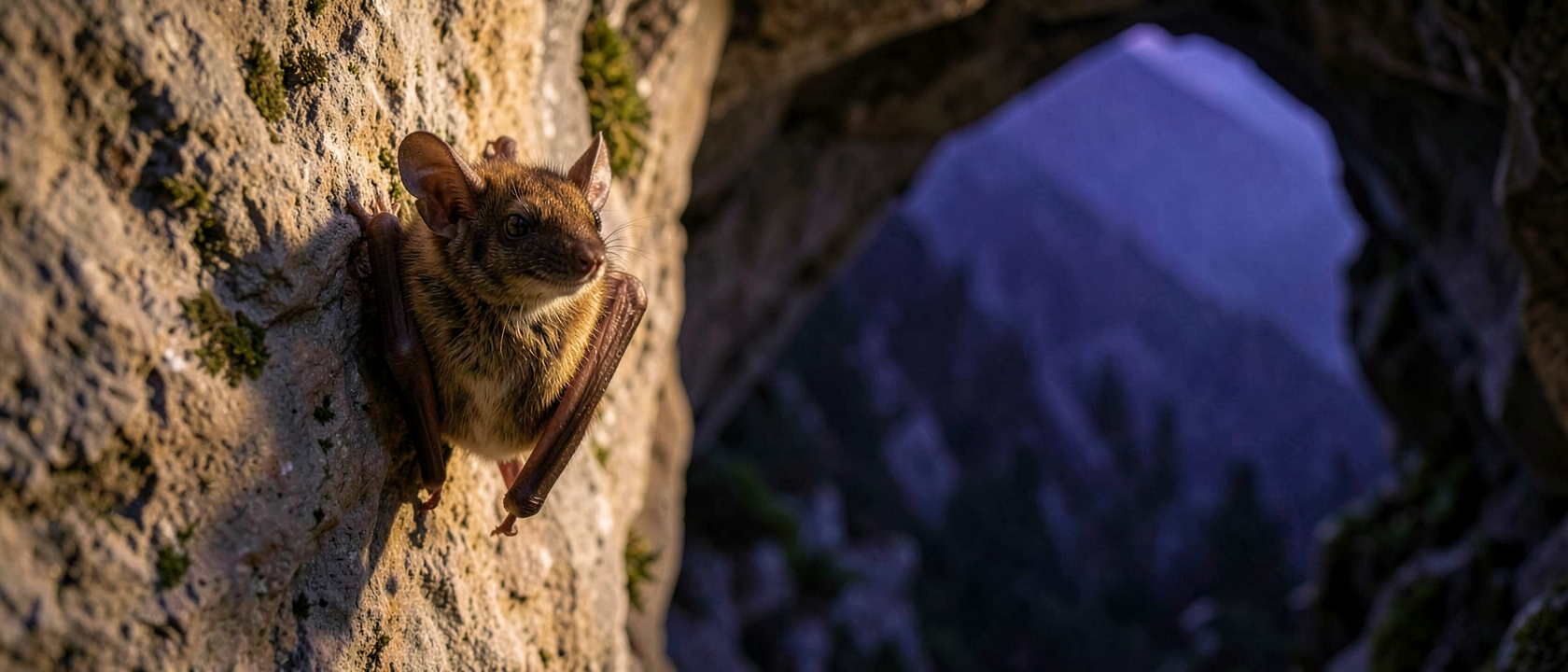
A bat weighing about a quarter of an ounce (7 grams) was recaptured in the wild 41 years after it was first banded, a lifespan roughly twenty times longer than a mouse that size would ever reach. That one bat, and the genus of small brown bats it belongs to, are forcing a rethink of a basic assumption about aging: that a damaged cell is always better off repaired than destroyed. In the longest-lived of these bats, it isn’t.
The 7-Gram Bat That Outlived Its Ringer
It happened in a cave in Siberia’s Biryusa region. A small bat, banded years earlier and logged at the time as Myotis brandtii, turned up alive in a survey 41 years after its first capture. It weighed about a quarter of an ounce; a mouse that size lives around two years. This one bat beat that clock by a factor of roughly twenty, the longevity record for a mammal its size.
Later genetic work split the eastern Siberian population off from Myotis brandtii into its own species, Myotis sibiricus, so strictly speaking the record belongs to a bat that isn’t the species it’s usually filed under. Guinness World Records still lists the case as Myotis brandtii, the species it was first assigned to. Scored against body size, the bat’s longevity quotient, how long a species lives relative to what its size predicts, comes out at 9.8, the highest ever recorded for a mammal, wild or captive. It’s one banded animal, not a species average. But it’s the single data point that got biologists asking a sharper question: why would destroying a damaged cell ever beat fixing it?
The Experiment: Kill the Cell, Not the Damage
The genus Myotis holds more than 139 species across six continents, all descended from one ancestor around 33 million years ago. Biologist Juan Manuel Vazquez, working with colleagues at UC Berkeley and Penn State University, has spent years asking why such closely related species differ so much in lifespan; the lab now holds cell cultures from 259 bats across 32 species. For eight of those species the team built near-complete genomes, the most detailed assemblies made for bats so far, published in Nature in 2026. One, Myotis evotis, contributed the gentle way: researchers took a tissue sample from a bat’s wing in Arizona, released it, and grew the cell line from that sample.
The key experiment used skin cells from the longest-lived species in the set, the little brown bat (Myotis lucifugus). Researchers exposed the cultures to chemicals that damage DNA and tracked which genes switched on. The expected move is repair: patch the break, keep the cell. Myotis lucifugus cells did the opposite. They ramped up genes for apoptosis, a cell’s built-in self-destruction program, instead of genes for DNA repair. Given serious damage, this bat’s cells don’t try to save themselves. They delete themselves.
Why Deleting Beats Repairing
A repaired cell keeps living, and it keeps whatever the repair missed. Across enough divisions and enough decades, an uncorrected error is exactly the kind of thing that becomes cancer. A deleted cell can’t carry a mistake forward; it’s simply gone. For an animal whose tissue has to keep working across forty-one years instead of four, betting on removal looks cheaper than trusting every repair to be flawless. The researchers note that comparing two closely related, similarly sized bats where one lives three years and the other thirty is a bit like comparing humans and Neanderthals: a small number of genetic changes, a very large difference in lifespan.
The genome comparison backs this from another angle. Whenever the team found a gene linked to longevity, that gene also turned out to be involved in how the bat’s cells deal with viruses, an overlap far too large to be chance. The strongest signal involved genes fighting RNA viruses, which mutate fast: instead of changing shape, bats keep extra backup copies of the relevant genes on hand, a pattern called copy number variation. Some Myotis species carry one copy of the antiviral gene PKR, some two, some three, and the extra copies track with longer life. Antiviral defense and cancer control appear to be running on the same machinery.
Two Myths, One Dead Bat’s Worth of Evidence
Myth one: bigger bodies buy longer lives, the rule that lets an elephant outlive a mouse as a matter of course. Myotis breaks it outright. Thirteen species in this one small-bodied genus have been documented living past 20 years. Myotis brandtii, at around a quarter of an ounce, can reportedly live half a century, nine times longer than its close relative Myotis nigricans, a bat of similar size and build that lives only about seven years, as if Homo neanderthalensis had lived nine times longer than modern Homo sapiens. Size predicts almost none of it.
Myth two: a severely damaged cell is best served by fixing it. The little brown bat experiment says the opposite. Given serious DNA damage, its cells chose destruction over repair, and the genomic evidence suggests that choice, repeated across millions of years, is part of why some Myotis species outlive their closest relatives by decades without any change in body size.
What Nobody Has Proven Yet
The genes under selection in long-lived Myotis species are associated with those long lives, not proven to cause them. This is a genome comparison and a cell-culture experiment, not a test of what happens when a single gene is switched off in a living bat. Whether keeping extra copies of PKR trades away something else, a cellular cost, an immune imbalance, is a question the researchers raise rather than settle.
There’s a second open thread, and it’s the harder one. Bats are also the animals most often named as the source of viruses that turn severe once they reach humans. This study finds a real, measured pattern: bats seem to handle DNA viruses and RNA viruses through different genetic tools, and that same toolkit looks tangled up with why some of them age so slowly. Nobody has shown that this pattern explains why a virus a bat tolerates becomes dangerous in a person. The study doesn’t reach that conclusion. It leaves the question sitting on the table.