
The Flip
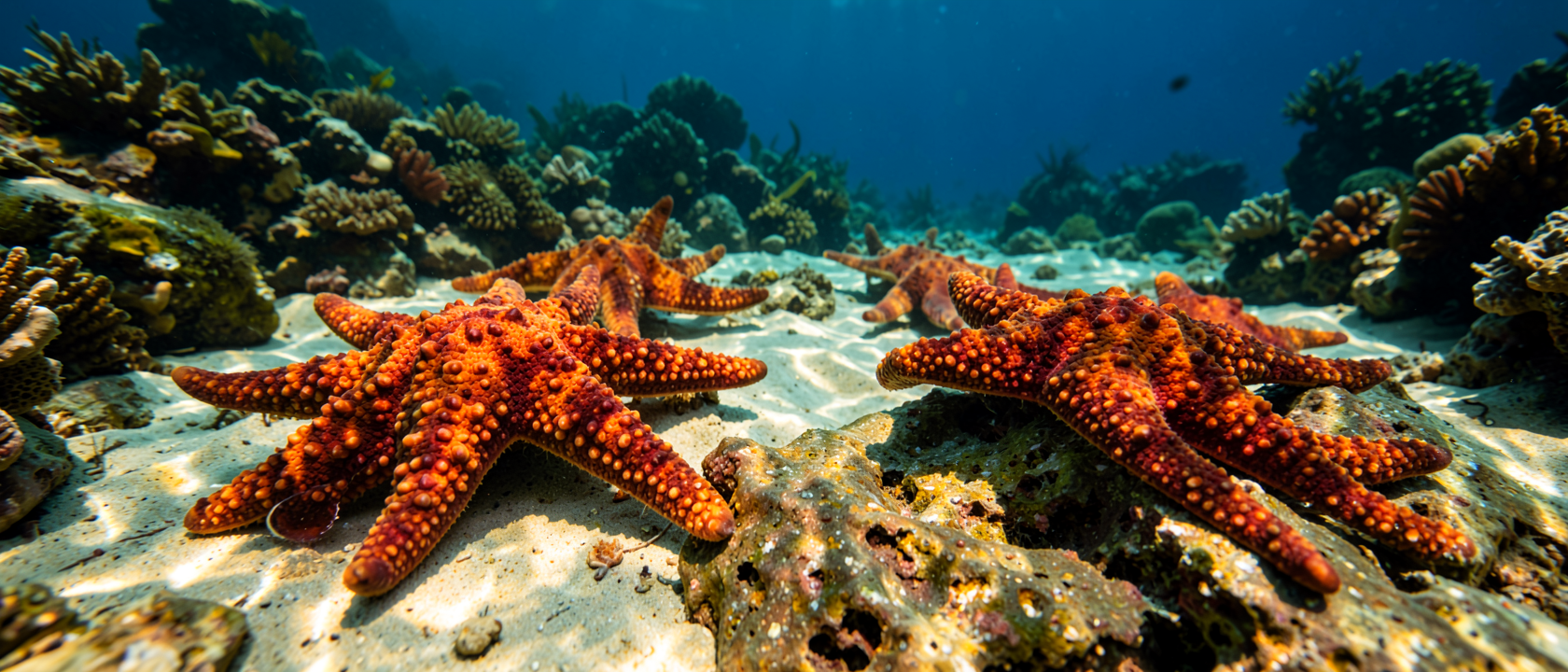
Starfish, the class Asteroidea, do something nobody expected from a group that was supposed to play by the same rules as everything else. In shallow water they crowd the tropics, same as almost every other group of animals on record. Past about 656 ft (200 m), the pattern flips: species diversity drops near the equator and climbs toward the temperate and polar latitudes instead. Dr. Hugh Carter, curator of starfish at the Natural History Museum in London, with colleagues Dr. Suzanne Williams and Dr. Lupita Bribiesca-Contreras, mapped 256,861 starfish records stretching from the shoreline down to 26,102 ft (7,956 m). The survey covers 91.4% of all known starfish species (1,751 of 1,916), 98.3% of genera (345 of 351), and all 38 recognized families. Published in *Nature Ecology & Evolution* on September 3, 2025, it is the most comprehensive survey ever done on the group. Same animal, same ocean. The map turns inside out depending on how far down you look.
Ruling Out the Obvious Suspect
The standard explanation for “more species at the equator” is heat. Warm, stable water supports more life, so diversity stacks up in the tropics and thins toward the poles. That explanation has survived hundreds of studies, across plants, insects, fish, even the fossil record. It falls apart the moment you check deep water. Below a certain depth, the ocean stops tracking latitude at all: whether the seafloor sits under the equator or under the Arctic, the water running over it holds at close to 39°F (4°C). A thermostat that barely moves cannot be the thing pushing diversity toward the poles down there. Carter’s team instead points to what rains down from above. Polar surface waters bloom hard and seasonally, the same blooms that pull in krill swarms and whale migrations, and the leftover organic matter sinks, feeding the seafloor below in heavier amounts at higher latitudes than near the equator.
A Bigger Map Than Starfish
Carter treats the starfish result as a test case, not a final word on starfish alone. If nutrient supply, not warmth, is what actually drives diversity on the deep seafloor, the same pole-ward shift could be sitting unnoticed in worms, mollusks, crustaceans, and anything else living below the reach of sunlight. Starfish just happen to be the first group with a dataset complete enough, covering 91.4% of every known species, to show the pattern this clearly. That extension to other animals is Carter’s own reading of the result, not something the paper proves. But it means the picture most people carry of the ocean floor, crowded and warm near the equator, empty and cold near the poles, might be backwards for an entire ecosystem most of us will never see.
The Rule That Isn’t One Rule
The latitudinal diversity gradient is about as close to a law as ecology has: more species near the equator, fewer toward the poles. Hundreds of studies have confirmed it across living animals and the fossil record alike. The myth is not that the gradient is fake. It is the assumption that it works the same way at every depth, for every group. Carter’s findings kill that version of it. Shallow-water starfish families follow the equator-rich script exactly as expected, while families that live only in the deep sea do the opposite, growing richer toward the temperate zones. The gradient is real. It just is not one rule everywhere; it is at least two rules, switching depending on how far the sun’s warmth actually reaches.
What’s Still Open
The nutrient explanation is Carter’s working hypothesis, not something the paper traces step by step. No one has followed a specific load of sinking plankton from a polar bloom down to a specific bed of deep-sea starfish and watched it turn into measurable diversity. The paper itself admits that explaining even the ordinary, shallow-water version of the latitudinal gradient is still, after decades of research, tricky to unpick. Why some starfish families ignore the pole-ward pattern entirely and stay locked to the tropics regardless of depth is not explained. There’s also a quieter wrinkle in the data itself: 22.6% of the species in the dataset have fewer than ten records each, and their contribution to the overall pattern could be getting lost in the modeling. Whether worms, mollusks, or other deep-sea animals show the same reversal has not been tested. For now, that part stays an open question, not a finding.