
The Fish That Stopped Growing Up
North Sea Atlantic cod (Gadus morhua) now reach sexual maturity at just over 19.7 inches (50 cm). Model a population that had never felt a trawl net, and the same species is expected to mature past 27.6 inches (70 cm). That gap, published March 16, 2023 in Nature Sustainability by Hanna Schenk, Fabian Zimmermann and Martin Quaas, of the German Centre for Integrative Biodiversity Research (iDiv), Leipzig University, and the Institute of Marine Research in Tromsø, is not a story about warmer seas or thinner plankton blooms. It is what fishing pressure alone does to a species, the researchers say.
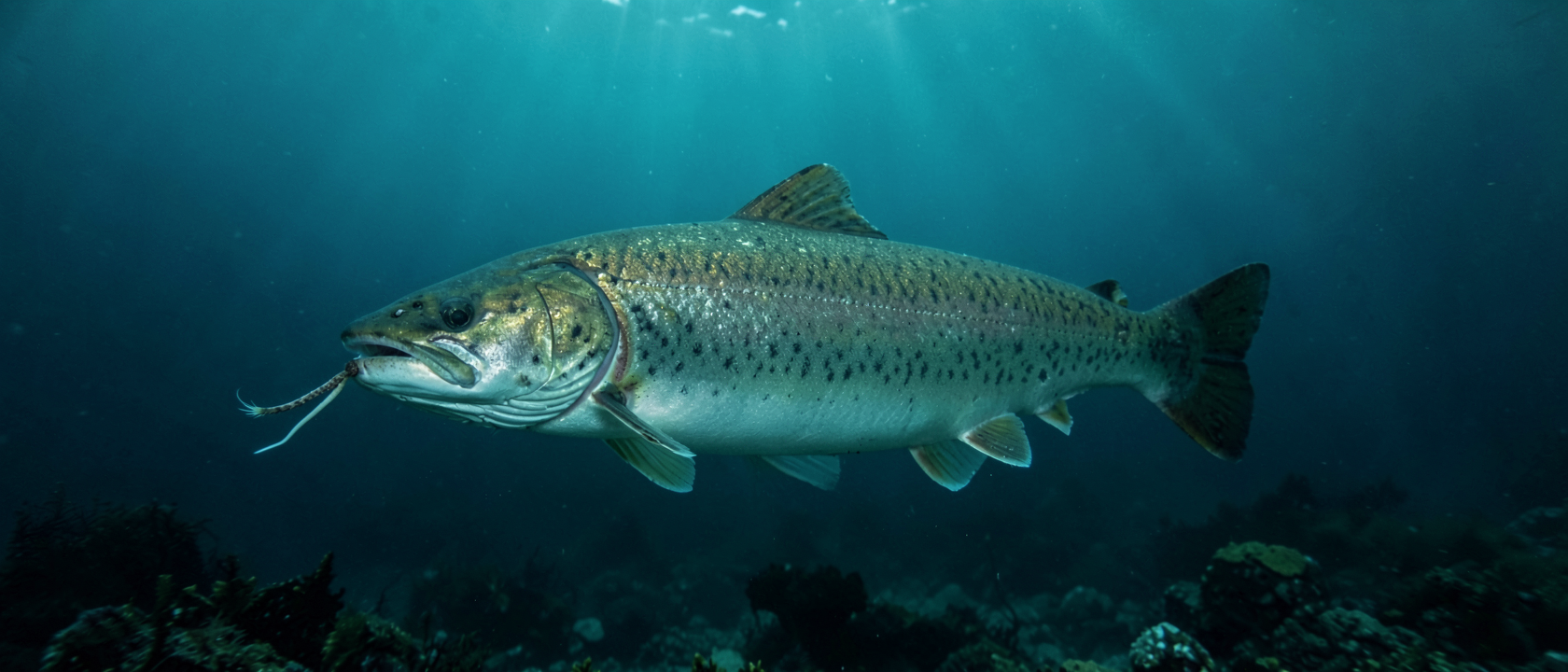
Atlantic cod is a cold-water gadoid with an elongated, tapering body, three dorsal fins and two anal fins, a single barbel under the chin, and a mottled greenish-brown back over a pale belly. It commonly runs 39.4 inches (100 cm) and can reach 6.6 feet (2 m), living at depths of 492 to 656 feet (150 to 200 m). None of that has changed. What has changed is the age and size at which North Sea cod start reproducing, and that is a population-level shift, not an individual fish having a bad year.
How You Breed a Smaller Fish Without Meaning To
Commercial fishing targets the biggest fish, because that is the fish worth selling. But the biggest cod are also, on average, the slowest to mature. Take those out of the water generation after generation, and the fish left behind to spawn are disproportionately the ones that matured small and early. The study describes exactly this pattern: intense fishing pressure has pushed North Sea cod toward lower growth rates, smaller maturation size and earlier reproduction. Earlier reproduction sounds like a fish adapting sensibly to danger, and in the short term it does prop up a stressed stock. Over enough generations, though, it produces a population of smaller fish that simply have fewer offspring, which is precisely the outcome the authors describe as a hit to both the productivity of a stock and its value on the market, in Schenk’s own words.
The Fix That Only Works If You Plan in Centuries
Schenk, Zimmermann and Quaas did not stop at diagnosing the problem. They built a model that couples fisheries economics with the eco-evolutionary dynamics of the cod population, to test whether the shrinkage can be undone and what it would cost to do it. Their answer: reversing the evolutionary decline is possible, and setting explicit conservation targets for the fish’s genetic traits only slightly reduces fishing profits. Choosing where and when to harvest, based on the size and genetics of the fish available, narrows that cost even further.
The catch is time. The model only produces a genuine reversal when management is planned across roughly a century. Run the same numbers on the planning horizon fisheries actually use, a few years at a stretch, and the fish stock’s overall biomass recovers on schedule. The evolutionary shrinkage, the small-and-early trait itself, keeps happening underneath that recovery. Just more slowly. “Fisheries typically consider short planning horizons of a few years,” Schenk says. “This stands in contrast to long-term sustainability and biodiversity targets.” The paper’s broader point cuts against economic incentives alone: profit-driven management, left to its usual clock, cannot get there on its own.
The Myth This Kills: “The Stock Recovered” Doesn’t Mean the Fish Did
It is tempting to read a headline about rebounding cod numbers as the end of the story. The study’s own modeling contradicts that reading directly. Biomass and evolution run on separate clocks. A fishery can rebuild the population count within a handful of years while the fish inside that population stay small, early-maturing and genetically shrunk, a state that can persist for many cod generations after the chart looks fine. A recovered stock and a recovered cod are two different claims, and the paper’s whole argument is that treating them as one is the mistake worth correcting. If someone tells you the North Sea cod problem is solved because the numbers are up, that is the exact gap this study was built to expose. It’s also, quietly, a gap that says something about how we read good news in general: a chart going back up is not proof that whatever broke it has been fixed.
What Nobody Has Even Started Measuring
The model stops at the cod. It does not, and current science cannot yet, say what a permanently smaller, earlier-maturing cod population does to everything connected to it: what it eats less of, what preys on it more easily now, how spawning timing across the wider food web shifts when one species changes its own clock. “We don’t know much about potential consequences such as trophic cascades and other ecosystem changes that feed back onto the harvested species and may interfere with critical ecological functions,” Schenk says. There is a policy gap sitting right next to that scientific one: UN Sustainable Development Goal target 14, the global framework for ending overfishing, tracks stock numbers. It has no formal metric for the genetic state of what is left inside those stocks, which means the exact thing this study measured is currently invisible to the target meant to fix it.