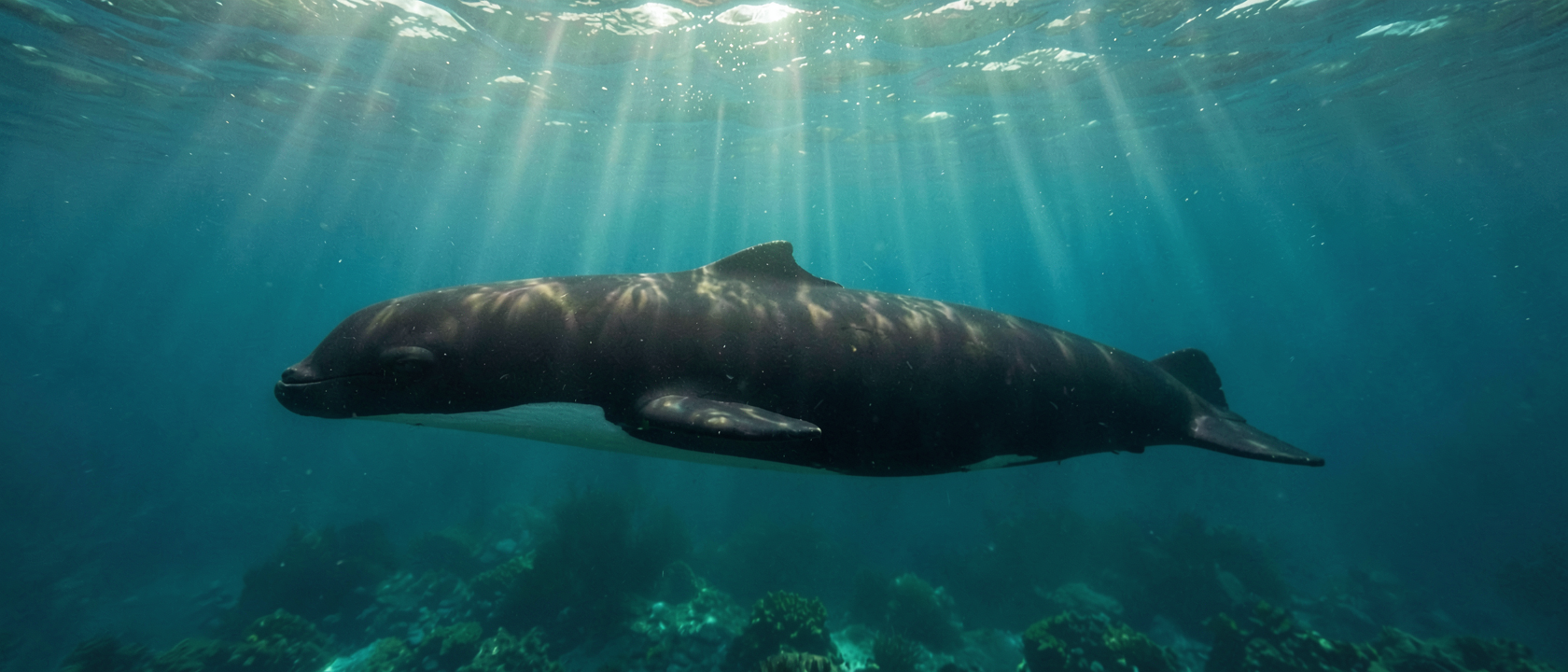
A false killer whale in Hawaiian waters lost about 500 pounds (227 kg) in roughly ten weeks, shedding close to 28 percent of its body mass. Researchers caught the loss on drone footage as part of a seven-year study of a population that now numbers fewer than 140 animals.
The species is Pseudorca crassidens, the main Hawaiian Islands insular population of false killer whale, a large, dark-bodied member of the dolphin family that ranges within about 45 miles of the seven populated islands. The name comes from a skull shape that echoes the killer whale’s, not from any close kinship: false killer whales and orcas (Orcinus orca) are not closely related, whatever the shared name suggests.
500 Pounds in 10 Weeks
Between 2019 and 2025, researchers from the Pacific Whale Foundation, the Marine Mammal Research Program at the University of Hawaiʻi at Mānoa’s Hawaiʻi Institute of Marine Biology, and the Okinawa Churashima Foundation flew drones over 68 of the population’s roughly 140 remaining whales. Among the cases they documented: one individual dropped an estimated 500 pounds (227 kg), about 28 percent of its body mass, in around ten weeks. A second whale showed a sunken blowhole, a sign of severe, ongoing nutritional stress.
Weighing a Whale From the Sky
Nobody puts a wild false killer whale on a scale. Instead, the research teams used drone photogrammetry, high-resolution aerial photographs taken from directly overhead that let researchers measure a whale’s length and width at multiple points along its body. Those measurements convert into an estimate of volume, and volume converts into an estimate of body mass.
The method is not a guess dressed up as math. Researchers calibrated it against 3D body scans of false killer whales living under professional care in Okinawa, animals whose real weight is known because they can, in fact, be weighed. Measured against those known weights, the drone-based estimates came out accurate to within about 3 percent. That precision is tight enough to catch one whale’s rapid weight swing in something close to real time, not just a population’s average drifting over years.
The Whales That Travel Further Get Thinner
The population’s Body Condition Index, the measure researchers use to track how much reserve a whale is carrying, hit its lowest recorded point in 2020. That was the same year Hawaiʻi’s waters went through a record marine heatwave, and the same year the population recorded its steepest single-year decline on record. Researchers stop short of calling the heatwave the cause; the two events line up, but a direct causal link has not been established.
Inside that pattern, one detail stands out. Whales belonging to “Cluster 1,” a social group known for ranging widely across the islands, showed more variable body condition than any other subgroup studied. False killer whales feed on large pelagic fish: mahi-mahi, ono (wahoo), aku (skipjack tuna), and ʻahi (yellowfin tuna), species that move in patches and can be scarce for long stretches. Whales that must travel farther to find that patch spend more energy hunting it than the fish gives back, which raises their metabolic risk.
What Nobody Knows Yet
Lead author Jens Currie of the Pacific Whale Foundation says the team is examining whether competition with commercial and recreational fisheries, which target the same mahi-mahi, ono, aku, and ʻahi the whales rely on, is forcing chronic nutritional stress onto the population. That question is open, not answered: the study does not establish that fishing pressure is driving the decline, only that it is worth investigating.
Also unresolved is how nutritional stress interacts with the population’s other known threats. High rates of dorsal fin and mouthline injuries point to fisheries interactions, meaning whales getting hooked or entangled in gear, as one of the most significant risks this population already faces. Whether hunger pushes a whale toward riskier encounters with fishing lines, or whether entanglement itself worsens body condition, has not been studied.
Losing a Kupuna
Cultural Advisor Kaʻapuni frames the population’s decline differently than a biologist would. In his telling, each of the fewer than 140 remaining false killer whales is not just a data point on a Body Condition Index chart. In Hawaiian culture, kūpuna means elders, the people who carry knowledge forward. Losing one of these whales, in his framing, is losing a kūpuna: not a statistic falling by 3.5 percent a year, but a specific, older animal that will not pass anything on again.
That is his framing, not a finding about what a false killer whale knows or remembers. Pseudorca crassidens can live more than 60 years, long enough for a great deal of experience to accumulate in a single animal. What that experience means to the whale itself remains, like much of this population’s future, an open question.