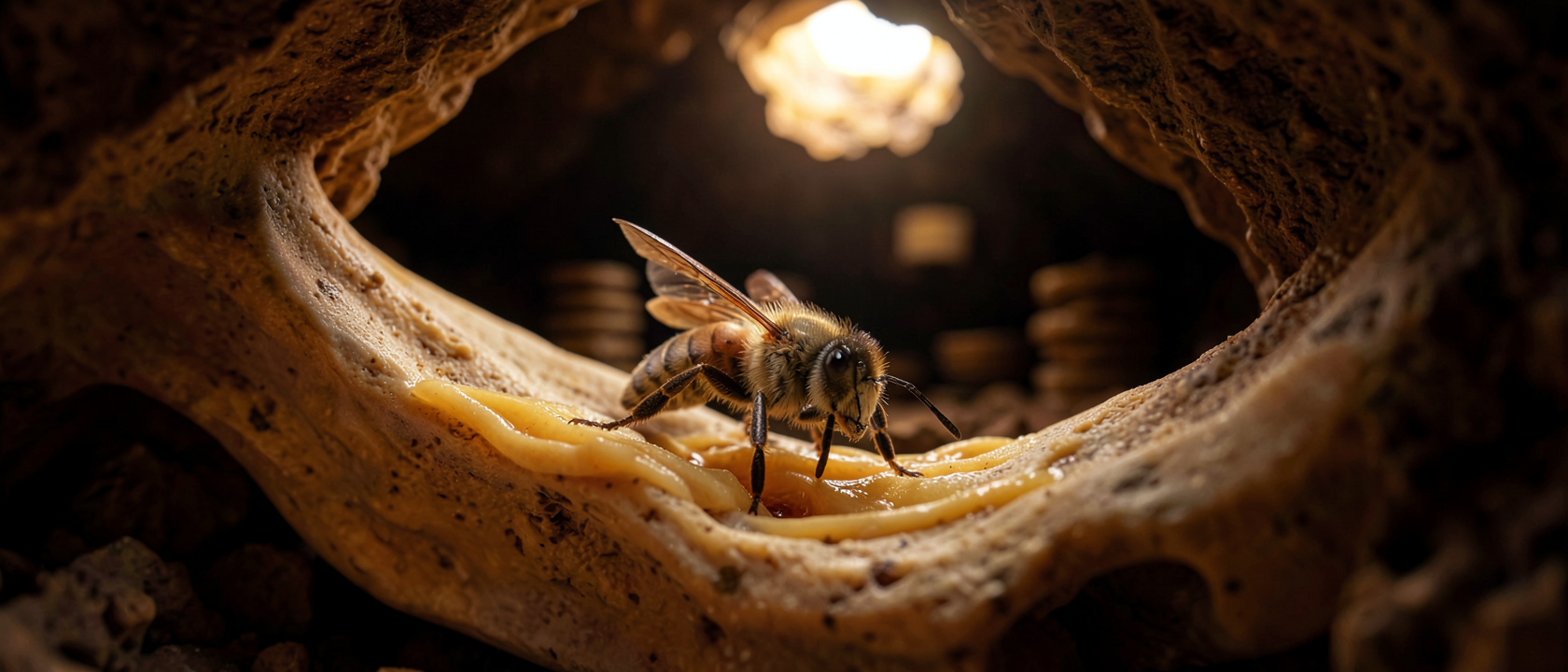
A Bee Moved Into a Dead Rodent’s Mouth
A solitary burrowing bee moved its nursery into the mouth of an animal that had been dead for a very long time. Paleontologist Lázaro W. Viñola-López, of the Florida Museum of Natural History, and five colleagues were excavating Cueva de Mono, a limestone cave southwest of the town of Oviedo in Pedernales Province, in the southwestern Dominican Republic, when they found brood cells packed inside the tooth sockets of a fossilized jawbone. The team described the discovery on December 1, 2025, in Royal Society Open Science, naming the tracemaker Osnidum almontei, an ichnospecies, meaning a species defined by the trace it left behind rather than by a body in hand. The jawbone belonged to Plagiodontia araeum, an extinct rodent built roughly like a small capybara, and had most likely been dropped in the cave by an owl after a meal. Most solitary bees dig their own tunnels into soil. This one moved into a skull instead.
How a Jawbone Becomes an Apartment Block
The jaw sat buried in fine clay silt long enough for its teeth to loosen and fall out of their sockets, called dental alveoli, leaving smooth, ready-shaped hollows behind. Those hollows turned out to be close to the exact size a bee needs for a brood cell: about 0.24 inches (6 mm) long and 0.16 inches (4 mm) wide, according to the team’s measurements. Micro-CT scans, a form of 3D X-ray imaging, showed something plain bone erosion would not produce: interior walls polished unusually smooth, in multiple thin layers, consistent with a waterproof lining applied by the bee itself. Some sockets held the curved remains of up to six stacked generations of cells, each new one built over the last. The rodent’s own anatomy did the digging. The bee only had to find it.
Same Address, Generation After Generation
A single polished socket could be an accident. A pattern is not. Once the researchers knew what the signature looked like, they found it repeatedly across the same sediment layer, including inside the pulp cavity of a sloth’s tooth. That is the mark of nest fidelity: bees, and later their offspring, returning to the same cavity instead of starting fresh elsewhere. The team suspects part of the reason is geography. Thin soil over limestone bedrock leaves ground-nesting bees with few places to dig, so a cave floor scattered with hollow bones may have worked as a substitute. It is worth naming the assumption this kills outright: bees are not, as a rule, hive-builders. More than 90 percent of bee species live alone, each female provisioning her own cells, and Osnidum almontei fits that pattern. What made Cueva de Mono unusual was not that the bees shared a nest. It is that so many separate, solitary females kept choosing the same kind of leftover real estate, generation after generation, until the cave functioned as a communal nesting ground built entirely out of someone else’s bones.
No Body, No Date
Here is the limit of what the fossils can say. What Viñola-López’s team recovered are trace fossils, evidence of behavior, not the bees themselves. No physical specimen of Osnidum almontei has turned up inside any cell, and no tunnel connecting the brood chambers has been confirmed, only a fragment of matrix that matches the right size and texture. That leaves an open question researchers have raised themselves: since no bee bodies were found, the species behind these nests could be extinct, like Plagiodontia araeum itself, or it could still be alive on Hispaniola today. The cave deposit has not been directly dated either. Similar cave deposits elsewhere run from roughly 20,000 years old to as recent as about 4,500 years ago, when some of the mammal species preserved at sites like this one went extinct, but no specific date has been attached to this nesting layer. Stephen Hasiotis, a geologist at the University of Kansas who was not involved in the study, called the find a solid addition to the record of hidden biodiversity: no bee bodies, but trace fossils that are diagnostic of soil-nesting bees all the same.
What This Says About the Cave, Not About Bees in General
It is tempting to picture Osnidum almontei building tidy little apartments, choosing real estate, picking neighborhoods. That is the joke, not the finding. What the fossils actually show is narrower and, honestly, better: several generations of solitary females, working alone, independently arriving at the same practical answer to the same local problem. No coordination, no colony, no shared architecture plan. Just repeated, individual decisions that happened to land on the same kind of cavity, in the same cave floor, over and over, until the pattern became visible to the people digging it up tens of thousands of years later. That is nest fidelity, not community. The bones did the hard part. The bees just kept noticing.