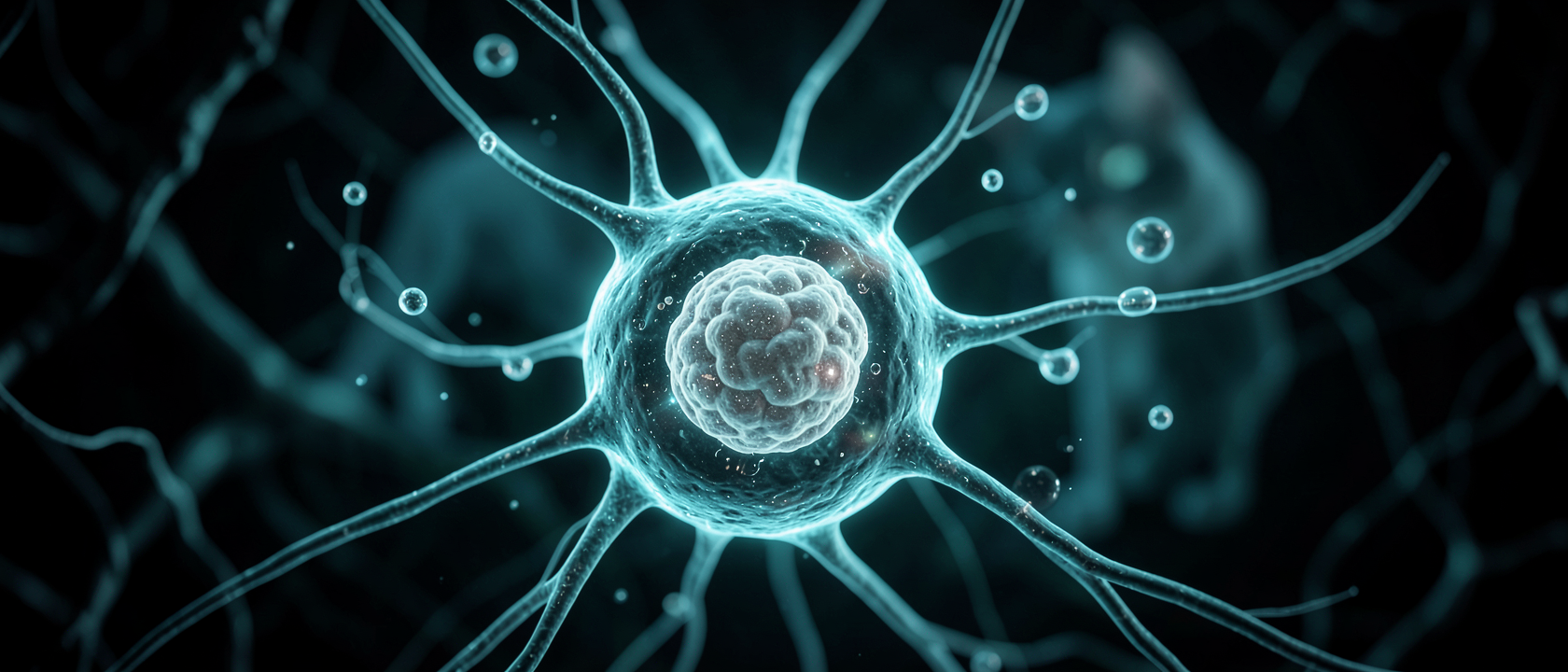
A Toxoplasma gondii infection does not have to take over a mouse’s brain to mess with it. It just has to change what a few neurons are saying to their neighbors. A research team led by Emma Wilson and Emily Tabaie at the University of California, Riverside, School of Medicine infected cultured mouse neurons, grown from C57BL/6 mouse embryos, with the parasite, then measured what those neurons send out once cysts form inside them: extracellular vesicles, small lipid-wrapped packets loaded with proteins, RNA fragments, and other cargo that neurons normally use to stay in touch with nearby astrocytes. The infected neurons made fewer of these packets. The ones they still released were not the same either; their protein and RNA cargo had shifted. Published in PLOS Pathogens on June 16, 2025, the study is not about a parasite eating brain tissue. It is about a parasite rewriting what neurons tell the cells around them.
How a Few Garbled Messages Spread
Extracellular vesicles are how a neuron texts an astrocyte, the glial cell responsible for managing the brain’s chemical surroundings: mopping up neurotransmitters, feeding neurons, keeping the local environment stable. Wilson and Tabaie’s team found that vesicles from infected neurons carried a secreted parasite protein called GRA7, one of the molecules Toxoplasma releases from structures inside itself called dense granules. When astrocytes absorbed these vesicles, GRA7 turned up inside the astrocyte’s own nucleus, and the astrocyte’s gene activity shifted: certain immune-signature genes switched on, while a gene for GLT-1, a transporter that normally clears roughly 90% of the glutamate sitting outside brain cells, switched down. Glutamate is the brain’s main excitatory neurotransmitter, essential in small doses and dangerous in excess. Too much of it is linked to seizures and neural damage, both known complications of severe toxoplasmosis. Understaff that one cleanup crew, and the chemical balance around it starts to drift.
Why the Parasite Does Not Need the Numbers
Toxoplasma gondii has a habit that makes this efficient. It crosses the blood-brain barrier and settles specifically into neurons, forming cysts that, per the study, can persist for the lifetime of the host. It never has to spread through most of the tissue, because astrocytes are not wired to listen to one neuron at a time. They integrate signals arriving from many neurons at once and set their own gene expression based on that pooled traffic. Corrupt the signal from a handful of infected cells sitting inside a large, listening network, and the network’s overall output can shift anyway. “Even a handful of infected neurons can shift the brain’s neurochemical balance,” Wilson said, describing communication between neurons and their supporting glial cells as “critical” and, it turns out, “vulnerable to hijacking by parasites.” The parasite is not occupying the tissue. It is occupying the right relay points.
The Myth This Kills, Carefully
For years, the popular version of the Toxoplasma story has been that the parasite performs a kind of mind control, most famously making rodents lose their fear of cat urine so cats, the only definitive host where the parasite can complete its sexual life cycle, are more likely to catch them. Some researchers have pushed back on that story, arguing the behavioral evidence is circumstantial and cannot be conclusively pinned on the parasite, especially in humans. What this study adds is not proof of mind control. It is a physical mechanism: EV disruption reshaping astrocyte gene expression and cutting GLT-1, showing how infection could plausibly alter brain chemistry without any behavioral experiment at all. That answers “just circumstantial” with something cellular and specific. It does not confirm that this exact pathway produces a symptom in a mouse, let alone a person. Wilson frames it as a possibility, not a verdict: the parasite, she said, “may play a larger role in neurological and behavioral conditions than we previously thought.” Might, not does.
What Nobody Can Check Yet
Roughly 10% to 30% of people in the United States carry a Toxoplasma infection, often without knowing it, and nearly one-third of the world’s population does too. Currently, the only way to test for it is an antibody test, which shows someone was exposed at some point but says nothing about whether the parasite is still active in their brain or doing anything like what this team saw in cultured neurons. Closing that gap is the next question Wilson wants to answer. “Our research opens the door to using EVs as biomarkers, which can be isolated from blood,” she said, meaning the same corrupted packets that tipped off astrocytes in a dish might, someday, tip off a diagnostic test in a living person. Whether that test would catch anything clinically meaningful, and whether the astrocyte disruption seen in these experiments ever adds up to a seizure, a mood change, or nothing at all in a living, behaving brain, is still open. The study answered how the signal breaks. It did not answer what breaking it does to the animal carrying it.