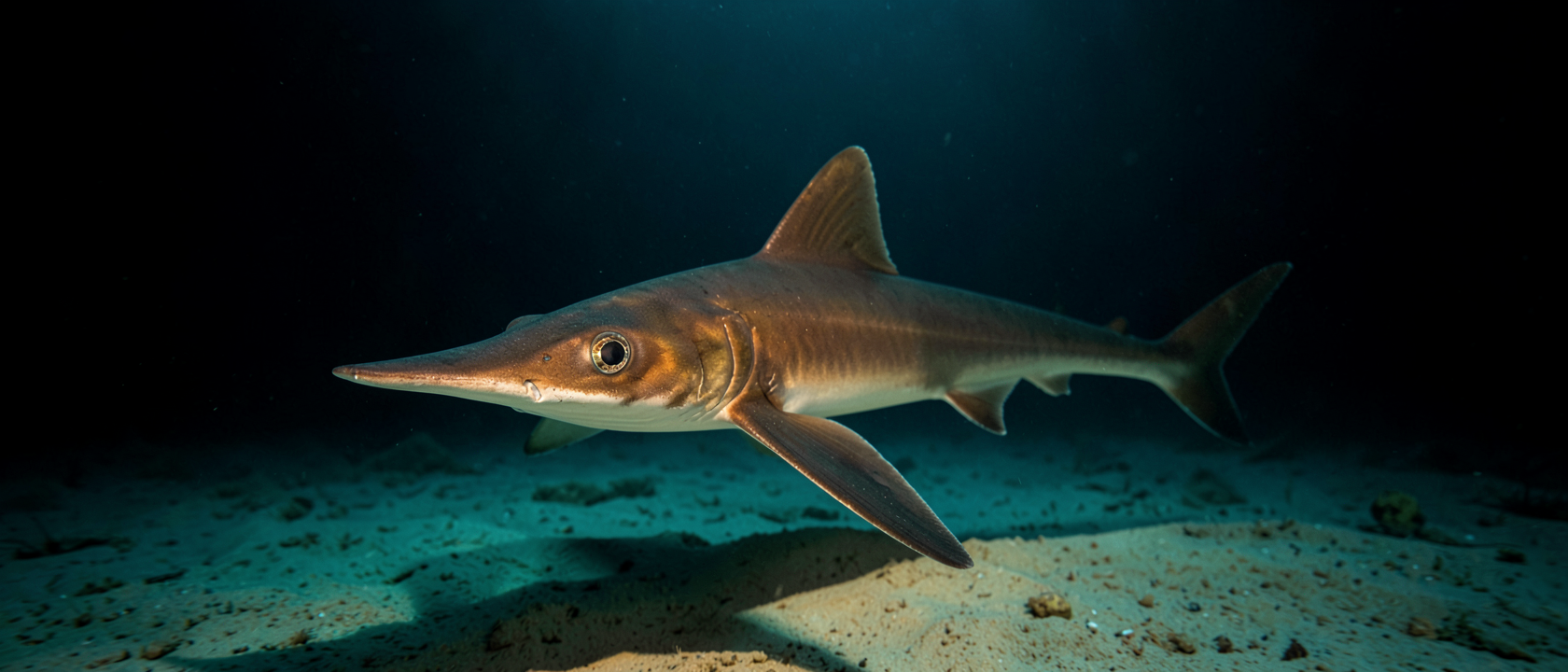
Meet Grandmother
A ghost shark hauled up from the deep water off New Zealand now carries a Latin name that translates to “grandmother.” In 2024, marine scientist Brittany Finucci at New Zealand’s National Institute of Water and Atmospheric Research, working with David Ebert of the Pacific Shark Research Center at San Jose State University, Dominique Didier of Millersville University, and co-authors Madeline Green and Jenny Kemper, published the formal description of a new chimaera species in the journal Environmental Biology of Fishes. They named it Harriotta avia. Avia is Latin for grandmother, and Finucci chose it in honor of her own grandmother, who she says “proudly supported me through my career as a scientist.” This is not a pet name attached to a viral photo. It is a taxonomic act: Harriotta avia now has an official two-part Latin name, a binomial, on the record, the same kind of designation carried by every recognized species on Earth.
How You Prove a Ghost Is New
Naming a chimaera does not happen from a glance at a photograph. Researchers first came across the animal while surveying for Fishers New Zealand, pulling specimens from the Chatham Rise, a stretch of ocean floor east of New Zealand’s South Island. Their first assumption was that this was an already-known species with a wide global range. Ruling that out took years of work. Confirming a new species meant comparing physical traits point by point: the shape of the long, narrow, flattened snout, the length of the slender trunk, the size of the eyes, the beak-like tooth plate, the dorsal fin spine, and the slender claspers, the paired structures male chimaeras use to transfer sperm to females. Handling the specimens also meant noting skin that sheds easily, called deciduous skin, and confirming a uniform chocolate-brown color when a specimen was intact. Then came the genetic side: sequencing a gene called NADH2 and checking how far it had diverged from the closest look-alike, Harriotta raleighana, a species this new one had long been mistaken for. Only when the body and the DNA agreed did Harriotta avia become its own species on paper.
Why Grandmother Fits Twice
The name works on a second level, one that has nothing to do with sentiment. Chimaeras split off from the shark lineage in the Carboniferous period, around 375 million years ago, at roughly the same time sharks themselves were taking shape, according to Didier. Fossils from that period, she notes, look strikingly close to the ghost sharks still swimming today, which is part of why the group gets called living fossils. They kept the ancestral toolkit: a skeleton built from cartilage instead of bone, males that fertilize females internally through claspers, and females that lay tough egg capsules on the seafloor, where an embryo lives off stored yolk until it hatches. Their beak-like tooth plates still do the job those plates were built for, crushing shrimp and mollusks on the bottom. None of that makes them untouchable, plenty of larger predators in the same deep water still eat them. Calling a chimaera “grandmother” in Latin is not whimsy. It is close to a job description for a branch that was already old when sharks as we know them were still new.
Not Actually a Shark
Here is the myth this species quietly kills: despite the “ghost shark” nickname, and despite “chimaera” borrowing its name from a mythological creature stitched out of lion, goat, and snake, Harriotta avia is not a shark. It belongs to Chimaeriformes, a separate branch of cartilaginous fish that shares smooth skin and a cartilage skeleton with sharks but broke away before modern sharks existed, on the timeline Didier describes above. “Shark” and “chimaera” are both borrowed words that oversell the resemblance. Calling this fish sharks’ grandmother is, if anything, more accurate than calling it a shark at all: it names the actual relationship, an older branch on the family tree, instead of just borrowing its descendant’s famous name.
What Nobody Knows About a Ghost Shark
Basic facts about Harriotta avia remain unknown. How large it can grow has not been established. Neither has how it finds a mate, or exactly where it lays its eggs. Didier says finding a juvenile ghost shark at all is rare, a rarity underlined by a 2022 survey of the same waters, when scientists turned up a young ghost shark and it made news simply for existing. How to age a chimaera reliably is also unresolved. Finucci has floated the idea that these fish might be slow-growing and long-lived, in the way some other deep-sea species are, pointing to Greenland sharks, reported to live past 300 years, as a comparison. That is speculation about a different species, offered as a hunch about what Harriotta avia might turn out to resemble, not a finding about the animal itself.
Decades Watching Ghosts
Dominique Didier has studied chimaeras for over four decades, and says what pulled her in originally was how little anyone knew about them. That gap has been closing. Over roughly the last two decades, the list of named chimaera species has grown steadily, helped by tools like remotely operated submersibles that can finally reach the depths where these fish live. Harriotta avia is one of the newer names on that list, in a field that used to be a footnote in ichthyology and now gets international attention. After decades of asking questions nobody else was asking, Didier and her colleagues have put a name on a fish nobody had heard of, and people are still talking about it, because that name happens to be somebody’s grandmother.