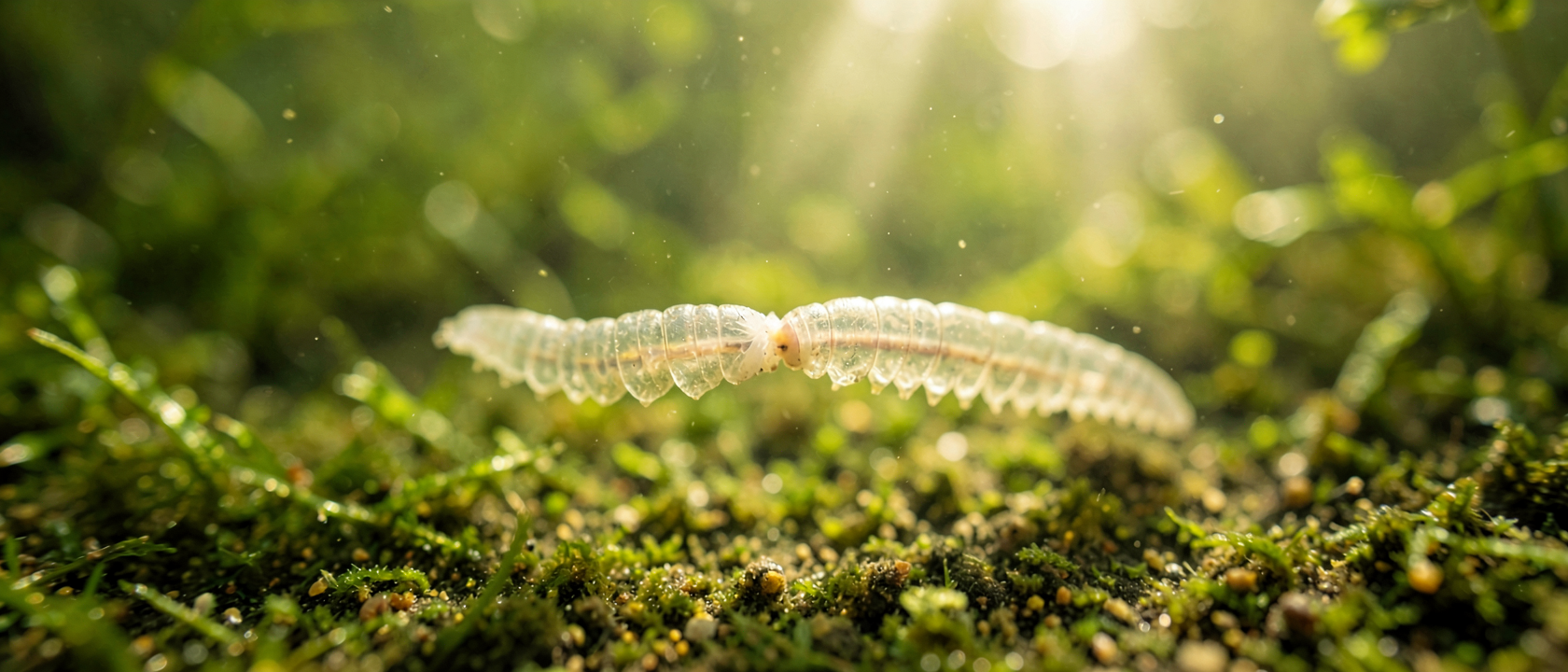
The worm that rebuilds itself from the middle out
Somewhere in the middle of a water nymph worm’s body, a single segment that has spent its whole life doing nothing more glamorous than moving food along suddenly starts building a brain at one end and a tail at the other. This is the water nymph worm (Pristina leidyi), a small, freshwater, largely transparent annelid, a segmented worm in the same broad group as earthworms. It doesn’t need a mate, an egg, or a courtship ritual to make more of itself. Once it crosses a size threshold, that mid-body segment commits, and for a while the animal is a single chain that looks like two worms welded together, head to tail. Then the seam gives way, and each half swims off on its own.
A stretch of gut gets promoted to a whole animal
Right up until the moment it divides, the segment in question is ordinary intestine, indistinguishable from its neighbors. Then it gets rebuilt from the inside out. A new nerve cord threads through it. A new brain forms. New reproductive organs appear too, ovaries in one resulting worm, testes in the other, all grown from tissue that used to just be gut. Like other annelids, Pristina leidyi keeps a growth zone at its tail end fed by two concentric rings of stem cells. Normally that supply line does the slower work of adding fresh segments as the worm lengthens. During fission, the same stem cells get redirected into a fast, wholesale rebuild, this time in the middle of the body.
Counting the worm, cell by cell
In 2024, an international team led by B. Duygu Özpolat at Washington University in St. Louis, with Jordi Solana at the University of Exeter and Patricia Álvarez-Campos at the Universidad Autónoma de Madrid, published the first single-cell atlas of Pristina leidyi in Nature Communications. A single-cell atlas works by breaking an organism down cell by cell and reading its transcriptome, a snapshot of which genes are switched on inside each one, then sorting cells into types by that activity rather than by eye. This atlas runs to 75,218 individual cell transcriptomes, enough to map every major annelid cell type, from neurons to muscle to skin. Inside the gut alone, the team counted roughly a dozen distinct cell types, several never documented in this worm before. The number isn’t decoration. It’s the parts list that turns “one segment rebuilds into a whole worm” from an observation into something researchers can trace, cell by cell.
What nobody knows: the start-splitting signal
That a size threshold exists is established. What flips the switch once the worm reaches it is not. Özpolat has said plainly that nobody yet knows what signal tells a water nymph worm it has grown large enough to begin splitting. It’s also unclear which of the worm’s stem cell populations get assigned to which rebuilt organ: which cells become brain tissue, which become ovary or testis, and which simply stay put as gut. The gut’s roughly dozen cell types, several turned up for the first time by the atlas, are the specific target for what comes next: working out what each one does, and how the whole set behaves during fission and regeneration.
Thousands of clones, one worm’s family tree
Özpolat has described her lab’s own cultures in plainer terms than a paper allows: they have grown, in her words, thousands of clones from a single individual, and the cultures are still going. That’s one lab’s account of its own worm population, not a measured result, but it’s a useful way to picture paratomic fission running at scale over time. Somewhere in a tank at Washington University in St. Louis is a population of water nymph worms that all trace back, mid-body split by mid-body split, to one original animal, and every one of them is a walking argument that a stretch of gut can, under the right conditions, remember how to be an entire worm.