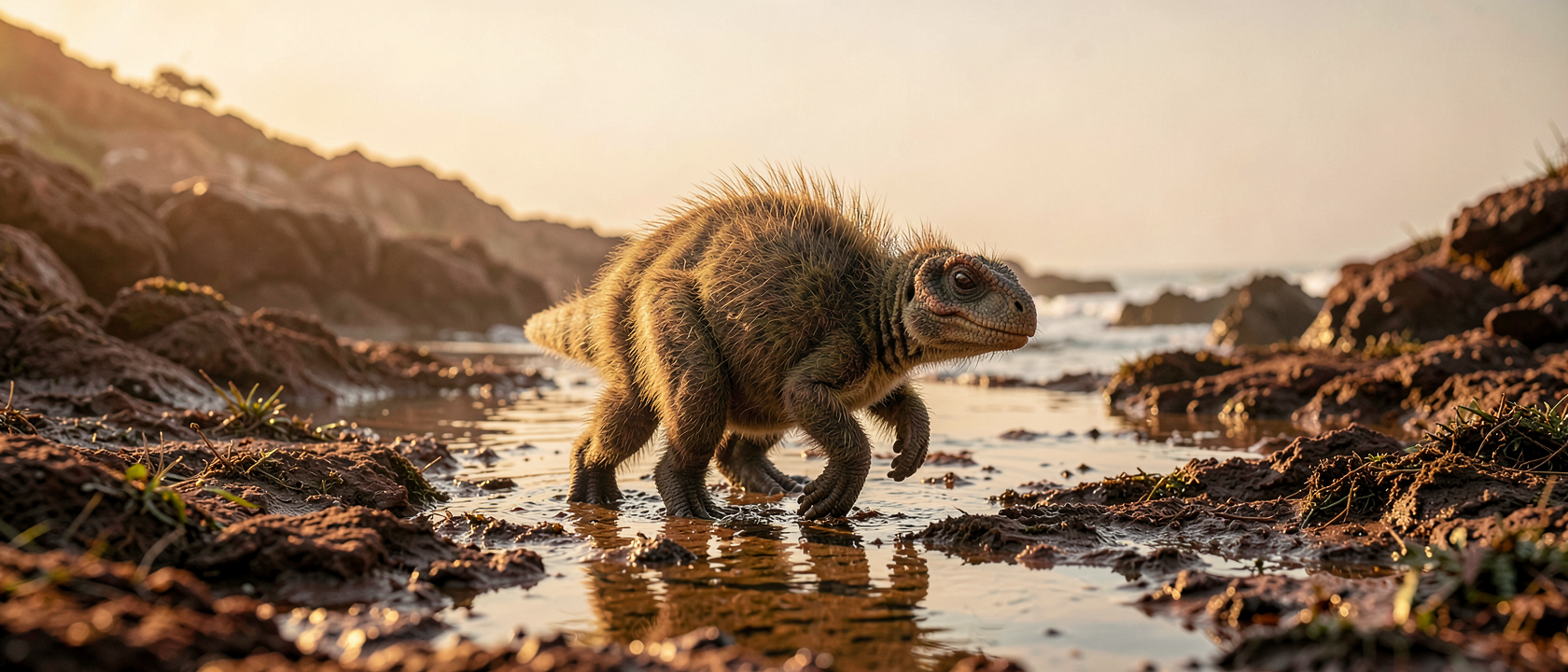
A Two-Foot Toddler with a Cartoon’s Name
A newly named dinosaur carries the name of Dooly, South Korea’s best-known cartoon dinosaur, because the fossil behind it really is a baby. Paleontologist Jongyun Jung and colleagues described the species, Doolysaurus huhmini, from a partial skeleton found on Aphae Island, off South Korea’s southwestern coast, in rock dated to about 113 million years ago. The animal measured roughly 2 feet (60 cm) long and died around age two. It belongs to the thescelosaurids, a family of small, fast-moving dinosaurs that ate plants, and, as it turns out, more than plants. Doolysaurus huhmini is only the third dinosaur species ever named from actual bones dug up in South Korea. The cartoon reference in the Latin name isn’t decoration. It’s a description.
Scanning a Skeleton Without Touching It
The bones came out of the ground fused solid into their rock block, the kind of specimen that usually takes months of careful chiseling to free, with a real chance of destroying something delicate along the way. Instead, the team ran the whole block through a micro-CT scanner, the same X-ray imaging used to look inside sealed containers, and rebuilt the skeleton digitally, bone by bone, without cracking the stone open. The scan turned up rib bones, arm bones, and skull fragments, the first dinosaur skull material ever recovered in South Korea. Near a set of emerging leg bones, it also picked up gastroliths, stones the animal swallowed to help grind down food in its gut. Their shape and quantity point toward an omnivorous diet rather than a strictly plant-based one. Working from a scan instead of a chisel meant nothing about that skull got lost in the digging, which is exactly why it survived to be the first one of its kind found in the country.
Why a Toddler Dinosaur, Specifically
Growth rings inside the bones, laid down the way tree rings are, show this individual was still actively growing when it died, probably somewhere between newly hatched and two years old. The researchers describe it as roughly double the size it would eventually reach as an adult, though how big that adult actually got is a detail the fossil record doesn’t give up. What the bones do confirm is that this wasn’t a species that stayed small its whole life. It’s a baby version of something bigger, and that’s what makes the name work at all. The team also raised the possibility that the animal carried a fuzzy, filament-like covering, based on comparisons with other small ornithischian dinosaurs rather than direct evidence preserved on this particular skeleton. That inference, not just the animal’s age, is the real link to Dooly’s tufted cartoon head.
Korea’s Dinosaurs Are Mostly Footprints
South Korea holds one of the richest dinosaur trace-fossil records on the planet, but that reputation rests almost entirely on footprints and eggshells, laid down when the region’s coastline was a tidal mudflat, the kind of soft ground that records a passing foot beautifully and almost never preserves a body. Bones are another matter entirely. Doolysaurus huhmini is only the third dinosaur species ever named from skeletal remains found in the country, following the ceratopsian Koreaceratops hwaseongensis and the neornithischian Koreanosaurus boseongensis, the latter named in 2011. Fifteen years separate that species from this one. A country famous for dinosaur evidence has, on the strength of actual bone, named exactly three species.
What Else Is Still in That Rock
Nobody knows yet whether more skeletal material sits in the rock at the Aphae Island site alongside the bones that became Doolysaurus huhmini. No further excavation has confirmed it, and none has ruled it out either. Jung has said he hopes the find marks a starting point for more advanced research on Korean dinosaur skeletons, with the micro-CT approach used here as a tool that could keep revealing what the ancient mudflats never let show on the surface. Whether Aphae Island is hiding other, still-unnamed species is an open question, not a prediction.