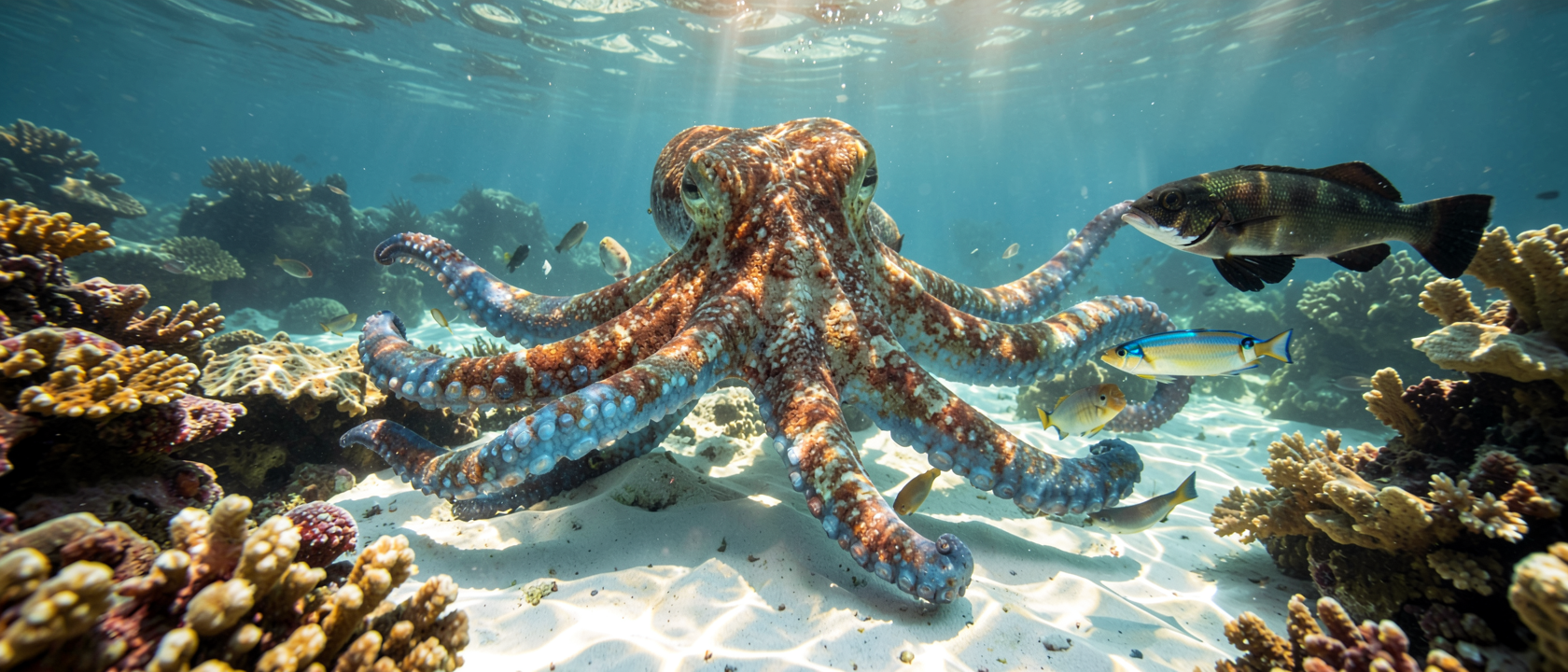
A big blue octopus (Octopus cyanea) will punch a blacktip grouper (Epinephelus fasciatus) that stops pulling its weight during a group hunt on a coral reef. The octopus isn’t fighting over food, it’s correcting a fish that stopped doing its job while the rest of the group keeps working.
The Punch
Eduardo Sampaio, a behavioral ecologist at the Max Planck Institute of Animal Behavior, and his colleagues built this finding from 120 hours of dive footage covering 13 mixed-species hunting groups in the Red Sea, filmed off Eilat, Israel, and El Quseir, Egypt. The paper, “Multidimensional Social Influence Drives Leadership and Composition-Dependent Success in Octopus-Fish Hunting Groups,” appeared in Nature Ecology & Evolution in 2024.
The puncher is Octopus cyanea. The fish most often on the receiving end is the blacktip grouper, Epinephelus fasciatus, an ambush predator that tends to hang back at the edge of a hunt rather than search for prey. Sampaio put a number on how often that gets a response: “Half of the times it’s present, it’s getting punched.” The timing is specific. It happens when a grouper is loitering mid-hunt while the rest of the group is still searching, not when there’s already prey on the table to fight over.
Who Does What
The hunting group runs like a small operation with three distinct job descriptions. Goatfish, including Parupeneus macronemus and Parupeneus cyclostomus, patrol out ahead and flush prey from sand and rubble into the open. Sampaio compared their function to radar: once a goatfish stops and lingers somewhere, the octopus reads that as worth checking, without doing any of the searching itself.
The octopus does what no fish can. It works its arms into crevices too narrow for a fish body, sometimes driving prey out toward a waiting mouth, and it decides when the whole group moves on. “The octopus basically works as the decider of the group,” Sampaio told Nature News. Nobody splits the catch formally. Whoever reaches the prey first keeps it, octopus or fish. But across repeated hunts, both octopuses and fish caught more crustaceans, fish, and mollusks hunting mixed-species than hunting alone, which may be why two lineages separated by more than 550 million years of evolution keep showing up on the same patch of reef.
Why the Fist
The researchers’ reading of the punch is a specific claim, worth slowing down on. It isn’t the octopus lashing out from hunger or being startled. The paper describes octopuses tracking how much effort each partner puts into the hunt and adjusting their own behavior, including switching strategy or delivering a punch, based on that tracking. That’s a claim about recognizing another animal’s contribution across a species line and responding to a shortfall in it. Study co-author Iain Couzin, director of the Max Planck Institute of Animal Behavior, said nobody had previously suspected octopuses ran a social life this sophisticated with other species.
The paper itself is careful with its language, describing “hallmarks of heterospecific social competence and cognition,” not proof that an octopus judges a grouper to be lazy. Why the punch happens at all is still debated within the study: it could be a low-cost way to keep a freeloader in line, or something closer to spite, with no direct payoff to the octopus. Both readings agree on one thing: the punch tracks a partner not pulling its weight, not a random jab.
The Loner Myth
Octopuses are the standard example of intelligence with no social explanation behind it. Most species, Octopus cyanea included, spend their lives avoiding other octopuses, sometimes violently, meeting only to mate, usually once. That gap between a large brain and a nearly nonexistent social life has been used for years to argue that octopus intelligence evolved for something other than social living, unlike the intelligence of primates or dolphins.
This finding doesn’t close that gap. It moves it. The social sophistication was never going to show up in how an Octopus cyanea treats another Octopus cyanea, since it barely treats another octopus at all. It shows up in how one solitary, short-lived cephalopod manages a shared task with two entirely different species it doesn’t compete with over territory. The loner still has no octopus friends. It appears to have fish coworkers.
What’s Still Unknown
Two things this study can’t answer yet. First, whether the same octopus keeps teaming up with the same grouper or goatfish across multiple hunts. That would matter, since all three species are otherwise territorial. But individual octopuses and individual fish are hard to tell apart underwater across repeated encounters, so researchers can’t yet say whether these are repeat partnerships or arrangements of convenience with whoever happens to be nearby.
Second, and bigger: why octopus cognition got this sophisticated in the first place. The usual explanations for large brains, an extended social life, culture, learning passed down from parents, don’t obviously apply to an animal that lives fast, lives mostly alone, and never meets its own offspring. An Octopus cyanea coordinating with a grouper and a goatfish on a reef doesn’t answer that question, it just makes it harder to set aside.