HEADLINE:
Megalodon was a slender 24.3-meter cruiser, not a bulky great white
ARTICLE:
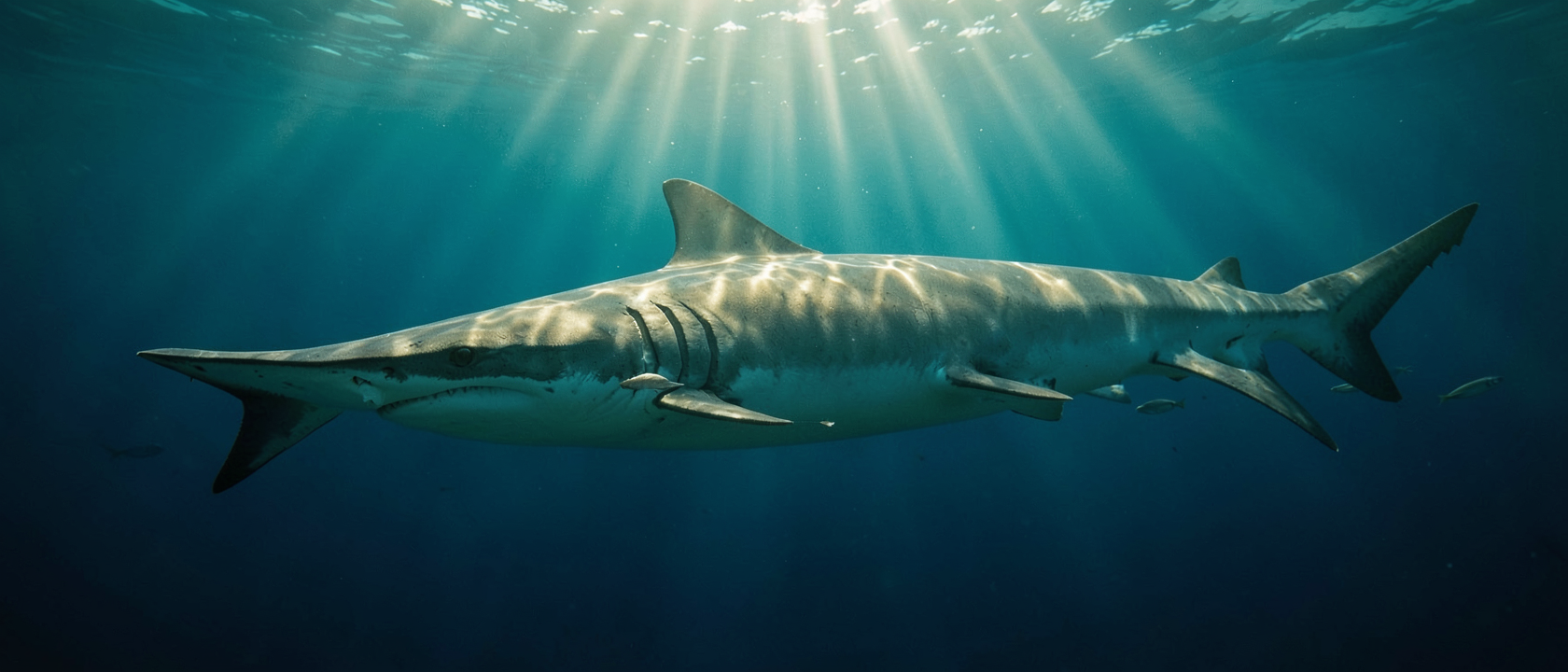
Megalodon was not a supersized great white shark. According to a 2025 study led by paleontologist Kenshu Shimada at DePaul University, the ancient giant shark, Otodus megalodon, had a long, slender build closer to a lemon shark than to the barrel-chested predator that fills every documentary reconstruction, and it may have stretched up to 80 feet (24.3 meters) nose to tail, roughly the length of two school buses parked end to end.
Forget the Giant Great White
Shimada worked with marine biologist Phillip Sternes, formerly of UC Riverside and now with SeaWorld, and 28 co-authors worldwide to rebuild megalodon’s body from the ground up. Instead of assuming the great white shark (Carcharodon carcharias) was the closest living stand-in, as most reconstructions have for decades, the team compared megalodon’s fossil remains against 145 living shark species and 20 extinct ones. Published in the journal Palaeontologia Electronica, their conclusion flips the standard image: megalodon was shaped more like a lemon shark (Negaprion brevirostris), long and slim, not the stocky torpedo on the museum wall.
How You Rebuild an Animal From a Spine
Shark skeletons are cartilage, and cartilage almost never survives fossilization, so what’s usually left of a megalodon is teeth and, occasionally, the calcified vertebrae of its spine. The team’s best specimen was a fossil spine measuring 36 feet (11.1 meters), recovered near Belgium. To turn that column of vertebrae into a full body, they measured how head length and tail length scale against spine length across their 145-species dataset: a head runs about 16.6% of total body length in sharks generally, and a tail about 32.6%. Applied to the Belgian spine, that produces a head of roughly 6 feet (1.8 meters) and a tail of about 12 feet (3.6 meters), for a full-body estimate of 54 feet (16.4 meters) for that individual shark.
Cruisers Get to Be Bigger Than Sprinters
A long, slim, hydrodynamic body is efficient for sustained travel, the same logic behind the whale shark’s (Rhincodon typus) huge, unhurried frame. A white shark’s stockier body is built for short, explosive bursts of speed instead, and that shape seems to cap how big the species can get: living great whites don’t exceed about 20 feet (6 meters). The study argues that megalodon’s cruiser-shaped body is exactly what let it grow past that ceiling. Using the largest known megalodon vertebra, 9 inches (23 centimeters) across, from Denmark’s Gram Formation, as an upper limit, the team put megalodon’s maximum plausible length at 80 feet (24.3 meters), which Shimada calls the largest size “that can be justified based on science and the present fossil record.” At that scale, the study estimates a cruising speed of just 1.3 to 2.2 miles per hour (2.1 to 3.5 km/h), with occasional bursts of speed layered on top.
Every Poster You’ve Seen Was Guesswork
Earlier estimates put megalodon at 43 to 59 feet (13 to 18 meters), figures reached by scaling up a great white shark’s proportions, because the white shark was the only large predatory shark anyone had to model it on. Shimada’s team argues that starting point was the mistake: megalodon’s head-to-body and tail-to-body ratios don’t match a great white’s at all. Decades of illustrations, documentaries, and museum casts were built by stretching the wrong body plan lengthwise, a stocky sprinter’s shape scaled up instead of a lean cruiser’s.
Nobody Has Ever Found a Whole One
No complete megalodon skeleton has ever turned up. What paleontologists have is teeth, scattered vertebrae, and the statistics built from them, which is why megalodon’s true length is still a range, not a number: 54 feet (16.4 meters) for the individual known from the Belgian spine, up to an 80-foot (24.3-meter) ceiling implied by the Danish vertebrae. A 2026 paper independently confirmed that 23-centimeter vertebra measurement, calling the specimen the largest shark vertebra, and the largest fish vertebra, ever recorded. Those particular vertebrae have their own history: they sat unrecognized in Denmark’s Museum of Southern Jutland from the 1980s until paleontologist Mette Elstrup rediscovered them. Even the shape, size, and position of most of megalodon’s fins remain unknown from the fossils available, and every length in this range will stay tentative until a better skeleton surfaces.