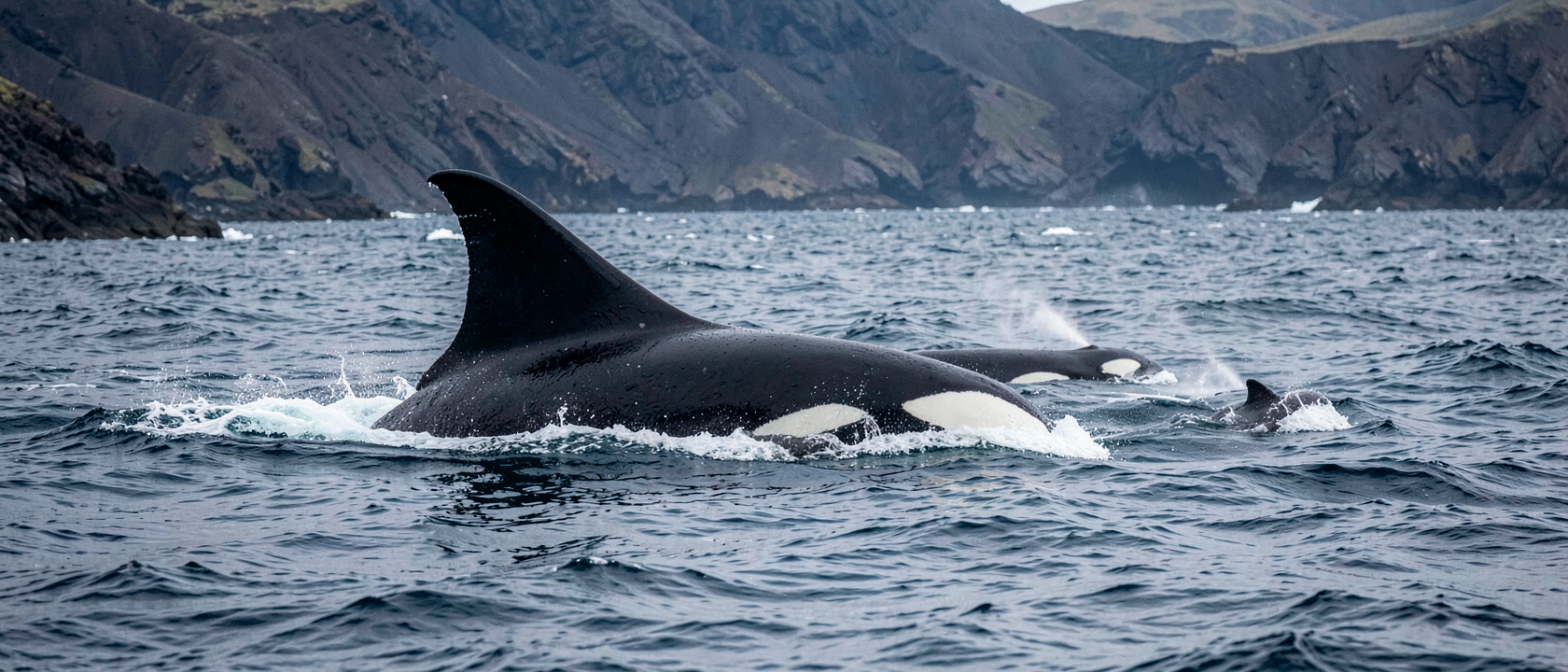
Two Fins, Two Years, One Killer
A dorsal fin turned up alone on a beach on Bering Island, off Russia’s Pacific coast, in August 2022. It was bloodied and scored with tooth marks, the kind of wound whale researchers usually read as the aftermath of an attack. Sergey Fomin, of the Pacific Institute of Geography in Russia, assumed at first he’d found evidence of a mammal-eating orca killing some other species. It likely belonged to a young male. In July 2024, about 1.2 miles (2 kilometers) away, he found a second, larger fin, marked the same way, from either an adult female or a juvenile male.
Genetic testing rewrote the story. Olga Filatova, of the University of Southern Denmark, and colleagues including Fomin sequenced skin left on both fins, reading mitochondrial DNA, the genetic material passed down mostly through mothers. Both matched North Pacific resident killer whales (Orcinus orca ater), fish-eating orcas that hunt salmon in tight-knit family pods. The bite marks came from another killer whale. The team published the findings on February 24, 2026, in Marine Mammal Science. Tooth-scarred fins had turned up before, but only from Baird’s beaked whales and minke whales killed by mammal-eating Bigg’s orcas (Orcinus orca rectipinnus). This was the first time the marks showed up on an orca itself, and the paper calls it a first case, not a pattern.
Why a Fin Washes Up At All
A killer whale carcass is supposed to sink, not drift ashore. Fresh remains go down fast and stay out of reach until decomposition produces enough gas to float them back up, days later, Filatova notes. A lone fin washing ashore points to a predator that ate around it and left the rest. Dorsal fin tissue is dense and cartilage-heavy, carrying almost none of the blubber and organ fat a hunting orca actually wants. Finish the kill, skip the fin, and it drifts free of the carcass.
The bite pattern matters too. Resident orcas do fight, but that aggression usually leaves rake marks along the flanks, from shoving within or between pods. That’s not where these marks sit. Filatova’s team reads the placement, and the fact that fins turned up without the rest of the animal, as evidence against ordinary pod conflict and toward something closer to predation.
What All Those Cousins Are For
Resident orcas live in an unusual arrangement: sons and daughters stay with their mothers for life, building family groups that can run for generations without splitting. The standard explanation is foraging, since salmon are patchy and seasonal and a large family finds them more reliably together. Filatova’s team proposes a second, sharper explanation: the group itself may be a defense.
Resident and Bigg’s orcas both seem to have deep roots in the North Pacific, with ties that researchers trace back hundreds of thousands of years, to a time when mammal-eating whales arrived first from the Atlantic as the waters opened up, with fish-eating residents establishing themselves later. If mammal-eating orcas have posed even occasional predation risk to residents since then, a large, permanent, related pod makes a straggler harder to pick off. Filatova believes the deaths behind these fins most likely happened during the huge social gatherings where dozens of unrelated resident families meet to breed, since related whales can’t mate within a family group. Those sprawling assemblies can stretch for miles, and a juvenile can slip away from its own tight-knit unit long enough to become a target. The hypothesis reframes the resident orca’s enormous extended family less as a fishing crew and more as a standing defense.
Orcas Don’t Actually Ignore Each Other
Most orca content repeats two comfortable assumptions: that fish-eating and mammal-eating orcas share the same water without conflict, and that a full-grown orca has nothing left to fear. This finding dents both. These fins mark encounters that were at minimum violent, and by Filatova’s reading lethal, between two orca types long assumed to just pass each other by. It doesn’t knock orcas off the top of the food chain; they remain apex predators with no non-orca species that regularly kills them. It does mean an orca’s short list of threats can include another orca.
Is This Enough to Explain Anything?
Outside researchers aren’t convinced this was a kill. Michael Weiss, of the Center for Whale Research, notes the same marks could come from Bigg’s orcas scavenging an already-dead orca, or from aggression between residents that drew blood without ending a life. Luke Rendell, of the University of St. Andrews, says two fins aren’t enough to build a theory of resident orca society; cooperative foraging and shared knowledge of where the fish are could still explain most of it.
Filatova doesn’t dispute the rarity. “At least now we know that cannibalism happens,” she has said, “but I think it is not super common.” Two fins, found two years apart, are a documented case, not a hunting habit. Whether occasional predation risk was strong enough over generations to shape resident orca society, or whether it’s a striking footnote to a life built mainly around salmon, isn’t settled by two dorsal fins on a beach.
The Calf That Wasn’t Eaten
In 2016, researchers watched Bigg’s orcas chase down and kill a newborn orca calf. They did not eat it. The leading explanation from the researchers who witnessed it is that killing the calf may have made its mother fertile again sooner than nursing would have allowed, a pattern documented in infanticide among other social mammals. It’s one incident, not a behavior rule for the subspecies. The detail worth keeping is the plain one: the kill wasn’t about hunger. It just cleared a calf out of the way, on somebody else’s biological schedule.