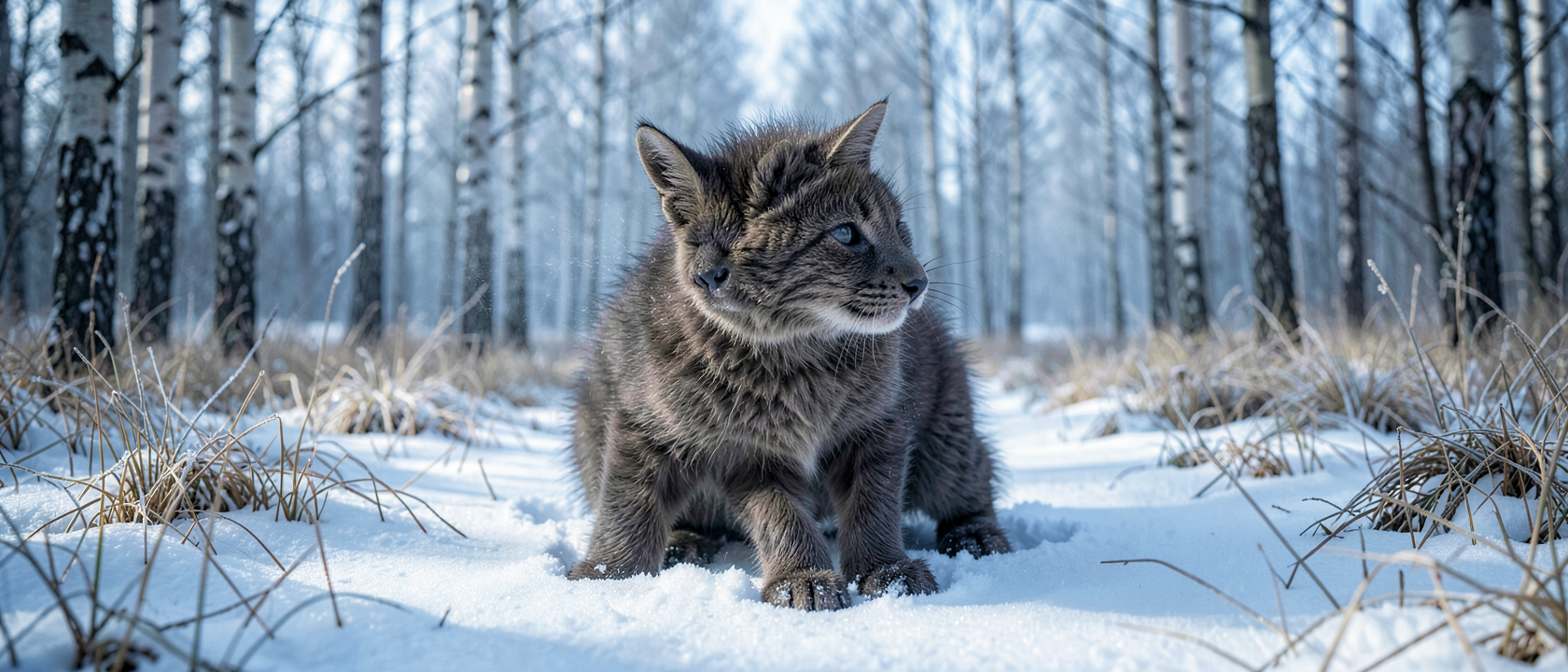
The Fact: A Mummy That Shouldn’t Exist
A mummified cub of Homotherium latidens, the scimitar-toothed cat, has come out of Siberian permafrost with its fur, muscle, and paws still on it. Radiocarbon dating places the cub somewhere between 31,808 and 37,019 years old, a range the team that studied it treats as the honest answer rather than a single tidy number. It is the first mummy of any saber-toothed cat species ever found, anywhere in the world.
Homotherium latidens is not the saber-tooth most people picture, that’s usually Smilodon, the dirk-toothed cat known from the La Brea tar pits, with huge curved fangs. Homotherium is a separate genus, with shorter, finely serrated canines and a leaner, longer-legged build suited to running prey down rather than ambushing it. Until this cub surfaced, everything known about either animal came from bone. Now a body exists, with soft tissue on it: a three-week-old cub preserving the head, forelimbs, and part of the chest.
The Mechanism: What Permafrost Actually Preserved
Because the cub froze fast and whole, soft tissue survived alongside bone, letting researchers measure traits that used to be pure guesswork. They compared it directly against a modern lion cub of the same age, the closest living reference point for a big cat’s proportions. Its neck was longer and more than twice as thick as the lion cub’s. Paleontologist Margaret Lewis noted that these enlarged neck muscles, along with the cub’s long, muscular forelimbs, were exactly what researchers had already expected from adult Homotherium bones, now confirmed on an actual body. Its jaw could open 11% to 19% wider than the lion cub’s, matching the bite mechanics those bones had always implied. Its upper lip ran more than twice as deep as the lion cub’s. Its paws were rounder than a lion’s, closer to a lynx’s shape, but the toe pads were square rather than round, and the cub had no carpal pad at all, the small pad normally set just above the toes that cats and dogs have today. None of that is inferred from bone shape; it is read straight off the preserved tissue.
A Coat Built for Nowhere to Hide
The fur held the biggest surprise. It is plain and uniform, a solid dark brown with no spots and no stripes, a detail Canadian Museum of Nature paleontologist Ashley Reynolds flagged as striking, since spotted and striped coats are the default on modern cat cubs.
The explanation researchers offer is about habitat, not style. A dappled coat exists to break up an outline against dappled light, and dappled light only exists where there is cover: forest edges, brush, broken shade. Homotherium latidens hunted across the mammoth steppe, the flat, largely treeless grassland of Ice Age Eurasia, where there was no dapple to disappear into. A plain coat fits a lanky, long-legged predator that ran prey down in open country rather than stalking from cover, in line with what is already known of the animal’s hunting style. What did not fit expectations was the shade: researchers had reasoned from living open-habitat cats, lions and pumas among them, toward something pale and sandy. Lopatin told National Geographic that the dark brown they actually found was completely unexpected.
Where Did the Teeth Actually Go?
A century of paleoart has trained everyone to expect a saber-tooth with its fangs on permanent display, two curved blades hanging past a shut jaw. That picture holds up reasonably well for Smilodon. Homotherium may be a different case.
A 2022 analysis argued that Homotherium’s muzzle was deep enough to treat its sabers as concealed weapons, tucked behind the upper lip once the mouth closed, the way a living lion’s canines vanish behind its own lip. The mummified cub adds real anatomy to that argument: its upper lip runs more than twice as deep as a modern lion cub’s. That is a structural fact, not a guess. What it is not is a photograph of a hidden fang, because this cub had not grown its adult saber teeth yet. The deep lip supports the concealed-weapon idea; it does not confirm it.
The Adult Nobody Has Found Yet
Whether a grown Homotherium actually hid its sabers behind that lip, and whether its coat stayed dark brown or lightened with age, are questions this cub cannot settle, since it is a cub. It has no adult teeth to check the lip proportions against, and mummified cave lion cubs found earlier in permafrost were darker at birth and lightened as they grew, so this cub’s shade may not match what it would have worn as an adult. Paleontologist Margaret Lewis has also pointed out that ice itself can shift a specimen’s color after death, meaning even this brown may not be the exact brown the animal carried in life.
None of that gets resolved without a second specimen, an adult one this time. Permafrost has produced exactly one mummified saber-toothed cat in the whole of the scientific record. Whether it produces a second is the real open question.
Found by Ivory Hunters, Not Scientists
Nobody on a paleontology grant found this animal. In 2020, prospectors working the banks of the Badyarikha River in Yakutia, hunting for ancient mammoth tusks to sell, noticed a frozen clump of hair sticking out of the bank. It turned out to be the cub, still wearing its fur after tens of thousands of years underground. A. V. Lopatin’s team at the Russian Academy of Sciences, who later described the specimen in Scientific Reports, took to calling it the saber-kitten.
Saber-tooth specialist Manuel Salesa summed up the moment for the New York Times: cat paleontologists had spent decades hoping a frozen saber-tooth would come out of the permafrost, and this was one of the high points of his career. It arrived, in the end, not from a research plan but from a riverbank, a tuft of hair, and someone looking for tusks.