HEADLINE:
New monkey species Colobus congoensis identified from 114 photos, no specimen
ARTICLE:
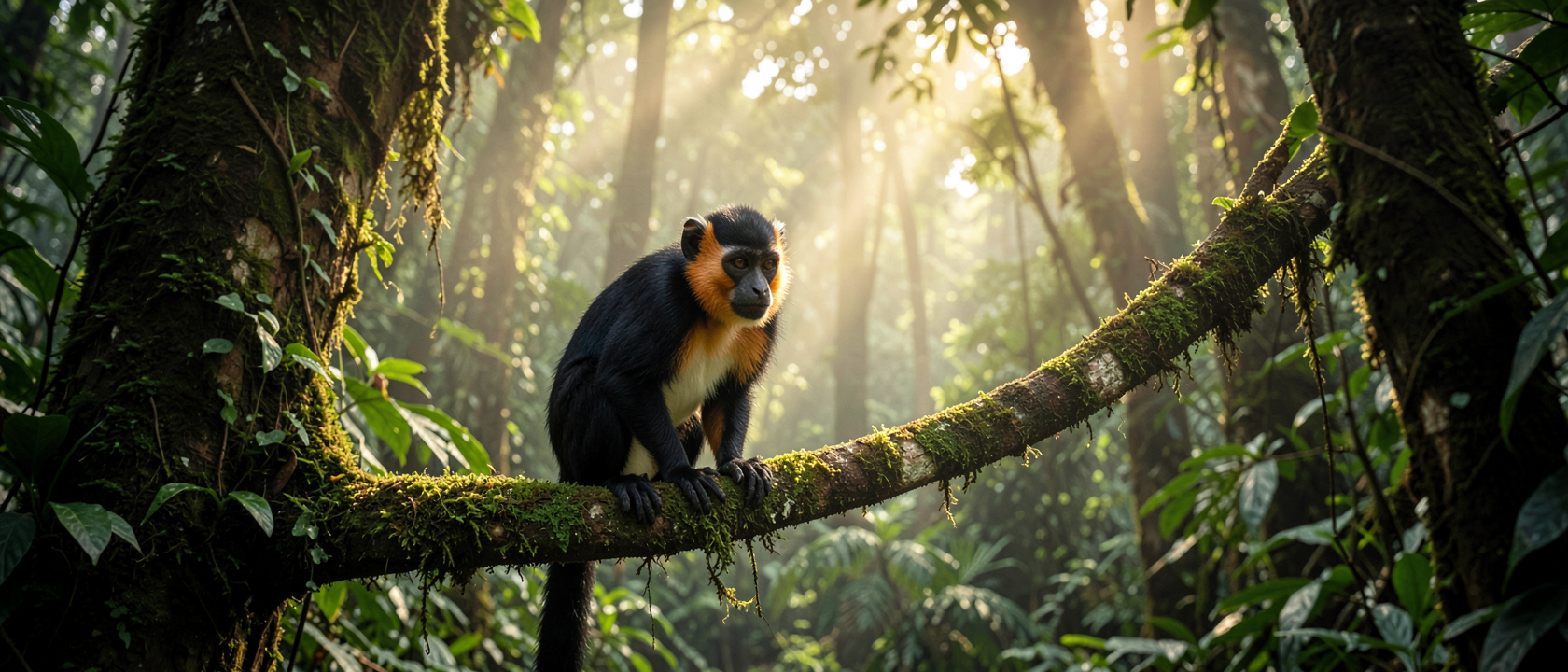
Between 2018 and 2022, patrol teams working the rainforest between the Lomami and Congo (Lualaba) rivers in east-central Democratic Republic of Congo photographed the same unfamiliar monkey 114 times. Nobody ever trapped one. Nobody ever brought one into a lab. The entire scientific case for a new species, Colobus congoensis, described in the journal PLOS One in 2026 by a team led by Hart, Amboko, Arenson, Horton, Coates, and colleagues, rests on photographs, six audio recordings, and comparisons against museum pelts collected decades earlier. The face is black, cut by a cream-orange patch running across the mouth, the philtrum (the groove between nose and upper lip), and the edges of the nostrils. Slate-gray cheekbones frame black-rimmed eyes. A white perianal patch, fine white hairs in males, bare skin in females, sits under a coat of silky black fur, with a spiky tuft standing up around the face and a long tail trailing behind. Nobody in a lab coat had ever laid a hand on this animal.
How You Describe a Monkey You’ve Never Touched
The case was built in layers. First came the physical traits above, none matching any known Colobus species on file. Julia Arenson of Yale University compared skulls and pelts against specimens held at the Yale Peabody Museum and the American Museum of Natural History, working alongside Christopher Gilbert of the City University of New York. Arenson noted that despite its smaller body size, the animal still shared teeth, skull, and facial features with the genus Colobus to the exclusion of other African colobines (a broader group of leaf-eating monkeys). Then came mitochondrial DNA sequencing, confirming it as a genuine Colobus and, more specifically, the sister species to Colobus satanas. Last came six recordings of its dawn and dusk roars, a rapid pulse punctuated by snorts, matching no relative’s call on record. Morphology, DNA, and voice all pointed the same way. That agreement is what separates “a monkey that looks a little off” from a species with a name.
Field teams also noticed how it behaves around people. Kate Detwiler of Florida Atlantic University, one of the researchers on the project, has described groups that don’t flee at the sight of a patrol. Instead, they climb higher into the canopy and watch, sometimes for over an hour. “It often feels as though we’re studying each other,” she said.
A Family Split Older Than the Rivers That Separate Them
Genetic analysis places the divergence between Colobus congoensis and Colobus satanas, its closest known relative, at roughly 4 to 5 million years ago, one of the oldest known splits inside the whole Colobus lineage. Satanas lives more than 746 miles (1,200 km) away, in west-central Africa. Congoensis, meanwhile, turned up in small groups averaging 6.2 individuals, often mixed in with two other colobine species, Piliocolobus parmentieri and Colobus angolensis, across roughly 656 square miles (1,700 km²) of closed-canopy forest on deep clay soils. Two close relatives, separated in genes and geography since long before the modern Congo basin looked anything like it does now. That timeline forces a rethink of how colobus monkeys actually spread and split across the continent, not just where they ended up.
The Myth This Kills
The assumption is that an undiscovered large mammal has to come from somewhere nobody goes, confirmed only through lab work on a captured specimen. Colobus congoensis argues otherwise. It already had names before any biologist showed up: Likweli among the Bangala, kasaba nkoni, “branch-shaker,” among the Mituku. But the gap wasn’t distance from people, and it wasn’t universal local knowledge either. When researchers visited 52 villages bordering the animal’s range, residents in only eight of them could describe it. What was missing was sustained photographic documentation and a genetic follow-up, built over four years of patrol work, that could turn a monkey some villages already had a word for into an entry in the scientific record. Alexander Georgiev of Bangor University, who wasn’t involved in the study, called the resulting analysis “very thorough and convincing,” adding that finding a monkey “little known to the people that live where it occurs is very rare and exciting indeed.”
What Nobody Has Counted Yet
No total population figure exists for Colobus congoensis. What researchers have proposed, citing its narrow range, small population, growing hunting pressure, and ongoing habitat loss, is a listing of Endangered on the IUCN Red List. A proposal is not a census. Nobody has published how many of these monkeys survive, how fast that number is dropping, or on what timeline the threats named in the paper will actually bite. A species can be fully entered into the scientific record and still be, in practical terms, uncounted.
One Biologist Named a Monkey After His Own Country
The species name fell to Junior Amboko, a biologist on the discovery team. He has described the choice as deeply personal, rooted in pride for his home country. Colobus congoensis is reportedly the first primate ever named directly after the Democratic Republic of Congo. It’s also the fifth new monkey species identified anywhere in Africa in the last 75 years, found in the buffer zone around Lomami National Park, a stretch of forest that had already produced one primate surprise before this one: the lesula, described by several of the same researchers in 2012.
—
**Style/consistency notes (fixed silently above):**, Added missing Oxford comma before “and colleagues” for consistency with the rest of the list style used elsewhere in the article. Changed comma-set-off parenthetical (“fine white hairs in males, bare skin in females”) to em dashes, since it interrupts the sentence more sharply and matches proper em-dash usage. Added comma after “Instead” for correct introductory-word punctuation. No relative-to-today time references were found requiring correction; all dates/timeframes are already absolute or year-based (“between 2018 and 2022,” “in 2026,” “4 to 5 million years ago,” “in the last 75 years,” “in 2012”), which are permitted. No subject–verb agreement, tense, homophone, or spelling errors were found beyond those corrected above.