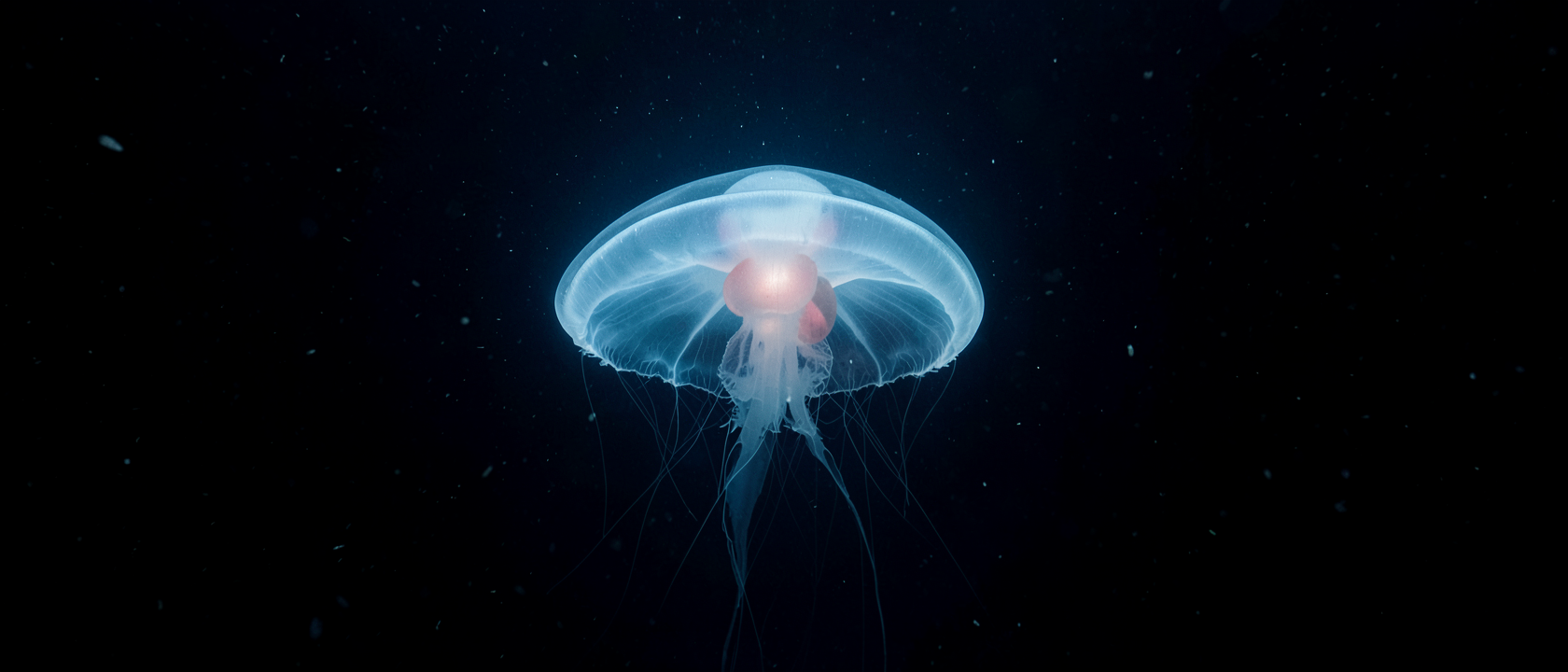
3,300 Feet Off Florida, Something That Wasn’t Supposed to Be There
On June 30, 2019, a jellyfish the size of a shot glass came up in a suction sampler off the Florida coast, pulled from 3,300 feet (999 meters) above the Blake Escarpment by the remotely operated vehicle (ROV) Deep Discoverer, working NOAA’s Windows to the Deep 2019 expedition aboard the research vessel Okeanos Explorer. The water at that depth was a steady 40°F (4.46°C), with a salinity of 34.988 and dissolved oxygen of 7.69 milligrams per liter, unremarkable numbers for the deep Atlantic. The animal itself was not unremarkable at all.
Genetic analysis published in 2025 by a team led by Javier Montenegro, of the Minderoo-UWA Deep-Sea Research Centre at the University of Western Australia, identified it as Botrynema brucei ellinorae, a subspecies (a population distinct enough to name, but not distinct enough to count as its own species) of deep-sea jellyfish that, until then, had only ever been documented in Arctic and subarctic waters. Florida is thousands of miles from the Arctic Circle. Before anyone worked out what it meant biologically, the finding was simply a location that made no sense.
The Deep-Sea Conveyor Belt That Might Have Carried It South
Montenegro’s team proposes an explanation, not a confirmed route: a current called the Deep Western Boundary Current, which creeps south along the ocean floor off North America, may have carried the Florida jellyfish down from higher latitudes over time, moving cold water southward for thousands of miles along the seabed.
The same paper points to a second current working in the opposite direction. The North Atlantic Drift, which helps keep subarctic waters distinct from the rest of the ocean, may act less like a route and more like a barrier, trapping the knobless form of the subspecies (the one missing the small bump on top of its bell, called an apical knob) up in the far north. That would explain why only knobbed individuals turn up far from home: one form gets a way out, the other doesn’t.
What the Knob Might Actually Be For
For decades, the apical knob was treated purely as an identification tag, the detail a researcher checked to decide which species was floating in the sample jar. Montenegro and his co-authors raise a different possibility, offered as a hypothesis and not a settled result: the knob might be a defense, something that makes the animal harder to eat for predatory jellyfish in the genus Solmissus, which show up more often in warmer, southern waters than in the Arctic.
If that holds up, the knob stops being a label and becomes equipment. A structure biologists spent generations using to sort jellies into boxes on a chart might actually be doing a job, out in the water, for the animal wearing it.
Scientists Have Been Splitting This Animal in Two for Decades, Wrongly
Since the 1940s, the standard assumption was that Botrynema cleanly divides into two species: a knobbed form, Botrynema brucei, found worldwide in deep water, and a knobless form, Botrynema ellinorae, confined to the Arctic. Montenegro’s team, working with co-authors from the University Museum of Bergen, NOAA Fisheries’ National Systematics Laboratory, and Japan’s JAMSTEC, ran genetic testing across specimens from both groups. Using four genetic markers, they found no clear species-level split.
The detail that broke the old rule: some specimens genetically confirmed as ellinorae carried the knob too, the exact feature that was supposed to rule that out. B. ellinorae has now been reclassified as a subspecies, Botrynema brucei ellinorae, rather than a separate species defined by a bump on its back.
Nobody Knows How It Actually Got There
What the 2025 paper does not resolve is why the knobless form of B. brucei ellinorae stays locked in the far north while knobbed individuals show up both in the Arctic and thousands of miles south, off Florida. The Deep Western Boundary Current is an inference drawn from ocean physics, a current running in the right direction at the right depth, not a journey anyone actually tracked. No one followed this jellyfish, or any jellyfish, down that route. The exact mechanism, and the path it truly traveled, stays open.
It Sat in a Sample Jar for Years Before Anyone Knew What It Had Done
In 2019, nobody aboard the Okeanos Explorer treated the Florida jellyfish as a headline. Daniel Rogers collected it with a suction sampler during dive 9, it was logged as specimen USNM-1580834, and it went into storage like a thousand other incidental catches from a routine ROV dive. It took six years and a genetic reanalysis, published by Montenegro’s team in 2025, to show that this one animal had already rewritten the known range of its own subspecies, quietly, the entire time it sat on a shelf. Nobody was chasing a discovery. The discovery was just waiting to be sequenced.