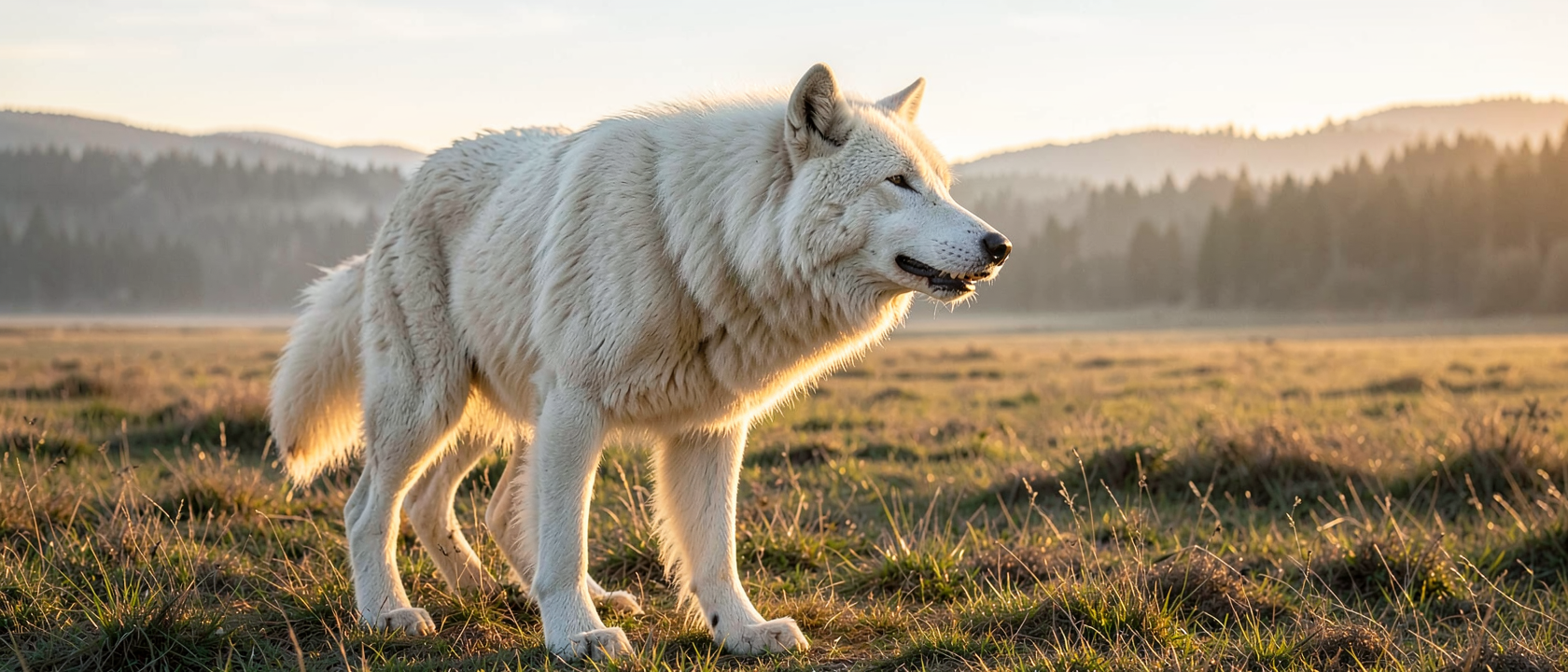
Three Pups, One Announcement
Colossal Biosciences CEO Ben Lamm has announced three living animals that his company calls dire wolves (Aenocyon dirus), a species extinct for roughly 12,500 years. Two of them, males named Romulus and Remus, were born by cesarean section on October 1, 2024. A third, a female named Khaleesi, was born on January 30, 2025, from a separate procedure. These are not fossils or reconstructions in a museum case. They are three animals that stand up, eat, and howl.
How You Actually Build a Dire Wolf
The blueprint came from two fossils: a tooth about 13,000 years old found in Ohio, and an inner ear bone about 72,000 years old found in Idaho. Colossal’s chief science officer, evolutionary biologist Beth Shapiro, and her team sequenced the dire wolf’s genome from that ancient material and compared it against living gray wolves, jackals, and foxes. The two species, it turns out, share about 99.5% of their DNA.
The remaining 0.5% is where the lab work happened. Using CRISPR, a gene-editing tool that cuts and rewrites targeted DNA sequences, scientists made 20 edits to gray wolf blood cells, 15 of them across 14 genes matching the exact ancient dire wolf variants. Those edited nuclei were inserted into gray wolf egg cells stripped of their own nuclei, the same cloning method that produced Dolly the sheep in 1996. The embryos were implanted into domestic dogs, technically a subspecies of the gray wolf, acting as surrogates. Out of 45 embryos transferred, exactly two pregnancies took hold, one each in two separate dogs. A 65-day gestation later, Romulus and Remus existed.
Why These 20 Genes, Specifically
Colossal ties its edits to four traits: a larger body, a white coat, bigger teeth, and a distinct howl. The size target is itself fuzzy. The San Diego Zoo Wildlife Alliance lists the historic dire wolf’s weight at 75 to 148 pounds (34 to 67 kilograms), other estimates run as high as about 176 pounds (80 kilograms), and body length estimates span roughly 4 to nearly 6 feet (1.2 to 1.8 meters). The animal being aimed at is a range, not a fixed number.
The white coat did the branding work by itself. Snowy fur, pink ears, an oversized frame: the pups look like Ghost, the direwolf belonging to Jon Snow in HBO’s Game of Thrones. Colossal ran with it. Romulus and Remus, for Rome’s mythical founders. Khaleesi, lifted straight from the same show. Reproductive biology scientist Darya Tourzani called the project “science fiction at its finest” in an April 2025 statement, a line that describes the marketing as accurately as it describes the science.
The Myth: “World’s First De-Extinction”
Colossal calls this the world’s first de-extinction. Its own reference points contradict that. In 2003, Spanish scientists cloned a Pyrenean ibex (Capra pyrenaica pyrenaica), a subspecies that had already died out; the clone was born alive and died minutes later, according to a 2009 study. A birth happened, briefly, more than two decades before Romulus took his first steps.
The bigger argument isn’t about the calendar. It’s about what these animals are. A 2021 study in Nature found dire wolves genetically distinct enough from gray wolves and coyotes that interbreeding between the lineages would not have been possible, distinct enough that dire wolves were pulled out of the genus Canis and given their own: Aenocyon. Vincent Lynch, a biologist at the University at Buffalo, put it directly: “It is not a dire wolf; it is a gray wolf clone with some mutations that make it superficially resemble a dire wolf.” Twenty edited variants sit on top of a genome that is still overwhelmingly Canis lupus. Whether that adds up to a dire wolf or a wolf wearing a very good disguise is the actual fight, and Colossal’s own critics are on the record on one side of it.
What Nobody Knows Yet
What’s public is footage: first steps, first howls, three animals growing up on a fenced 2,000-acre (809-hectare) preserve at an undisclosed U.S. location. TIME reported in April 2025 that Remus weighed 80 pounds (36 kilograms) at five months old, on track for an expected adult weight of 150 pounds (68 kilograms). That’s one measurement from one pup, not a growth curve. Nobody has published what these animals look like, weigh, or behave like as adults, because none of them have finished growing up.
Colossal has also announced two litters of cloned red wolves (Canis rufus), described as the world’s most critically endangered wolf species, using related cloning technology. No numbers on those litters have been released at all. The dire wolves got the headlines. The red wolves, for now, got a footnote.
—
**Changes made:**
1. Removed “right now” from “What’s public right now is footage”, a forbidden relative-to-today phrase; replaced with “What’s public is footage.”
No other errors were found: subject–verb agreement, articles, tense, pronouns/homophones, spelling, punctuation, and capitalization were all correct throughout.