
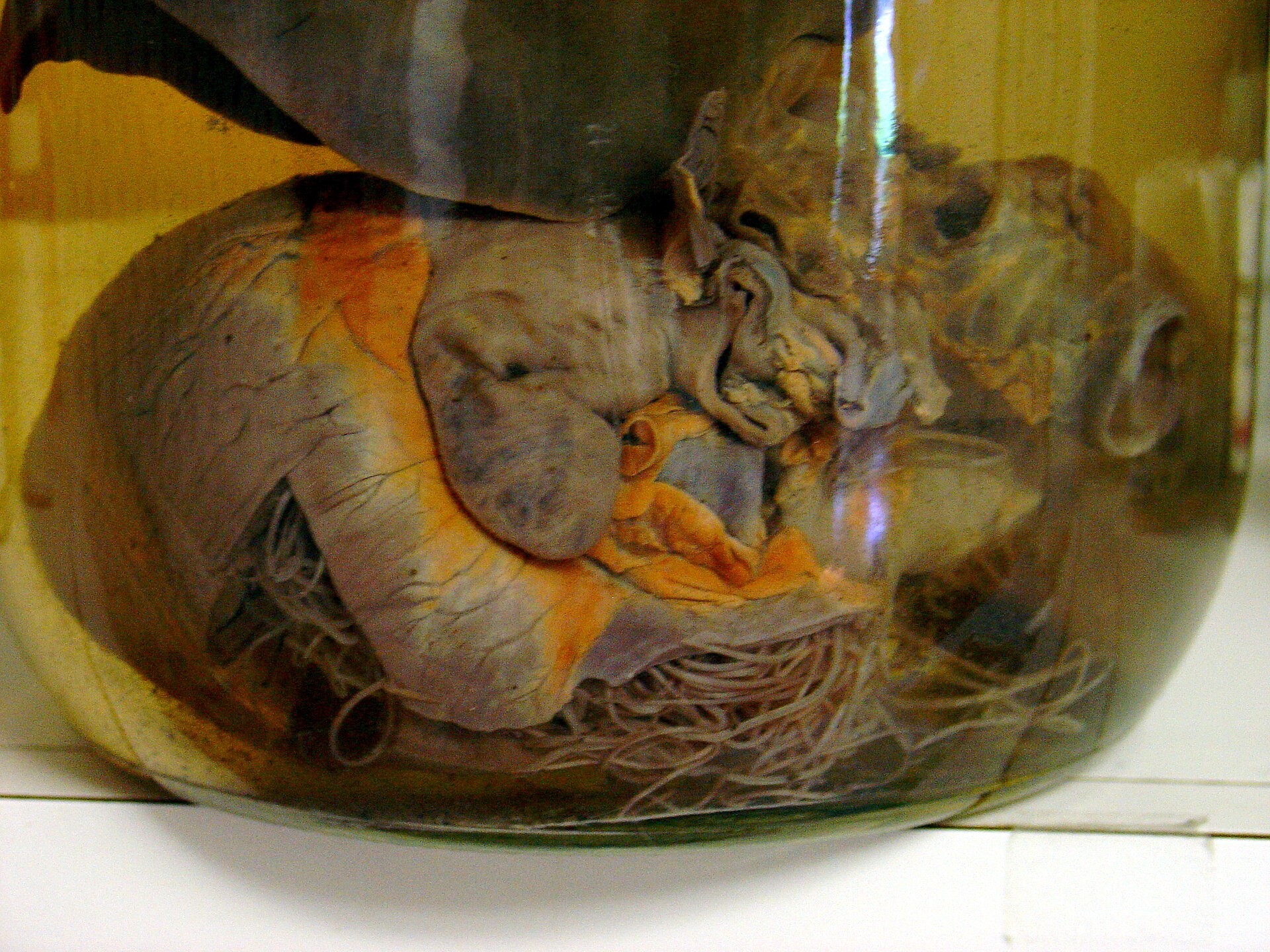
Dirofilaria immitis, commonly called the heartworm, is a parasitic nematode that completes its adult life inside the right side of the heart and the pulmonary vessels of mammalian hosts, most often dogs. Adult females reach up to 30 cm in length, making them among the largest tissue-dwelling nematodes recovered from companion animals. The species is transmitted exclusively through mosquito bites, and its microfilariae have evolved a blood-density cycle locked to the hours when mosquitoes are most actively feeding. From a single documented region in the mid-nineteenth century, the parasite now registers in shelters, clinics, and hyperendemic zones across multiple continents.
Key facts
- Scientific name: Dirofilaria immitis
- Kingdom: Animalia
- Phylum: Nematoda
- Class: Chromadorea
- Order: Rhabditida
- Family: Onchocercidae
- Genus: Dirofilaria
- Taxonomic rank: species
- Endemic to: Bangladesh
Physical description
Adult female heartworms are slender and white, reaching up to 30 cm in length. Males are approximately half that size, and the male’s tail ends in a characteristic spiral, the detail most useful for distinguishing sex in necropsy specimens. Adults live free in the blood of the right heart and pulmonary vessels rather than encysted in tissue, which keeps them in constant contact with circulating blood and the microfilariae they produce.
Females are ovoviviparous, releasing live first-stage larvae called microfilariae directly into host tissues rather than depositing eggs. These larvae can persist circulating in a dog’s bloodstream for up to two years even after all adult worms have died. Their density in peripheral blood peaks at night, a timing that corresponds precisely to the peak biting activity of the mosquito vectors that must ingest them to continue the parasite’s life cycle.
History of discovery and naming
The earliest recorded encounter with the parasite predates formal taxonomy by nearly three centuries. In 1586, Chez Jean Wolf sketched what he described as a ‘monster’ found inside the heart of a horse, an image that captured the worm’s presence without placing it in any biological framework. The species was not scientifically described until 1856, when American parasitologist Joseph Leidy formally named it Filaria immitis after specimens were recovered from dogs on the southeastern coast of the United States.
Heartworm infection was not documented in cats until the 1920s. The first reported human infection in America came in 1952, nearly a century after Leidy’s original description. Each of these expansions of the known host range arrived long after the parasite had been circulating undetected in those populations.
Life cycle and host range
After a dog acquires infection through a mosquito bite, adult worms reach sexual maturity in 6 to 7 months, a window called the prepatent period. Once established, adults survive inside the dog host for 5 to 7 years. Diagnosis by antigen detection becomes possible around 180 days post-infection, which aligns closely with the end of the prepatent period.
Cats occupy a different position in the parasite’s biology. They are considered imperfect hosts, typically harboring only 1 to 3 adult worms, often of a single sex, which means reproduction frequently cannot occur. Circulating microfilariae are seldom found in infected cats. A 2020 comparative study found adult heartworm infection prevalence of 28% in dogs versus 4% in cats when both species were tested with multiple diagnostic methods at the same time.
Melarsomine is the only registered adulticide drug approved against adult Dirofilaria immitis. For cats, no equivalent adulticide exists, partly because the low worm burden and atypical immune response make the feline disease a distinct clinical entity from the canine form.
Geographic spread and prevalence
A 2024 survey by the AHS and the Association of Shelter Veterinarians, covering 135 shelters across the United States, found a median heartworm-positive prevalence of 1% among dogs. Regional variation, however, is extreme: one shelter in the Southeastern United States reported a positive rate of 70% among its dog population in that same survey. Between 2013 and 2016, positive heartworm antigen tests in U.S. dogs increased by 15.28%, a rise that tracked a reported 21.7% increase in average cases per veterinary clinic over the same period.
Gran Canaria, in Spain’s Canary Islands, illustrates how local conditions can produce concentrated transmission. Researchers describe the island as hyperendemic for dirofilariosis, a designation supported by a dog population of approximately 203,917 animals and a cat population of around 31,758, alongside abundant mosquito vectors including Culex theileri.
Drug resistance and current research
At least six strains of Dirofilaria immitis have been identified as resistant to macrocyclic lactone preventive drugs, the class most widely used against the parasite. One of these strains, designated JYD34, has become a recognized reference point in resistance tracking. The existence of multiple resistant strains raises questions about the long-term reliability of the preventive tools available, particularly in high-prevalence regions where transmission pressure is constant.
Current research is focused on anti-Wolbachia molecules as a therapeutic strategy. Wolbachia are endosymbiotic bacteria that live inside heartworm tissue and appear essential to the parasite’s survival and reproduction; molecules that disrupt them offer a potential route around the limitations of existing adulticides and the problem of macrocyclic lactone resistance.
Did you know
- One heartworm strain resistant to standard preventive drugs has been given the nickname JYD34 by researchers tracking drug resistance. (dvm360.com)
- Microfilariae circulate most densely in a dog’s blood at night specifically because that is when mosquitoes are most actively seeking blood meals. (esccapuk.org.uk)
- One shelter in the Southeastern United States reported a heartworm-positive rate of 70% among its dogs in a 2024 survey, far above the national median of just 1%. (pmc.ncbi.nlm.nih.gov)
- Gran Canaria in Spain’s Canary Islands is considered “hyperendemic” for heartworm, a status tied to its dense dog and cat populations alongside the mosquito species Culex theileri. (ncbi.nlm.nih.gov)
Data sources
Data updated: 2026-11-28