
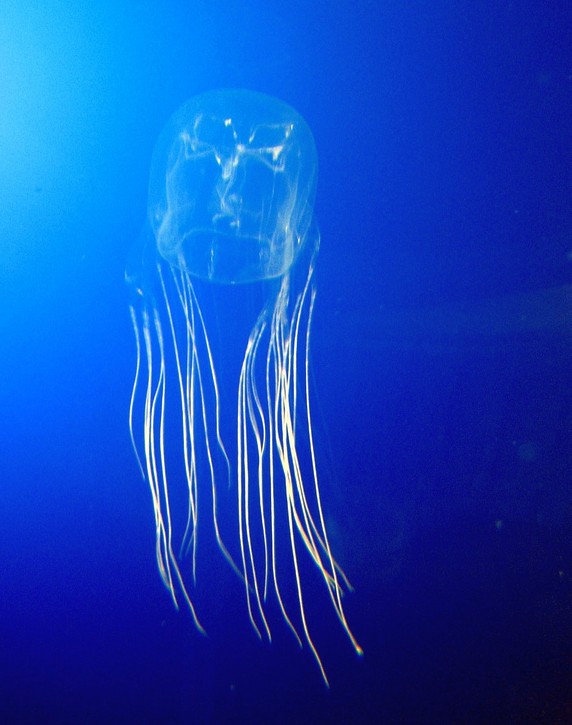
Chironex fleckeri, the Australian box jelly, is the largest species in the class Cubozoa and carries a venom capable of killing a person within two to five minutes of a significant sting. It belongs to the phylum Cnidaria and is found in the coastal waters of northern Australia and the Indo-Pacific region. A single specimen can deploy roughly 30 million nematocysts across up to 60 tentacles, each one capable of injecting toxin on contact. The IUCN Red List classifies the species as Least Concern, meaning its survival is not currently at risk, even as research into its venom proteins continues to advance.
Key facts
- Scientific name: Chironex fleckeri
- Kingdom: Animalia
- Phylum: Cnidaria
- Class: Cubozoa
- Order: Chirodropida
- Family: Chirodropidae
- Genus: Chironex
- Taxonomic rank: species
Size, structure and movement
Chironex fleckeri is the largest of the box jellyfish, with bell diameters reaching up to one foot and tentacles that extend to ten feet in length. The tentacles are thick and bootlace-like in texture, bearing the nematocyst-laden cells responsible for envenomation. Each individual carries around 60 tentacles, and the total nematocyst count across those tentacles reaches approximately 30 million.
Unlike most jellyfish, which drift passively with ocean currents, C. fleckeri can swim at maximum speeds approaching four knots. Combined with eyes equipped with photoreceptors, this mobility leads some researchers to conclude that box jellyfish actively pursue prey rather than encountering it by chance. The species feeds mainly on shrimp and small fish, with adults typically hunting in shallow water. When prey is killed, the tentacles reel the body back toward the mouth.
Eyes without a brain
Chironex fleckeri has eyes with functional photoreceptors, yet possesses no brain. How the animal integrates visual information and coordinates behavior without any centralized nervous processing is a genuinely open question in cnidarian biology. The mismatch between sophisticated sensory structures and the complete absence of a brain makes characterizing the animal’s perception and any form of communication especially difficult.
Reproduction and the polyp stage
Breeding occurs once a year, from late summer to early autumn. Adult box jellyfish gather each spring to spawn in rivers and similar bodies of water, where mature individuals release either sperm or eggs. Shortly after spawning, the adults die.
The benthic polyp stage, the sessile phase between fertilization and the free-swimming medusa, was long difficult to locate in the wild. Researchers eventually used environmental DNA (eDNA) metabarcoding technology to detect polyps in habitats associated with nearby rocky substrata and shallow carbonate reefs, resolving a gap in the life-cycle record that had persisted for decades.
Venom mechanism and toxicity
The venom of C. fleckeri acts by making cell membranes porous, allowing potassium to leak out of cells. The resulting hyperkalemia can trigger cardiovascular collapse. The measured LD50 in laboratory mice is 0.04 mg/kg, placing the toxin among the most potent venoms studied in marine animals. Death in humans can occur within two to five minutes following a severe sting.
A transcriptome and venom proteome study sequenced C. fleckeri tentacle tissue using the Illumina platform, generating 43,150,858 paired reads. From this dataset, researchers identified two sets of porin toxins: CfTX-A and CfTX-B, suspected to cause hemolytic effects, and CfTX-1 and CfTX-2, suspected to cause cardiotoxic effects. These proteins are specific to Chironex fleckeri and are considered the major toxic components of its venom.
Stings in the wild: patterns from the Top End study
A prospective study of C. fleckeri stings in the Top End of Australia found that 92% of stings occurred during the stinger season, defined as October 1 to June 1. Of all recorded stings, 83% happened in water one meter or less deep. The concentration of incidents in shallow, nearshore water during those months shapes where stinger nets are deployed: some beaches within the species’ range use these enclosures to separate swimmers from open water during peak season.
Formal description and naming
Chironex fleckeri was formally named by Southcott in 1956. The species name honors Dr. Hugo Flecker, a North Queensland toxicologist and radiologist who identified the animal following the death of a 5-year-old boy stung at Cardwell on January 20, 1955. The case gave Flecker the material needed to characterize the species, and Southcott’s formal description established it in the taxonomic record under the family Chirodropidae, order Chirodropida.
Conservation status
The IUCN Red List classifies Chironex fleckeri as Least Concern. No population data in the verified record indicates a decline sufficient to move the species toward a threatened category. Research attention has focused far more on the venom and life cycle than on population monitoring, which leaves the ecology of the polyp stage and the full geographic range of the species as areas where the record remains incomplete.
Data sources
Data updated: 2026-11-28