
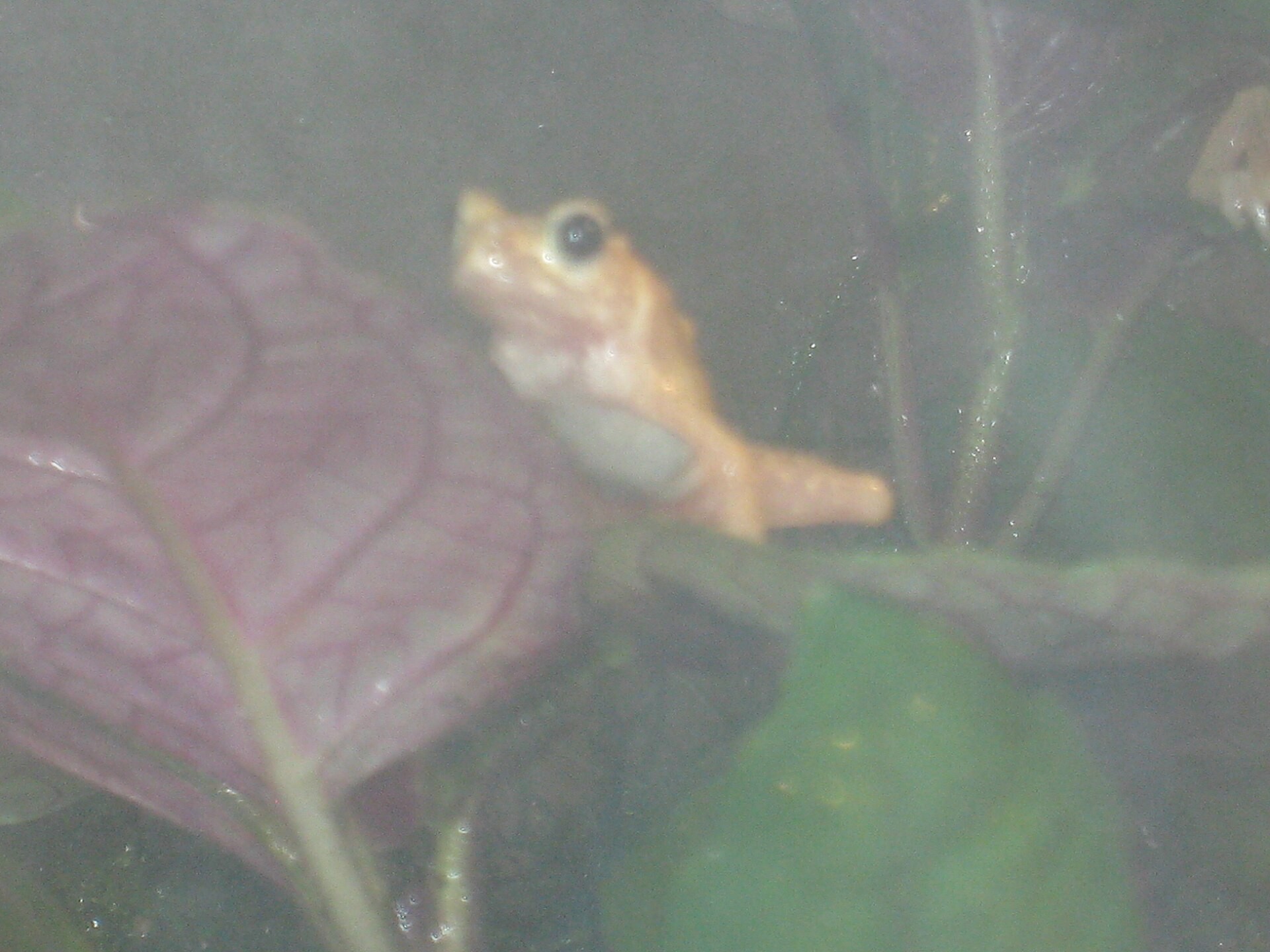
The Kihansi Spray Toad (Nectophrynoides asperginis) is a small bufonid amphibian endemic to a single gorge in the Udzungwa Mountains of Tanzania, discovered in 1996 and formally described in African Journal of Herpetology 47(2): 59–67. Its entire pre-dam natural range covered roughly 4,700 square metres of spray wetland at the Kihansi River Gorge upper falls, at an elevation of approximately 940 metres. A population that once numbered an estimated 18,000 individuals collapsed after the Lower Kihansi Hydropower Project diverted the river; the species was subsequently declared extinct in the wild before a coordinated captive-breeding and reintroduction programme returned it to its native habitat. The holotype specimen is held at the Natural History Museum under accession number BM 1998.136.
Key facts
- Scientific name: Nectophrynoides asperginis
- Kingdom: Animalia
- Phylum: Chordata
- Class: Amphibia
- Order: Anura
- Family: Bufonidae
- Genus: Nectophrynoides
- Taxonomic rank: species
- Endemic to: Tanzania
Physical characteristics and diet
Reporters described the species as roughly the size of a human thumbnail, with gold coloration. No external tympana are present on the sides of the head, a feature that sets it apart from many other bufonids. The toads also carry small flaps over their nostrils, a structure that may represent an adaptation to continuous moisture in the spray zone of a waterfall, though the precise function has not been established in controlled study.
Stomach content analysis of wild individuals showed a diet centred on dipterids and dipterid larvae, with acarine mites and springtails appearing as secondary items. The analysis does not currently support claims of a broader or more generalised diet.
Habitat: the Kihansi spray wetland
The species is known from one location: the upper-falls spray wetland of the Kihansi River Gorge, in the southern Udzungwa Mountains of Tanzania. The gorge sits at roughly 940 metres elevation, and the habitat it supports depends entirely on the continuous spray produced as the Kihansi River drops over the steep Udzungwa scarp. That spray historically showered patches of herbaceous vegetation and moss-covered rocks, creating a series of interconnected spray wetlands across an area encompassing about 2 hectares.
The dependency of the entire species on a single 2-hectare site, within which the functional spray wetlands themselves covered only about 4,700 square metres, meant that any significant change to water flow represented an existential threat to the population.
Discovery and formal description
Nectophrynoides asperginis was first found in 1996 during surveys at Kihansi Gorge. The formal description was published in the African Journal of Herpetology, volume 47, issue 2, pages 59 to 67. The holotype is catalogued at the Natural History Museum in London as BM 1998.136. The species belongs to the family Bufonidae, order Anura, class Amphibia, phylum Chordata, kingdom Animalia, within the genus Nectophrynoides.
Population crash and captive rescue
Construction of the Lower Kihansi Hydropower Project diverted a substantial portion of the river’s flow, stripping the gorge of the spray on which the toads depended. The wild population, estimated at close to 18,000 individuals before the project, crashed. By 2000, the Tanzanian government invited the Bronx Zoo to intervene; staff collected 499 toads from the gorge to establish a captive assurance population. Some individuals were subsequently transferred to the Toledo Zoo, extending the genetic base of the captive group.
The captive programme was not straightforward. Parasites and nutritional problems drove the combined captive population down to a low of just 72 individuals at one point, a figure that, given the total wild collapse happening simultaneously, represented the entire species. By 2010, however, the breeding programmes at both institutions had recovered: 5,000 toads lived at the Toledo Zoo and 1,500 at the Bronx Zoo, all descended from the original 499 animals collected from the gorge.
Artificial spray system and reintroduction
An artificial sprinkler and misting system designed to replicate the pre-dam spray conditions at Kihansi Falls was constructed in 2000 and has operated continuously since, maintained by the Tanzanian government and the World Bank. The system was a prerequisite for any reintroduction attempt, as the natural spray regime that defined the habitat no longer existed in its original form.
In August 2010, 100 toads were flown from the Bronx and Toledo Zoos to Tanzania and housed at a propagation centre in Dar es Salaam. About 2,000 captive-bred toads from the two zoos were subsequently reintroduced into the Kihansi Gorge, an event described at the time as the first occasion on which an amphibian species declared extinct in the wild had been returned to its native habitat. WCS president Cristián Samper called the 2012 reintroduction a momentous achievement in conservation after a 12-year rescue effort.
Post-reintroduction monitoring and ongoing challenges
A December 2022 field survey and subsequent monitoring recorded 98% mortality among 1,000 captive-bred toads released into the Midgorge Spray Wetland. The scale of mortality prompted researchers to re-evaluate the role of chytrid fungus, which had been detected at the site two decades earlier. The findings indicate that successful reintroduction into the gorge remains an open problem rather than a completed achievement, with the specific contribution of chytrid relative to other stressors still under active investigation.
Did you know
- The toad’s entire natural range before the dam was just 4,700 m² of spray wetlands, an area smaller than a standard soccer pitch. (ncbi.nlm.nih.gov)
- Reporters described the species as roughly the size of a human thumbnail, with gold coloration. (reptilesmagazine.com)
- WCS president Cristián Samper called the 2012 reintroduction “a momentous achievement in conservation” after a 12-year rescue effort. (newsroom.wcs.org)
- During the captive-rescue period, the combined zoo populations at one point fell to just 72 individuals due to parasites and nutritional problems. (thegef.org)
- By 2010, 5,000 toads lived at the Toledo Zoo and 1,500 at the Bronx Zoo, all descended from the original 499 collected from the wild. (programs.wcs.org)
Data sources
Data updated: 2026-11-27