
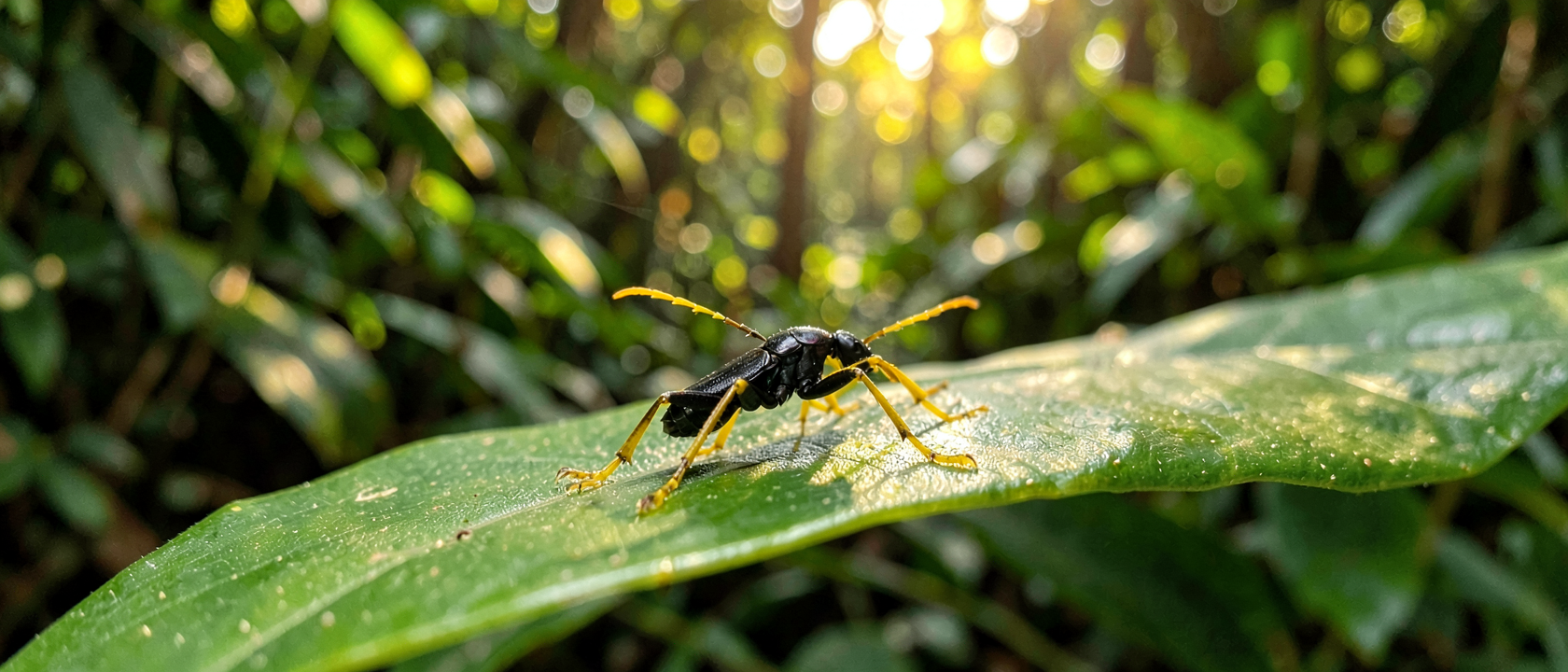
Macratria durrelli is a black beetle with yellow-tipped legs and antennae, newly described from Madagascar, and it tilts and swings its head in a motion that mimics the scanning sweep of a biting ant. Dmitry Telnov, the curator who named and described the species at the Natural History Museum in London, has now personally authored formal descriptions for more than 150 species within its genus, Macratria, which holds over 320 species worldwide.
Half a Genus in One Man’s Pinned Drawers
Macratria durrelli appears in a paper published in the journal Annales Zoologici, Telnov’s survey of the antlike flower beetle family, Anthicidae, in Madagascar, which also reports seven species new to science and an annotated checklist of the island’s known members. The new beetle brings Telnov’s personal tally inside the genus Macratria past 150 formally named species, close to half of the roughly 320 species recognized worldwide. Macratria beetles occur on every continent except Antarctica, concentrated in the tropics, the zone Telnov has built his career around.
The same survey found that more than 80% of Madagascar’s Anthicidae species exist nowhere else on the planet, among the highest endemism rates recorded for any invertebrate group on the island. One curator’s pinned drawers now hold the type specimens, the single preserved individual each species name is officially anchored to, for close to half of a genus spread across the tropical world.
How to Scan the Sky Like a Formicid
Most beetles move like small tanks: a hardened, heavily armored exoskeleton, and a head that swings only as far as a stiff joint will allow. Antlike flower beetles, the family Macratria durrelli belongs to, break that pattern. A narrowed, flexible joint behind the head lets the whole skull tilt, dip, and rotate somewhat independently of the thorax, the mid-section the legs and wings attach to, instead of staying locked forward.
As the beetle moves, it sweeps its antennae through the air in the same searching rhythm a foraging ant reads a trail. Ants belong to the insect family Formicidae, formicids for short, and the Natural History Museum suggests this is likely where the group’s common name comes from: a beetle doing an ant’s job of scanning, without being an ant. A bird or spider hunting by sight has to decide, in an instant, whether a small moving body is worth a bite. An ant that bites back is a bad bet. A beetle that moves like one gets the same pass, at no chemical cost to itself.
Smuggled Natural History in Soviet Latvia
Telnov grew up in Soviet-occupied Latvia, where leaving the USSR was not an option for ordinary citizens. Foreign travel was banned, but Russian translations of Gerald Durrell’s wildlife memoirs slipped past Soviet censors, who read them as harmless, apolitical escapism, and they circulated widely across the Soviet Union. Telnov received his first one in his youth.
“Travelling outside the Soviet Union was banned,” Telnov has said, “so Gerald’s stories provided a way for many of us to peer from behind the Iron Curtain into the wider world.” Those paperbacks pointed him toward tropical insects long before he could see one in person; his career studying them began only after the Soviet Union collapsed in the 1990s. Naming a Madagascan beetle after the author honored that early influence.
Killing the Victorian Animal Showcase
“This new species of beetle is from Madagascar, a country where Gerald worked for a long time,” Telnov has said. “It was part of his work here that made him realize that species were disappearing and we had to do something about it.” Durrell’s childhood on Corfu was spent filling the family home with collected tortoises, scorpions, butterflies, and snakes, an instinct for collecting that later turned into one of conservation’s clearest arguments: that keeping and breeding endangered animals, with the aim of returning them to the wild, is what gives a zoo its reason to exist.
Durrell died on January 30, 1995, and a memorial celebration of his life was held later that year at the Natural History Museum, attended by guests including Sir David Attenborough. In 2025, the centennial year of his 1925 birth, the tribute was a newly described beetle from the island where he first watched a species disappear.
Known Only by Its Pinned Silhouette
Telnov described Macratria durrelli entirely from preserved museum specimens, not from animals observed alive in the field. No published source yet gives its body length or weight, and the exact site and date where the type specimen was collected in Madagascar is not detailed either.
What the beetle eats as a larva, how long it lives, how it finds a mate, and how many individuals survive in the wild are all unanswered. Nobody has confirmed whether it lives high in the forest canopy, down in leaf litter, or somewhere a collecting net has never reached twice. The species currently exists in scientific records solely as pinned museum material and a diagnosis in print.