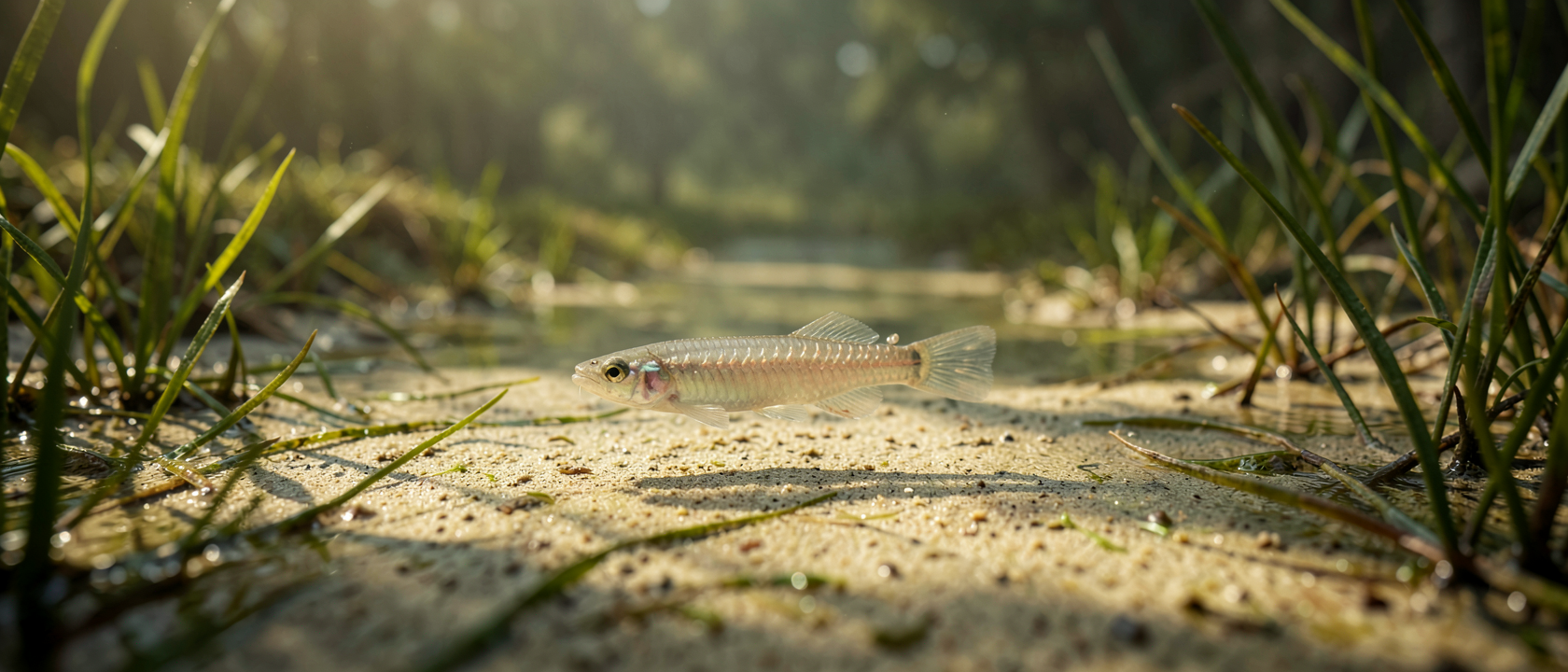
A Thumb-Sized Fish Rewrites Its Own Family Tree
A fossil fish about 1.6 inches (4 cm) long, roughly the length of a thumb, has turned out to be the oldest known North American member of the otophysan supergroup, the lineage that today includes catfish, carp and tetras and accounts for two-thirds of all freshwater fish species alive. Researchers from Western University, the Royal Tyrrell Museum of Palaeontology, the University of California, Berkeley, and the University of Alberta described the new species in the journal Science on October 2, 2025. Western University’s press release spells it Acronichthys maccognoi; other sources, including the paper’s own taxonomic record, use maccagnoi. The spelling has not been settled between sources. It comes from a freshwater fossil bed at Dry Island Buffalo Jump Provincial Park in southwestern Alberta and dates to the Late Cretaceous, the same span of time, roughly 100.5 million to 66 million years ago, that produced Tyrannosaurus rex. So far it is the only known member of its own family, Acronichthyidae.
Otophysan is a mouthful for a simple idea: it means a fish built around a specific bony hookup for hearing, four modified vertebrae wired between the swim bladder and the inner ear. Finding that hookup this far back in the North American fossil record, in a skeleton this small, is what makes the discovery matter. “The reason Acronichthys is so exciting is that it fills a gap in our record of the otophysan supergroup,” said Neil Banerjee, the study’s senior author at Western University. “It is the oldest North American member of the group and provides incredible data to help document the origin and early evolution of so many freshwater fish living today.”
How Four Vertebrae Became a Hearing Aid
To look inside the skeleton without taking it apart, the team turned to synchrotron micro-CT scanning, a technique that stacks thousands of ultra-thin X-ray slices into a 3D model with no chisel involved. The scans ran at the Canadian Light Source in Saskatoon and the Advanced Photon Source in Lemont, Illinois. Co-author Lisa Van Loon of Western University explained the choice of method simply: many of the fossils held by the Royal Tyrrell Museum are too fragile to cut into.
What the scans confirmed was already visible to the naked eye on the fossil itself: Acronichthys’s first four vertebrae are not ordinary backbone. They form a chain of small bones running from the swim bladder, a gas-filled organ that lets a fish hold its depth without constant swimming, straight to the inner ear. The swim bladder works like a drum, picking up vibrations moving through water and amplifying them. That bony chain, called the Weberian apparatus, carries the amplified signal the rest of the way to the ear. In effect, the whole fish becomes part of its own hearing system. The same setup is still doing its job inside living catfish and carp, more than 66 million years after Acronichthys swam its last river.
Why Fish Needed to Hear at All
The study puts a new number on when this happened: otophysans split from marine ancestors and moved into freshwater around 154 million years ago, in the Late Jurassic, not long after the supercontinent Pangea began breaking apart about 200 million years ago. Open ocean is a large, relatively even acoustic space. Freshwater is not. Rivers and lakes are shallow, cluttered with sediment and plants, often too murky for sight to do much good, and full of noise bouncing off banks and rocks. A fish that could turn its own swim bladder and spine into a hearing aid had a real advantage in water where spotting a predator by eye was not reliable.
That advantage is presumably why the trait stuck. It rode along through the otophysan line long enough to end up in catfish, carp and tetras living in freshwater on every continent except Antarctica, a spread that started with fish leaving the sea behind for rivers not much wider than they were.
The Continent Problem Nobody’s Solved
Acronichthys does more than fill a gap. Its age and its position in the otophysan family tree imply that fish made the marine-to-freshwater switch independently at least twice, according to the study, not once as earlier work had assumed. That alone revises a tidy single-origin story into a messier, more interesting one.
It also opens a question the researchers have not closed: if these were freshwater fish built for rivers and lake bottoms rather than open ocean, how did their ancestors get from one continent to another? Otophysans today live on every continent but Antarctica, and a fish that cannot survive a saltwater crossing does not casually swim between landmasses. Nobody has a settled route for how that happened.
“There’s still so much we don’t know,” said Don Brinkman, curator emeritus at the Royal Tyrrell Museum, “and a fossil site right here in Canada is giving us the key to understanding the origins of groups that now dominate rivers and lakes around the world.” Freshwater fish fossils draw far less attention than dinosaur bones do, and the record shows it: fewer specimens, fewer people looking for them, and long stretches of the story still unfilled.
Acronichthys Has Opinions About Your Continental Drift Theory
As far as Acronichthys is concerned, this was never its problem to solve. It never crossed an ocean in its life. At 1.6 inches, it barely crossed a stream. And yet one fossil skeleton pulled out of a hillside in Alberta, extinct for tens of millions of years, is now giving paleontologists more trouble over how ancient continents connected than any fish built for open-water crossings ever managed. If Acronichthys had opinions on continental drift, it would probably point out that it pulled this off without leaving freshwater even once.