
Sleeping Without a Head
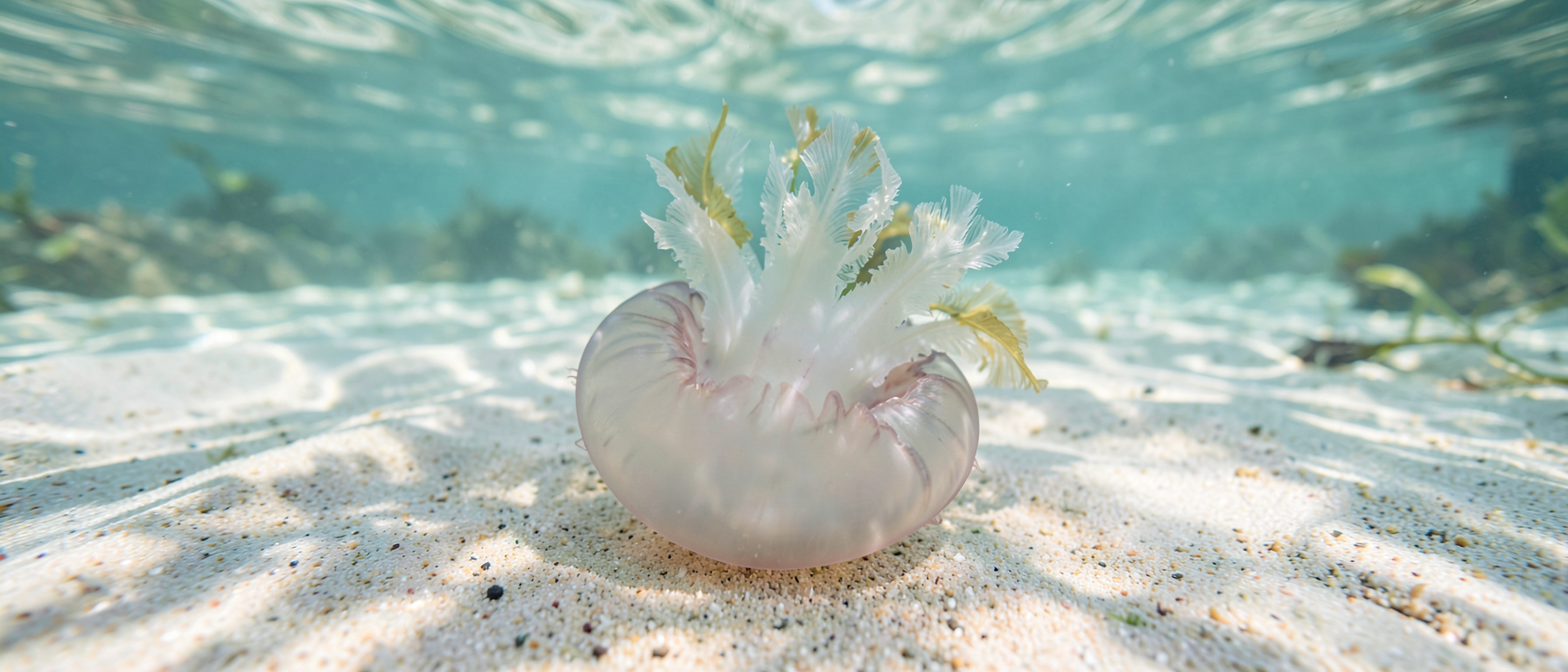
An upside-down jellyfish (Cassiopea andromeda) rests mouth-up, bell-down, on the floor of a shallow lagoon, pulsing its translucent bell like a slow heartbeat. It has no brain, not even a knot of neurons that could pass for one. Every pulse and every reflex runs through a nerve net instead, a web of cells spread through its tissue with no command center at all. A study published January 26, 2026, in Nature Communications by Lior Appelbaum, Raphaël Aguillon, and colleagues found that Cassiopea andromeda, tracked in the lab and in a shallow Florida lagoon, and the starlet sea anemone (Nematostella vectensis), tracked only in the lab, both enter a genuine behavioral sleep state. The jellyfish pulses through the day and quiets at night, with a short catch-up nap around noon; the anemones do the reverse, sleeping mainly through the day. When the researchers disturbed the water overnight to keep the jellyfish awake, the following day’s noon nap stretched out to pay back the lost rest. Cnidarians, the group that includes jellyfish, anemones, and corals, split from the lineage that eventually produced brains more than 600 million years ago. A sleep drive this precise had to predate any nervous system complex enough to deserve the name.
DNA Breaks in the Nerve Net
Ordinary wakefulness is hard on a nerve cell. Every bell contraction, every reaction to a shadow or a current, runs on metabolic activity that leaves physical breaks, snapped double strands, in the neuron’s own DNA. Cassiopea’s pulse rate sits near 36 beats a minute by day and drops to nearer 30 at night; once a jellyfish holds below 37 beats a minute for three minutes or longer, it reacts more slowly to a flash of white light or a squirt of brine shrimp extract, the same measure the researchers used to confirm sleep in the anemones, which qualified by staying still for at least eight minutes. Staining of the nerve cells showed DNA breaks piling up through the jellyfish’s mid-morning and the anemone’s late afternoon, then falling once each animal had logged real sleep. Melatonin turned out to be the switch: added straight to the tank water during each animal’s normal busy stretch, daylight for the jellyfish, after dark for the anemone, it alone was enough to send them dozing instead of pulsing. When the team exposed jellyfish to ultraviolet-B light, doubling their neuronal DNA breaks within an hour, the animals slept longer that day, until the strands were stitched back together. An earlier 2017 Current Biology study by Nath, Abrams, and Bedbrook had already tracked the same pulse drop in 23 Cassiopea jellyfish held in about a 9-gallon tank (35 liters) over six days and nights, an average of one pulse a second by day falling by nearly a third at night. The new paper explains what that nightly slowdown was buying the animal all along.
The Scaffolding Came First
Memory consolidation and emotional processing, the two functions most often credited to sleep in humans, could only appear once some animals evolved the centralized forebrains capable of doing either job. The nerve net’s problem came first. A damaged neuron cannot divide and replace itself the way skin can, so a break in its DNA that goes unrepaired stays broken for good. The Nature Communications findings point to a narrower, more mechanical original purpose for sleep: shut the system down long enough that sensory traffic stops competing with repair enzymes, so those enzymes can work through the damaged chromosomes undisturbed. Dreaming and memory sorting look like later additions, layered onto a much older piece of cellular maintenance that a jellyfish still runs almost unchanged, six hundred million years on.
The Myth of the Thinking Sleeper
Sleep research built around vertebrates long assumed that true sleep required a centralized brain, and that melatonin existed to run a cerebral clock suited to exactly that kind of brain. Cassiopea andromeda and Nematostella vectensis break both assumptions. Neither animal has a head, a cortex, or anything resembling a thought, yet both produce melatonin and both enter a measurable sleep state: a slowed pulse or total stillness, delayed reactions to stimuli, and rebound sleep after a night of forced wakefulness. The finding moves sleep’s origin past the brain entirely, down to the individual neuron. Whatever cell fires electricity, it seems, eventually needs the lights off to fix itself, skull or no skull.
Sleep Under Miles of Water
The Nature Communications study covered one jellyfish population in a Florida lagoon and one anemone species kept entirely in tanks, which leaves plenty unresolved. Nobody has yet tested whether cnidarians living in cold, deep, or sunless water run the same sleep-repair cycle without a day-night rhythm to set it by. Whether sleep in these animals also handles other housekeeping, rebuilding cell membranes or restocking lipids, alongside patching DNA, is not yet known. The precise signal that tells a brainless nerve net its DNA is fixed, that it is safe to start pulsing again, has not been identified either. The paper’s authors suspect sleep carries more benefits than DNA repair alone; the rest of the list remains open, even in an animal with no head to keep a thought in.