
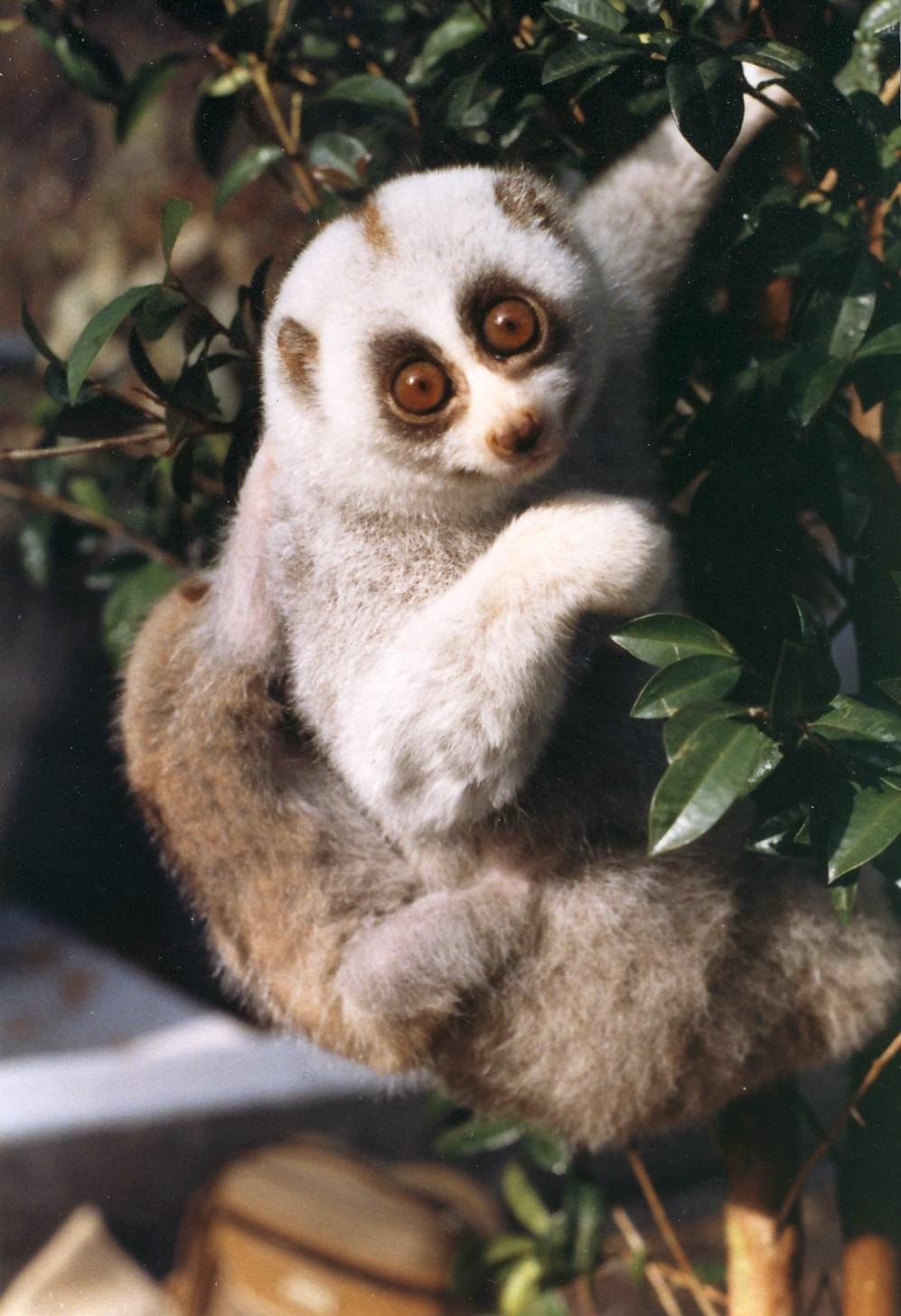
The Bengal Slow Loris (Nycticebus bengalensis) is a nocturnal, arboreal primate belonging to the family Lorisidae, distributed across a broader geographic range than any other member of its genus. It occurs from the northeastern states of India through Cambodia, Myanmar, Thailand, Vietnam, southern China, and Bangladesh, reaching elevations up to 2,400 metres. Among its most unusual traits is a venom apparatus: a brachial gland near the elbow that secretes a toxin, making the Bengal Slow Loris one of only a small number of venomous primates on Earth. As of 2020, the IUCN Red List classifies the species as Endangered.
Key facts
- Scientific name: Nycticebus bengalensis
- Kingdom: Animalia
- Phylum: Chordata
- Class: Mammalia
- Order: Primates
- Family: Lorisidae
- Genus: Nycticebus
- Taxonomic rank: species
- Habitat: forest
Physical characteristics
Compared with other slow loris species, Nycticebus bengalensis has shorter ears and a paler head. Its fur is generally orange-buff, and the neck and forelimbs develop considerable frosting. It is also the northernmost species of the genus Nycticebus.
Large stereoscopic eyes serve a clear function in a strictly nocturnal animal: they increase the amount of light available for vision after dark. The dental structure includes incisors modified into a toothcomb, used to gouge tree bark and scrape out gum. Gum and plant exudates form the backbone of the diet: observations in Tripura, India, found that plant exudates accounted for 67.3% of diet in summer and 94.3% in winter. The broader diet also includes nectar, fruit, invertebrates, bark, and bird eggs.
Venom and defence
The brachial gland, located near the elbow, produces a pungent toxin. Before being bitten, a threatened Bengal Slow Loris strikes a defensive venom posture, raising both arms above the head to expose its glands.
The venom also serves a parental function. Mothers lick their brachial glands and groom their young before leaving the infants parked in trees, transferring the toxin to the infants’ fur. That transfer provides a measure of protection for young animals left unattended while the mother forages.
The chemical complexity of brachial-gland venom in this group is documented in the related pygmy loris, whose gland secretion contains 212 isolated chemicals, placing it among the most chemically elaborate venoms of any animal.
Range and habitat
Nycticebus bengalensis holds the largest geographic range in the genus and is its northernmost species. Its confirmed presence spans seven northeastern states of India, plus Cambodia, Myanmar, Thailand, Vietnam, and southern China. The species is found in Lawachara National Park in Bangladesh, and roughly 80% of its range within China falls inside protected areas.
The species occupies forested habitat from sea level to 2,400 m. A small hybrid zone with the closely related Sunda Slow Loris (N. coucang) exists in southern peninsular Thailand, where the two species’ ranges meet.
Behaviour and reproduction
Bengal Slow Lorises are largely solitary and produce little sound, though social grooming and communal feeding at gum licks have been recorded. High-pitched whistles function in mate attraction. The combination of silence and nocturnality makes field observation difficult, and many aspects of social behaviour remain poorly understood.
Estrous cycles run 29 to 45 days, with copulation typically concentrated into a single day of estrus. Gestation averages around 192 days. In captive colonies, females first copulate at 18 to 24 months of age; one male in a captive colony sired his first offspring at 17 months.
Taxonomy and description history
French naturalist Bernard Germain de Lacépède originally described the species in 1800 under the name Lori bengalensis, based on a specimen from Bengal, India. For most of the following two centuries the Bengal Slow Loris was treated as a subspecies of the Sunda Slow Loris (N. coucang). Taxonomist Colin Groves recognised it as a distinct species in 2001.
The species’ Bengali name in the Bengal region, lajjawati banor, translates to something close to ‘shy monkey’, reflecting local perception of its retiring character.
Conservation status and threats
Before 2007 the IUCN Red List carried N. bengalensis as Data Deficient. A 2008 reassessment elevated the species to Vulnerable, based on a projected 30% population decline across three generations. By 2020, the status was updated again to Endangered.
In June 2007, all species of Nycticebus were moved from CITES Appendix II to Appendix I, in response to increasing and unsustainable international trade. The principal threats are demand from the exotic pet trade and use in traditional medicine, where the species is taken primarily by urban women following childbirth and also for treatment of stomach complaints, broken bones, and sexually transmitted diseases.
A 2026 study conducted in Bangladesh monitored radio-tracked lorises across 138 nights and eight months to examine survival after release, providing one of the more sustained post-release monitoring efforts recorded for the species.
Did you know
- The venom from the related pygmy loris’s brachial gland contains a concoction of 212 isolated chemicals, among the most complex of any venomous animal. (discoverwildlife.com)
- In a 2026 Bangladesh study, radio-tracked lorises were monitored for 138 nights across eight months to study their post-release survival. (en.prothomalo.com)
- Before being bitten, a threatened Bengal Slow Loris strikes a “venom posture,” raising both arms above its head like a brace position to expose its toxic glands. (discoverwildlife.com)
- The species’ name traces back to a 1800 description by French naturalist Bernard Germain de Lacépède, based on a specimen simply labelled “Bengal.” (zenodo.org)
- In Bangladesh’s Bengal region, the species is known locally by the Bengali name “lajjawati banor,” meaning something akin to a shy monkey. (en.banglapedia.org)
Data sources
Data updated: 2026-11-24